



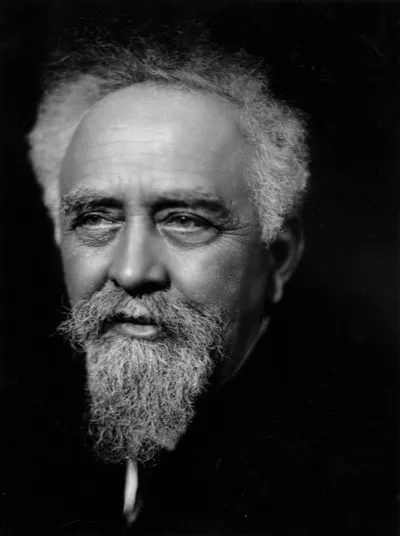
Jean Perrin didn’t just theorize about atoms. He watched them.
Born in Lille, France, on September 30, 1870, Perrin spent his life turning abstract math into visible reality. He died in New York on April 17, 1942, but his legacy is simpler than his biography: he proved that the tiny building blocks of matter are not just useful fiction. They are real.
For this, he won the Nobel Prize in Physics in 1926.
Before Perrin, atoms were a hypothesis. A powerful one. A necessary one for chemistry and physics to work. But they were still ghosts. You couldn’t see them. You couldn’t touch them. They existed in the equations.
Perrin changed that.
The Proof in the Motion
The key was Brownian motion.
It’s the random, jittery dance of particles suspended in a liquid. Dust motes in a sunbeam. Pollen in water. If you look closely enough, they don’t sit still. They wiggle.
In 1905, Albert Einstein published a mathematical explanation. He said the jitter wasn’t random chaos. It was collisions. The invisible water molecules were hitting the visible particles from all sides. If Einstein was right, you could calculate the size of the water molecules by watching the dance of the visible particles.
But math is not proof.
Perrin took Einstein’s equations and tested them.
He used a new tool: the ultramicroscope. Standard microscopes can’t see molecules. But this device could make the tiny particles visible against a dark background. Perrin watched them. He counted them. He measured their sedimentation.
His data matched Einstein’s predictions perfectly.
“Perrin’s work helped raise atoms from the status of useful hypothetical objects to observable entities whose reality could no longer denied.”
This is why it matters. Before 1908, skeptics could argue that atoms were just a convenient model. Perrin showed they were physical entities. You could estimate their size. You could count them in a given volume. The atomic nature of matter was no longer a guess. It was a fact.
A Career of Firsts
Perrin’s path to this moment wasn’t linear.
He studied at the École Normale Supérieure in Paris. By 1895, he was already making waves. He demonstrated that cathode rays were negatively charged particles. He tried to measure their mass. He was beaten to the punch by J.J. Thomson, who published similar findings. Thomson got the credit for the electron. Perrin took the win for the atoms.
He joined the faculty of the University of Paris in 1898. By 1910, he was professor of physical chemistry. He held that post until 1940.
Throughout his career, Perrin cared about more than just physics. He cared about truth. And in the early 20th century, the truth about atoms was still debated. Some scientists, like Ernst Mach, remained skeptics. They liked empirical data. They didn’t like unobservable entities.
Perrin gave them the data.
By 1913, most scientists accepted atoms as real. Perrin