



Nitrogen makes up about 78 percent of the air we breathe. It is everywhere. Yet plants and animals cannot use it in this form. The atmosphere holds a massive reservoir of nitrogen gas, but it sits there, locked away from living systems. To become useful, that gas must first undergo a series of chemical transformations. This complex journey is the nitrogen cycle, a biogeochemical process that circulates and supplies nitrogen to all living things.
Without this cycle, life as we know it would collapse. Nitrogen is a fundamental building block of amino acids, the proteins that make up our muscles, enzymes, and DNA. It is also essential for chlorophyll, the molecule that allows plants to photosynthesize. If plants cannot get nitrogen, they cannot grow. If plants don’t grow, the rest of the food web starves.
The conversion of atmospheric nitrogen into usable forms does not happen by chance. It relies on two distinct types of processes: biotic and abiotic.
The Role of Living Organisms
The biotic or biological processes are driven by life itself. Plants, animals, fungi, and especially bacteria play a starring role here. Some bacteria have a unique superpower. They can take nitrogen gas from the air and convert it into ammonia, a process called nitrogen fixation. This happens in the soil, often in partnership with the roots of legumes like beans and peas.
Other bacteria then convert ammonia into nitrites and nitrates. Plants absorb these nitrates through their roots. Animals eat the plants. When animals and plants die, decomposers like fungi and bacteria break them down, releasing nitrogen back into the soil. This recycling loop ensures that nitrogen keeps moving through ecosystems.
The Impact of Non-Living Factors
But biology is not the only player. Abiotic or non-biological processes also influence the cycle. These are driven by physical and chemical factors in the environment. Light intensity affects the rate of chemical reactions in the soil. The pH level determines which forms of nitrogen are most available to plants. Climate conditions, such as temperature and rainfall, dictate how fast organic matter decomposes and how much nitrogen leaches away.
Soil characteristics matter too. Sandy soils drain quickly, potentially washing away nitrates before plants can use them. Clay soils hold onto nutrients longer. Even lightning strikes can fix nitrogen. The intense heat of a lightning bolt breaks nitrogen molecules apart, allowing them to combine with oxygen to form nitrogen oxides. These dissolve in rainwater and fall to the ground as a natural fertilizer.
Why It Matters
Understanding the nitrogen cycle is not just an academic exercise. It explains why farmers rotate crops. It explains why overuse of synthetic fertilizers can pollute waterways. When we add more nitrogen than the soil can handle, excess nitrates run off into rivers and oceans. This causes algal blooms that deplete oxygen, creating dead zones where marine life cannot survive.
The cycle is delicate. It balances the needs of living organisms with the physical realities of the planet. We are part of this cycle too. Every breath we take, every meal we eat, ties us to this constant, invisible exchange. We rely on bacteria to fix the air we breathe. We rely on soil health to feed us. The health of the nitrogen cycle is the health of the biosphere.
Nitrogen is abundant in the

Nitrogen is everywhere. You breathe it in. It makes up about 78 percent of the atmosphere. But here is the catch: most plants and animals can’t actually use it in that form. It is locked away in diatomic molecules, too stable to be useful. The cycle we are looking at solves that problem. It transforms inert air into the building blocks of life. This biogeochemical process moves nitrogen from the sky, into the soil, into water, and finally into living tissue. Without this constant shifting, life as we know it would starve. Nitrogen is essential for amino acids, the proteins that build our bodies, and nucleic acids, the DNA that holds our instructions. The cycle ensures this vital nutrient doesn’t stay trapped in the sky.
Nitrogen Fixation: Breaking the Bond
The first major hurdle is breaking the triple bond between the two nitrogen atoms in the air. This process is called nitrogen fixation. It requires massive amounts of energy. Lightning provides a tiny fraction of this energy. When a bolt strikes, it heats the air so much that nitrogen and oxygen combine to form nitrates. Rain washes these nitrates into the soil. That is one route. The other is far more significant for ecosystems.
Certain bacteria perform biological fixation. They have a special enzyme called nitrogenase that can crack that triple bond at ambient temperatures. These microbes live freely in the soil or form symbiotic relationships with plants like legumes. They take atmospheric nitrogen and convert it into ammonia. This ammonia is usable. Plants can absorb it through their roots. The nitrogen enters the biological part of the cycle.
Nitrification: Turning Ammonia into Plant Food
Once the nitrogen is in the soil as ammonia, it is not yet in the best form for many plants. The soil undergoes a second transformation. This is nitrification. It is a two-step process carried out by different groups of soil bacteria. First, bacteria like Nitrosomonas convert ammonia into nitrites. Then, bacteria like Nitrobacter take those nitrites and turn them into nitrates.
Nitrates are highly soluble. They dissolve easily in water. This makes them readily available for plant roots to uptake. This step is critical. It bridges the gap between microbial activity and plant growth. Without nitrification, much of the fixed nitrogen would remain in forms that are less accessible to the vegetation that forms the base of the food web.
Assimilation: Into the Food Web
Now the nitrogen is in the soil as nitrate. Plants take it up. They use it to build proteins, chlorophyll, and DNA. This is assimilation. The nitrogen moves from the abiotic environment into the biotic one. It becomes part of the plant’s structure.
Then the animals eat the plants. Herbivores incorporate that nitrogen into their own tissues. Carnivores eat the herbivores. The nitrogen moves up the food chain. It is constantly being recycled and repurposed. Every protein in your body contains nitrogen that once floated in the atmosphere or dissolved in groundwater. The connection is direct.
Ammonification: Returning to the Soil
Not all nitrogen stays in complex molecules forever. When plants and animals die, or when they produce waste, that organic nitrogen needs to be processed. Decompos

Breaking Down the Nitrogen Cycle: From Atmosphere to Soil
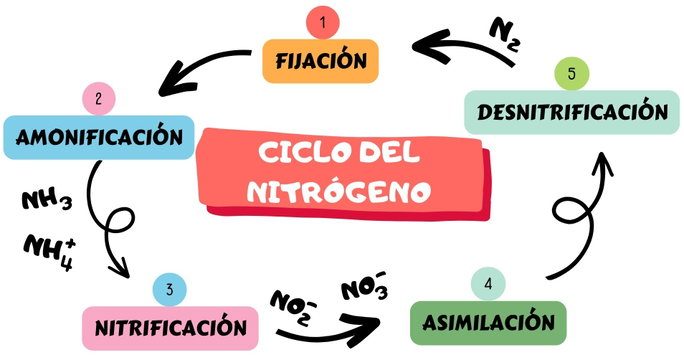
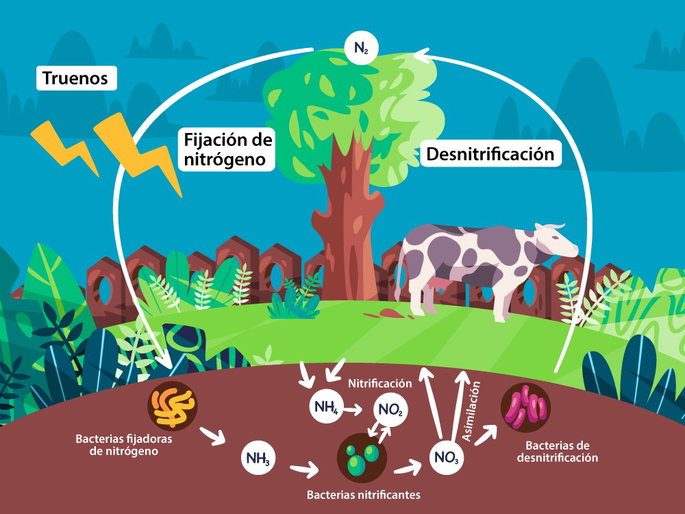
The nitrogen cycle is often treated as background noise in biology textbooks, but it is the silent engine keeping terrestrial life running. It is not a single event but a five-part loop that transforms inert gas into the building blocks of existence. If you break it down, the process involves fixation, ammonification, nitrification, assimilation, and denitrification.
Here is how that machinery actually works.
How Nitrogen Enters the Ecosystem
The biggest bottleneck in the system is simple chemistry. Nitrogen gas makes up 78% of our atmosphere, yet most living things cannot use it in that form. It is locked tight. To get it into the food web, it has to change shape.
This transformation starts with nitrogen fixation.
Microorganisms do the heavy lifting here. Bacteria in the soil and water take atmospheric nitrogen and incorporate it directly into their cells. This makes the element accessible to plants, which then absorb it through their roots. Without these tiny bacteria, plants would starve despite being surrounded by nitrogen.
But biology isn’t the only fixer. Weather plays a role too. Lightning and heavy storms act as industrial-scale fixers. The energy from lightning breaks nitrogen bonds, allowing it to precipitate onto the ground, rivers, lakes, and seas via rain. This adds to the available supply, though on a smaller scale than microbial activity.
The Decomposition Phase
Once nitrogen is in the system, it travels through bodies. All living organisms contain nitrogen in varying amounts. When plants and animals die, that nitrogen doesn’t disappear. It waits.
Ammonification is the process that unlocks it.
Decomposers—specifically fungi and bacteria—break down the dead organic matter. As they feed on the remains, they release nitrogen back into the environment in the form of ammonia (NH3) or ammonium (NH4+). This is a critical reset button. It turns complex organic matter back into a form that can be processed further.
Animal waste contributes significantly to this stage. Urine and excrement are nitrogen-rich. When these are broken down by microbes, they feed directly into the ammonification step, keeping the loop moving.
Turning Ammonia into Plant Food
Ammonia isn’t always the preferred fuel for plants. This is where nitrification steps in.
Microorganisms convert the ammonia and ammonium produced in the previous step into nitrites (NO2-) and nitrates (NO3-). This chemical upgrade is essential. These compounds are far more stable and easily absorbed by plant roots. It is the bridge between decay and growth.
Uptake and the Food Chain
Plants are the gatekeepers. They take up both nitrates (NO3-) and ammonium (NH4+) from the soil or water through their root systems. Once inside, the plant cells synthesize amino acids. These are the precursors to proteins, which are fundamental to life.
From there, the nitrogen moves up the trophic ladder.
Herbivores eat the plants and assimilate that nitrogen. Carnivores eat the herbivores, inheriting the nitrogen stored in their prey’s tissues. When these animals die, the cycle loops back to ammonification. The nitrogen never leaves the biosphere in this phase; it just changes hosts.
Returning to the Air
Not all nitrogen stays in the soil or water. Some of it returns to the atmosphere through denitrification.
Specific bacteria, known as denitrifying bacteria, break down nitrates and nitrites. In the process, they release nitrogen gas back into the air. This completes the biogeochemical loop. The gas rises, waits in the sky, and eventually gets fixed again by lightning or bacteria, restarting the cycle.
Why This Matters
You might wonder why the slow movement of nitrogen matters to you. It matters because nitrogen is a structural requirement for life. It is essential for forming proteins, DNA, phospholipids, and carbohydrates.
Without the cycle, the biosphere would collapse. The equilibrium of life on Earth depends on this constant shuffling of elements. If the cycle stalls, nitrogen becomes locked away. The soil loses its fertility. Plants stop growing. Animals starve.
The cycle is slow. A single nitrogen particle can spend years or even centuries cycling through the atmosphere, soil, and living tissue. Bacteria are the primary drivers of this movement, handling the fixation, nitrification, and denitrification. The system also interconnects tightly with oxygen and hydrogen cycles.
Human Impact on the Cycle
Human activity has disrupted this delicate balance. We are moving nitrogen faster than nature intended.
Excessive fertilizer use dumps massive amounts of reactive nitrogen into soils. Deforestation removes the plants that help retain nitrogen. Intensive farming without fallow periods depletes soil health. Industrial activities like thermal power plants and vehicle emissions release nitrogen compounds into the air.
These actions alter the natural levels of nitrogen and contribute heavily to pollution. The most visible consequence is acid rain. When nitric acid (HNO3) forms in water vapor and falls as precipitation, it damages ecosystems, corrodes structures, and alters soil chemistry.
We have turned a slow, closed loop into a leaky, accelerated system. The result is a planet where nitrogen is everywhere, but often in the wrong place. The cycle continues, but it is changed. And we are still trying to figure out how to live with the imbalance we created.

