



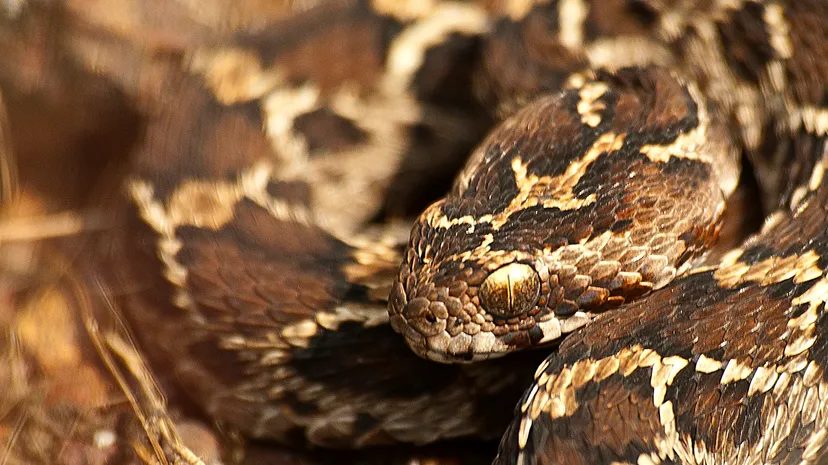
It’s small. It’s ugly. And it is arguably the most dangerous snake on Earth.
The Indian saw-scaled viper (Echis carinatus ) doesn’t look like a killer. It looks like a dusty rug with a head. But don’t let the camouflage fool you. This reptile is responsible for more human deaths across its range than any other venomous species. Not the king cobra. Not the black mamba. The saw-scaled viper.
Why? Because it’s fast. It’s aggressive. And it lives where people live.
The Sound of Danger
You don’t find a saw-scaled viper by seeing it. You hear it first.
These snakes are roughly 12 to 30 inches long. That’s it. But they have a trick up their sleeve—or rather, between their scales. Their bodies are lined with keeled, saw-like scales. When threatened, they rub these scales together.
Hisssssss.
It sounds like sandpaper on stone. It’s a warning. Back off. Most snakes hide. The saw-scaled viper stands its ground. It coils tight. It makes that noise. And if you don’t back off? It strikes.
They are nocturnal hunters, active at night in deserts and scrublands from India to North Africa. They blend into loose rocks and deep burrows. You might step on one before you see it.
Venom Yield: A Lethal Mismatch
Size doesn’t matter here. A juvenile saw-scaled viper can deliver about 12 mg of venom in a single bite. That is more than twice the lethal dose for an adult human.
We don’t know exactly why evolution favored such potent venom in such a small package, but it works. The venom is hemotoxic. It breaks down tissues. It destroys blood vessels. It causes internal bleeding and necrosis. Without antivenom, the damage is often permanent.
Interestingly, their venom yield is similar to the African carpet viper. Both species are notorious for causing massive human casualties relative to their size. It’s a statistical anomaly. They aren’t the biggest snakes, but they are the most efficient killers.
Where They Live Matters
Geography is a major factor in the saw-scaled viper’s danger level. They thrive in hot, dry climates. Deserts. Rocky outcrops. Dry grasslands.
But here is the kicker: they like human settlements.
They hang out near farms. Near villages. In fields where people work with their bare hands. This proximity is why they cause so many bites. People don’t expect a deadly predator in their backyard. The snakes don’t expect humans to be clumsy.
When you work outdoors in these regions, the risk is real. The snake is already there. You just haven’t seen it yet.
Hunting and Survival
They are ambush predators. They wait.
Their diet consists of small rodents, insects, and occasionally other small reptiles. When prey gets close, the strike is lightning-fast. The venom does the rest, immobilizing and partially digesting the meal.
In arid environments, food is scarce. These snakes are opportunistic. They can go long periods without eating. Their metabolism is efficient. They survive on little.
Life in the Fast Lane
Unlike many other vipers that give birth to live young, the saw-scaled viper lays eggs. Females hide them under rocks or in burrows. The eggs hatch after a few weeks.
The babies are independent immediately. And yes, they are just as venomous as the adults.
They grow quickly. They reproduce often. But they don’t live long. Five to ten years in the wild is the max. It’s a short, violent life. High reproductive rates make up for the short lifespan.
The Bigger Picture
We often romanticize snakes. We look at their patterns. We study their taxonomy. The saw-scaled viper belongs to the genus Echis, part of the old world vipers. Relatives include the puff adder and the Gaboon viper.
But this isn’t about taxonomy. It’s about respect.
This snake is a reminder that nature doesn’t care about our size or our strength. It only cares about survival. The saw-scaled viper survives by being invisible, aggressive, and toxic.
If you are in its range, keep your eyes open. Listen for the rasp.
The snake is watching.
Are Saw-Scaled Vipers Actually Endangered?
Contrary to the fear they often inspire, saw-scaled vipers are not listed as endangered or threatened. In fact, their population numbers remain generally stable across their wide geographic range. While they suffer from the usual pressures facing wild reptiles—such as habitat destruction and direct human conflict—they continue to thrive.
The reason for this resilience lies partly in their ecological role. These snakes are vital regulators of their environments. By preying on small rodents and insects, they help keep local pest populations in check. Without them, agricultural and urban areas might see a significant spike in rodent-borne diseases and crop damage.
The Scientific Value of Carinatus Venom
Beyond their ecological utility, saw-scaled vipers hold immense medical potential. Researchers are increasingly interested in carinatus venom not just as a danger, but as a resource.
Studies are currently exploring how components of this venom might be used in blood clotting research. This isn’t just academic curiosity; it has real-world implications for developing treatments for bleeding disorders or improving surgical outcomes. As scientists peel back the layers of viper biology, the saw-scaled viper shifts from being a feared adversary to a crucial subject in modern pharmacology.
While saw-scaled vipers are certainly something to be cautious around, they’re also incredible creatures with unique adaptations that allow them to survive in some of the harshest environments on Earth.
Brumation: Winter Survival Mode
When temperatures drop, these snakes don’t hibernate in the traditional mammalian sense. Instead, they enter a state called brumation.
This is a form of dormancy specific to cold-blooded reptiles. During the cold winter months, brumation forces the viper to seek out sheltered refuges. Their metabolic rate slows down dramatically. Activity levels plummet. The goal is simple: conserve energy and avoid starvation when prey is scarce.
It is a survival strategy honed over millennia. Next time you see one in a museum exhibit, remember that behind the scales is a creature perfectly tuned for survival in some of the harshest environments on Earth.
We created this article in conjunction with AI technology, then made sure it was edited and fact-checked by a HowStuffWorks editor.


