















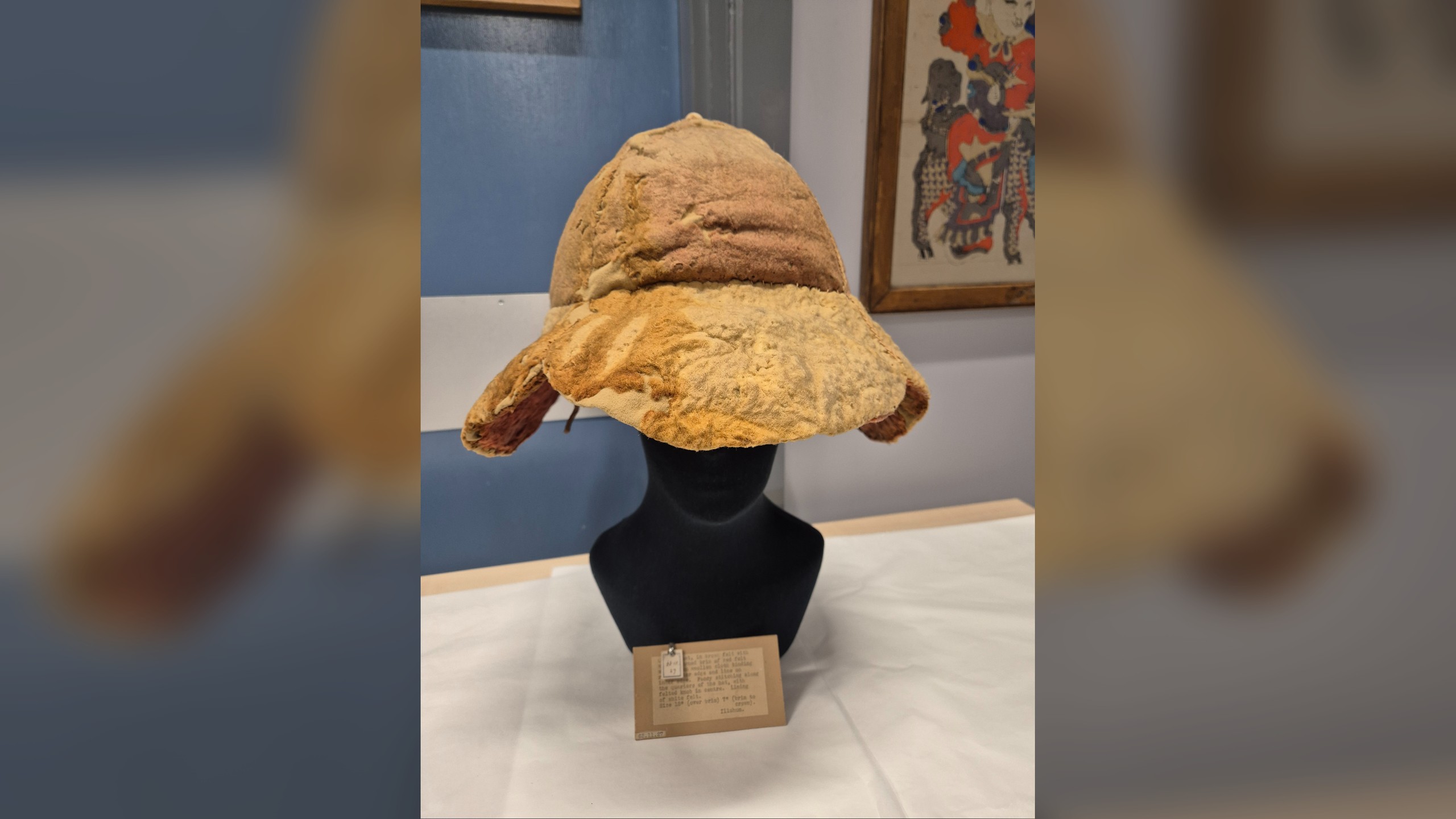
A remarkably preserved Roman-era sun hat, dating back approximately 1,600 years, has gone on display at the Bolton Museum in England after undergoing extensive conservation. The hat, discovered in 1911 by British archaeologist Sir Flinders Petrie at the Lahun site in Egypt’s Fayum region, offers a rare glimpse into the daily life of Roman and early Christian Egyptians.
A Unique Find
The hat is one of only three known examples of its kind to survive to the present day. Constructed from vibrantly colored felted wool, the conical cap features a broad brim designed for protection against intense sunlight and sandstorms. The artifact measures about 15.5 inches in diameter and is stitched from four sections of brown felt, reinforced with a red brim and bound in green and blue woolen cloth. Decorative chain stitches along the seams highlight the high level of craftsmanship.
Who Wore It?
While the hat’s exact purpose remains uncertain, experts believe it may have been worn by a member of the Roman military stationed in Egypt. The design shares similarities with earlier third-century Roman headwear, yet it appears adapted for the harsh Egyptian climate. This suggests either a Roman soldier adapted the style for local conditions or that the hat was made by Egyptians influenced by Roman designs.
The Coptic Period
The hat emerged during the early Christian or Coptic period of Egypt, beginning around A.D. 395 after the Roman Empire’s fragmentation. During this time, Egyptian Christians developed their own distinct language and textile traditions, blending Roman and Egyptian iconography. Coptic textiles from this era are known for their intricate patterns, vibrant colors, and incorporation of symbols like the ankh (representing life) alongside Roman deities and Christian saints.
Conservation and Display
The hat underwent careful conservation led by textile expert Jacqui Hyman. Despite damage from moths, the artifact was stabilized using hand-dyed materials to restore its original shape. The hat is now on display for the first time, offering a rare chance to examine this tangible piece of history.
As Hyman notes, the hat embodies a lost narrative: “This hat was made to be worn… if only it could talk and tell us who made it and who wore it.”
The hat’s survival provides an exceptional insight into the cultural fusion and practical adaptations of life in Roman Egypt. It stands as a testament to the resilience of textiles and the enduring stories they hold.