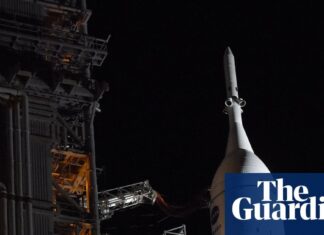
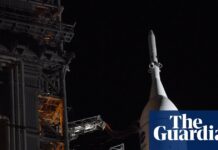



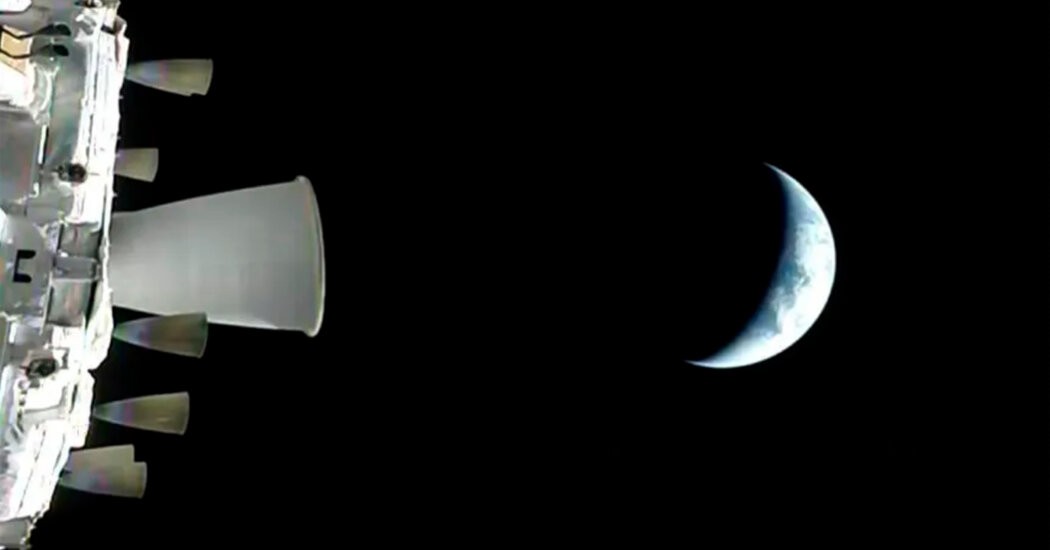
The four astronauts aboard the Orion spacecraft have initiated their journey toward the moon following a precise engine burn that committed them to a lunar trajectory. The crew—three Americans and one Canadian—successfully executed a five-minute, 50-second firing of the spacecraft’s main engine at 7:49 p.m. Eastern time, marking a critical step in NASA’s Artemis II mission.
Mission Execution and Crew Statements
Speaking from the capsule during the burn, NASA astronaut Christina Koch stated, “With this burn to the moon, we do not leave Earth; we choose it.” This sentiment underscores the mission’s ambition: not just reaching the moon, but demonstrating humanity’s continued capacity for exploration. Canadian Space Agency mission specialist Jeremy Hansen added, “Humanity has once again shown what we are capable of… your hopes for the future carry us now on this journey.” The flawless execution of the trans-lunar injection—the maneuver that propels Orion out of Earth orbit—was confirmed by NASA’s acting associate administrator for Exploration Systems Development, Lori Glaze. She explained, “From this point forward, the laws of orbital mechanics are going to carry our crew to the moon, around the far side and back to Earth.”
Mission Objectives and Testing
The Artemis II mission is not a landing; it is a rigorous test flight designed to validate the Orion spacecraft’s systems before future lunar landing missions. Astronauts Reid Wiseman, Victor Glover, Christina Koch, and Jeremy Hansen spent the first day in a high Earth orbit, testing critical life support systems (including carbon dioxide filtering and temperature control) and performing docking maneuvers led by pilot Victor Glover—critical practice for future lunar lander docking. NASA confirmed that these systems performed “exactly as we predicted, and in some cases, better.”
What to Expect
The crew will pass behind the far side of the moon on Monday, April 6, and conduct video conferences with Earth. NASA is broadcasting the mission live on YouTube, X, and its website. The entire mission concludes in eight days with a Pacific Ocean splashdown.
Astronauts have also adapted to the realities of zero-gravity living, utilizing exercise equipment (a flywheel) and reconfiguring seats into sleeping arrangements. Crew cohesion is key in such confined spaces, as Victor Glover noted, “there comes a point where what maybe started off as a potential annoyance actually becomes a thing of endearment.”
The Artemis II mission reaffirms NASA’s commitment to deep space exploration, laying the groundwork for sustained lunar presence and future missions beyond.