

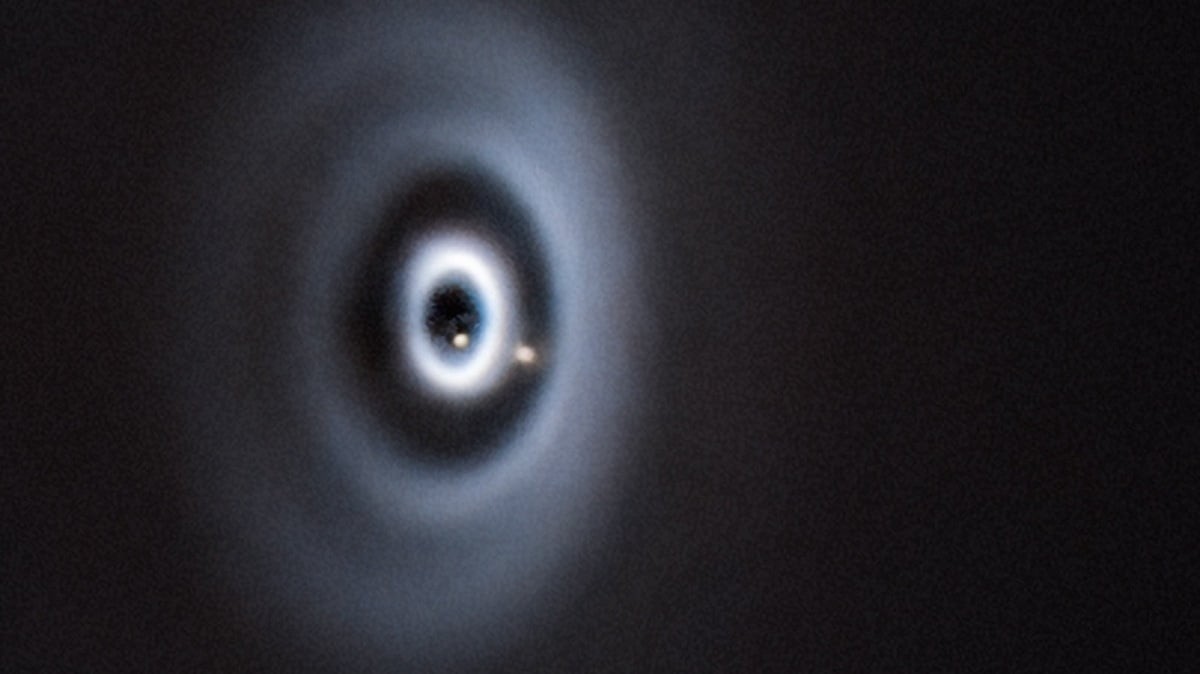
Astronomers have directly observed the formation of a young solar system, a rare glimpse into the early stages of planetary development. The star, designated WISPIT 2, is just 5 million years old – a blink of an eye in cosmic terms – and already hosts at least two gas giant planets still actively forming within its swirling disk of dust and gas.
A Rare Opportunity to Study Planetary Birth
For decades, most exoplanet discoveries have relied on indirect methods: detecting planets by their gravitational tug on stars or the dimming of starlight as they pass in front of their host. WISPIT 2 is different. Astronomers can actually see the planets themselves, using powerful telescopes like the European Southern Observatory’s Very Large Telescope, and study the light they emit. This direct observation provides invaluable data for understanding how planetary systems, including our own, come into existence.
Two Giants in the Making
The first planet in the WISPIT 2 system, WISPIT 2b, was previously confirmed. Now, a second, even larger planet – WISPIT 2c – has been identified. WISPIT 2b is already five times more massive than Jupiter, while WISPIT 2c doubles that size. Both orbit at considerable distances from their star, far beyond where Earth sits in our solar system.
The presence of two gas giants forming simultaneously suggests that planetary systems can develop in parallel, rather than sequentially, as previously thought. As Frank Eisenhauer, project leader of the GRAVITY+ instrument, put it, “This shows that planetary systems do not develop one after the other, but in parallel – much like our own solar system once did.”
Evidence from the Disk
The WISPIT 2 system’s surrounding disk is marked by bright rings and dark gaps. These features are consistent with planet formation: as planets grow, they clear out material in their orbital paths, creating the observed structures. Researchers believe that additional planets may still be forming within the disk, potentially including a Saturn-mass world carving out a smaller gap.
Why This Matters
The discovery is significant because it provides a real-time case study of planetary formation. Studying WISPIT 2 allows scientists to test theories about how gas giants grow and shape their environments, giving them better insight into the origins of our own solar system.
The observation also supports the idea that certain distances from stars may be more favorable for the growth of massive planets, though further research is needed to confirm this hypothesis. Future observations with next-generation telescopes will track the planets’ orbits, analyze their atmospheres, and monitor changes in the surrounding disk, promising an even deeper understanding of this dynamic system.
The direct observation of planets in formation is incredibly rare, but WISPIT 2 offers an unprecedented opportunity to witness the birth of a solar system in action.