


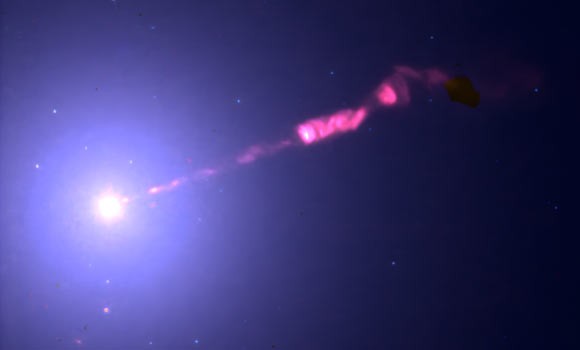
Astronomers have pinpointed the likely origin of the powerful jet emanating from the supermassive black hole at the heart of the galaxy Messier 87 (M87), located 53 million light-years away. This breakthrough, achieved using the Event Horizon Telescope (EHT) – a global network of radio observatories – provides crucial insight into how these immense cosmic structures form and interact with their host black holes.
Decoding the Jet’s Power Source
M87 is a giant elliptical galaxy dominated by a black hole with a mass six billion times that of our Sun. The black hole drives a narrow jet of high-energy particles extending 3,000 light-years into space. The EHT, effectively a planet-sized telescope, allowed researchers to observe M87 in unprecedented detail. By comparing brightness levels across different scales, they discovered a compact radio emission source just 0.09 light-years from the black hole’s shadow. This source aligns perfectly with the expected launch point of the jet.
“By identifying where the jet originates and how it connects to the black hole’s shadow, we are adding key pieces to the puzzle,” notes Saurabh, a Ph.D. student involved in the research.
Implications for Black Hole Physics
The findings confirm long-held theories about how black holes generate jets. These jets are believed to tap into the rotational energy of the black hole via electromagnetism, creating an environment where general relativity and quantum electrodynamics interplay. Observing this process near the event horizon—the point of no return for matter—is a significant leap forward in understanding black hole behavior.
The EHT collaboration is already preparing to incorporate more telescopes into the array, promising even sharper images of the jet launching region. This future data will allow scientists to directly image the jet’s formation, rather than relying on calculations alone.
Why This Matters
Black hole jets aren’t just spectacular phenomena; they profoundly influence galactic evolution. They can trigger star formation, heat surrounding gas, and regulate the growth of galaxies themselves. Studying the physics of these jets helps us understand how black holes shape the Universe at large. The ongoing research highlights how extreme environments around black holes serve as natural laboratories for testing fundamental physics.
The results of this study were published on January 28, 2026, in Astronomy & Astrophysics. The work represents a crucial step toward unraveling the mysteries of black holes and their impact on the cosmos.
Saurabh et al. 2026. Probing jet base emission of M87* with the 2021 Event Horizon Telescope observations. A&A 706, A27; doi: 10.1051/0004-6361/202557022