
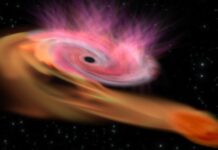





Astronomers have observed a unique cosmic event: a star being violently ripped apart and consumed by a black hole. This event, designated AT2022zod, is significant because the black hole involved appears to be an elusive intermediate-mass black hole (IMBH) —a class of object that has long puzzled scientists. The discovery provides a rare opportunity to study these cosmic “middlemen” in the black hole hierarchy.
The Nature of Tidal Disruption Events
Tidal Disruption Events (TDEs) occur when a star wanders too close to a black hole. The immense gravity stretches the star into a thin stream of gas—a process often called “spaghettification.” Some of this material falls into the black hole, while the rest is ejected in powerful jets. While these events are known to happen near supermassive black holes at the centers of galaxies, this one occurred far from the galactic core.
An Unusual Flare in a Distant Galaxy
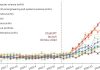
The flare, detected in October 2022, originated in the galaxy SDSS J105602.80+561214.7, approximately 1.5 billion light-years away. Unlike typical TDEs, which last for hundreds of days, AT2022zod faded in just over a month. This short duration, combined with its off-center location—roughly 10,000 light-years from the galaxy’s supermassive black hole—suggested a smaller, but still substantial, black hole was responsible.
“The combination of being hosted by an elliptical galaxy, famously home to large populations of star clusters, while being off-nuclear and of short duration, made us intrigued that this may be one of the elusive intermediate mass black holes that might exist outside the center of the galaxy,” explained Kristen Dage, team leader at Curtin University.
The Mystery of Intermediate-Mass Black Holes
Supermassive black holes can have millions or billions of times the mass of our sun, while stellar mass black holes typically range from 3 to hundreds of solar masses. IMBHs fill the gap between these two, yet remain incredibly difficult to find. Scientists believe that IMBHs could play a key role in the growth of supermassive black holes, but their relative scarcity has made them hard to study.
“We are excellent at finding supermassive black holes, and thanks to LIGO-Virgo-Kagra gravitational wave detectors, we are getting better at finding stellar mass black holes, but I could count on my hands the number of intermediate mass black hole candidates that have reached some kind of consensus within the astronomical community,” Dage said.
Clues to Formation and Environment
The discovery of this off-center TDE provides clues about where IMBHs might reside. Astronomers theorize the event occurred within a dense star cluster, such as a globular cluster or an ultracompact dwarf galaxy (UCD). These environments are packed with aging stars, providing ample fuel for black hole mergers and growth.
The origins of UCDs themselves are debated. Some may be remnants of stripped dwarf galaxies, while others could be the result of colliding globular clusters. Determining which scenario is correct could reveal insights into how IMBHs form and evolve.
The Future of IMBH Hunting
Future telescopes, like the Vera C. Rubin Observatory, are expected to revolutionize the search for IMBHs. Its decade-long Legacy Survey of Space and Time will scan millions of star clusters, increasing the chances of detecting more TDEs caused by these elusive objects.
The discovery of AT2022zod offers a critical step forward in understanding the population of intermediate mass black holes, and how they contribute to the larger cosmic ecosystem.
With ongoing observations and improved technology, scientists are poised to finally unravel the mysteries surrounding these “missing link” black holes.