



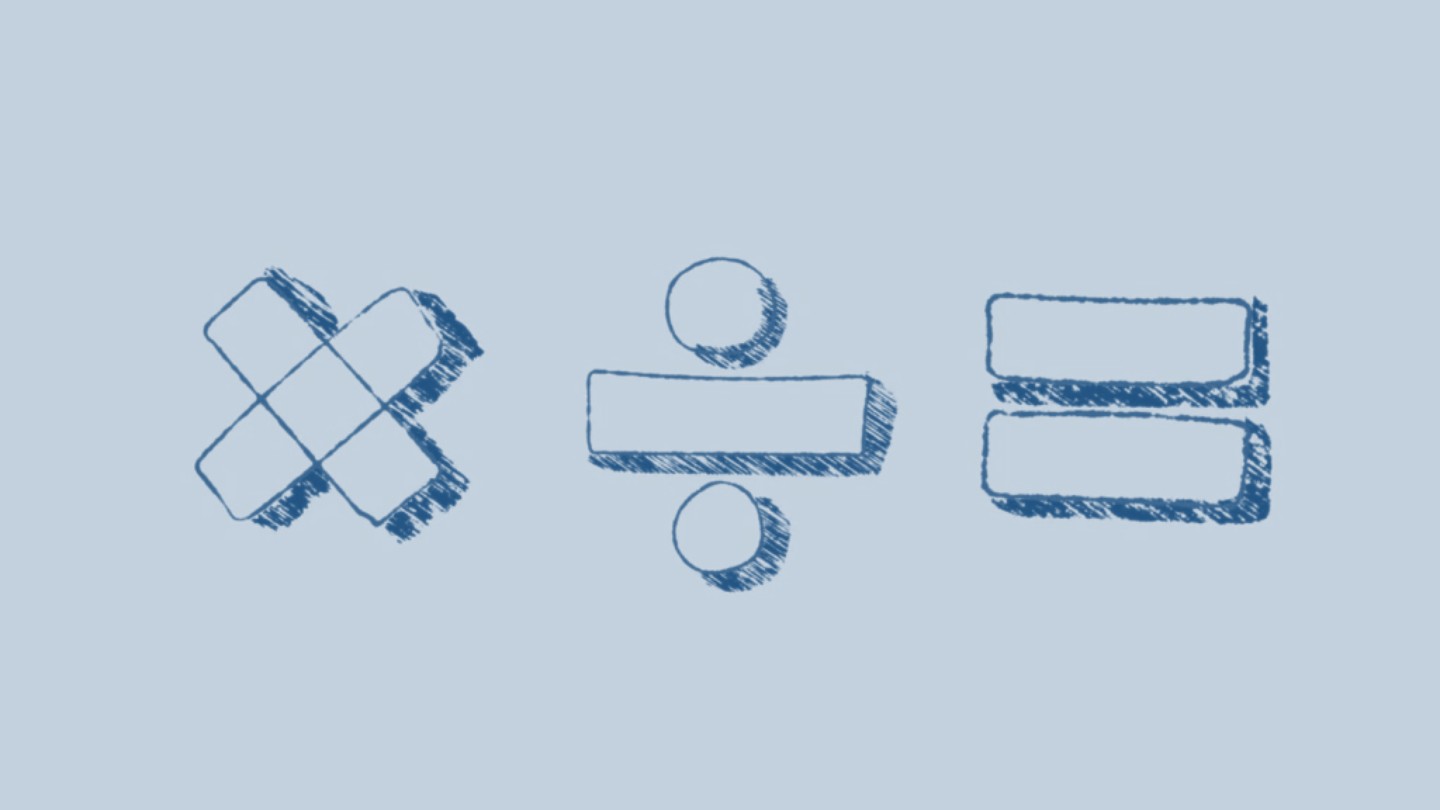
For anyone who’s ever stared blankly at an equation filled with plus signs, fractions, or the mysterious symbol for pi (π), it might be hard to imagine that these tools were born from very human stories. Math isn’t just about abstract truths; its symbols have evolved over centuries, shaped by merchants, scholars, and even dreams. Understanding this history isn’t just academic – it can reshape how we approach the subject, making it less intimidating and more relatable.
From Trade Routes to Plus and Minus Signs
The symbols we take for granted today weren’t always part of the mathematical landscape. The plus (+) and minus (-) signs, for example, didn’t appear until the late 15th century in a German math text. Their initial purpose wasn’t abstract addition or subtraction, but rather denoting surplus or shortfall in trade. As sea trade flourished, merchants needed a faster way to record transactions than longhand descriptions.
Imagine: “Ship one brought in three crates of apples… two hundred fish…”. Switching to symbols like “+,” “-“, and “x” slashed the character count by up to 65%, saving time and avoiding hand cramps for busy bookkeepers. This practical need drove the adoption of these now-ubiquitous signs.
The Rise of Symbolic Language
The evolution didn’t stop there. The “x” for multiplication emerged in the 17th century thanks to English mathematician William Oughtred, who also introduced the colon (:) for division. But even these weren’t entirely new: Arab scholars had used horizontal lines for fractions centuries earlier, a concept that blended with Oughtred’s colon to become the modern division symbol (÷) thanks to Swiss mathematician Johann Rahn.
This process highlights a key point: mathematical notation isn’t divinely inspired. It’s a patchwork of cultural exchange and adaptation. Symbols aren’t born in a vacuum; they spread, morph, and sometimes disappear, reflecting the messy reality of human progress.
Algebra’s Unexpected Origins
Algebra itself, with its abstract symbols representing unknown quantities, has roots in practical legal and business problems. The 9th-century Arabic polymath al-Khwarizmi didn’t write a math textbook; he wrote a guide for judges on fairly dividing inheritances. His methods, using what would become algebraic equations, were later translated into Latin and spread throughout Europe.
The idea of solving for an unknown (like finding “a” in 7 + a = 10) wasn’t a theoretical exercise; it was a tool for resolving real-world disputes. This practical origin often gets lost in modern classrooms, where algebra feels detached from everyday life.
The Epic of Pi and the Power of Dreams
Even seemingly immutable constants like pi (π) have a human story. Ancient Babylonians and Egyptians approximated its value to calculate the area of circular fields. Later, Archimedes refined it using geometry, earning it the nickname “the Archimedes constant.”
The pursuit of greater precision continued for centuries, culminating in the work of Srinivasa Ramanujan, an Indian math genius who claimed a Hindu goddess revealed the first nine digits of pi to him in a dream. The symbol itself, π, wasn’t used until the early 1700s by William Jones, possibly chosen as the first letter of the Greek word for “perimeter.”
Math as Human Heritage
The history of math symbols is a reminder that even the most abstract fields are shaped by human needs, quirks, and serendipitous discoveries. Mathematicians like Giuseppe Peano even attempted to write entire works using only symbols, a trend that ultimately proved impractical.
Ultimately, understanding these origins can make math feel less like an alien language and more like a shared cultural heritage. As mathematician Kate Kitagawa puts it, the journey of mathematical notation is “far from complete,” with endless possibilities for how we represent the principles that govern our world.
This isn’t just about memorizing formulas; it’s about recognizing the human stories embedded in every equation.


