


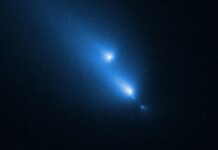



The NASA/ESA Hubble Space Telescope has captured the dramatic breakup of comet C/2025 K1 (ATLAS) – a rare event that provides crucial insights into how comets disintegrate under extreme solar heat. This is not just another space observation; it’s a glimpse into the fragile nature of these icy bodies and why some fall apart while others survive close encounters with the Sun.
Unexpected Discovery
The observation was serendipitous. Originally slated to study a different comet, researchers switched targets due to technical constraints. “Sometimes the best science happens by accident,” explains Auburn University’s Professor John Noonan, a co-author of the study. The team quickly witnessed the comet fragmenting just days after its closest approach to the Sun, an unprecedented timing for such a high-resolution view.
Comet’s Close Call
C/2025 K1 (ATLAS) reached perihelion – the point of closest approach to the Sun – on October 8, 2025, at just 0.33 AU (about one-third the distance between Earth and the Sun). This extreme proximity subjects comets to intense heating and stress. Within days, Hubble resolved five distinct fragments, revealing a nucleus actively breaking apart.
“Never before has Hubble caught a fragmenting comet this close to when it actually fell apart. Most of the time, it’s a few weeks to a month later. And in this case, we were able to see it just days after.” — Professor John Noonan
Why Comets Break Apart
The observation suggests that the fragmentation may be linked to the formation of a dust layer on the comet’s surface, which is then ejected by escaping gas. This process highlights the physics at play as comets approach the Sun. Long-period comets, like C/2025 K1 (ATLAS), appear to be more susceptible to fragmentation than their short-period counterparts, though the underlying reasons remain unclear.
Future Missions Will Benefit
The findings will inform future missions, particularly ESA’s Comet Interceptor, scheduled to launch later this decade. This mission will be the first to intercept a long-period comet, and the data from C/2025 K1 (ATLAS) will help scientists understand fragmentation mechanisms and select optimal targets.
Currently, the fragments of C/2025 K1 (ATLAS) are approximately 400 million kilometers from Earth and moving out of the Solar System, unlikely to return. The study, published in Icarus on February 6, 2026, represents a significant step forward in understanding the dynamics of cometary nuclei.
This observation underscores that comets are not just frozen relics of the early Solar System, but dynamic bodies that can dramatically change when exposed to the Sun’s intense energy. The real-time breakup of C/2025 K1 (ATLAS) offers a rare opportunity to study these processes in action, refining our understanding of the fate of long-period comets.