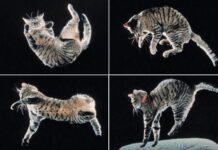


For over a century, scientists have puzzled over the uncanny ability of cats to right themselves mid-air and land squarely on their feet. The answer, it turns out, lies in an exceptionally flexible region of their spine – the thoracic spine, located in the middle of their back. New research confirms that this spinal segment allows for a level of rotation far exceeding that of other animals, enabling cats to perform a complex aerial maneuver with remarkable efficiency.
The Long-Standing Mystery
The question of how cats achieve this feat has been approached through several models. One suggests the tail acts as a propeller, but studies have shown cats can still land correctly without tails. Another proposed that cats bend almost in half and twist front and back simultaneously. The third, the “tuck-and-turn” model, suggests a sequential rotation of the front and rear halves, extending and contracting limbs to generate the necessary torque.
The Breakthrough: Thoracic Spine Flexibility
Researchers at Yamaguchi University in Japan conducted two key experiments. First, they tested the spinal flexibility of deceased cats, discovering that the thoracic spine rotates three times more easily than the lumbar spine (lower back). This suggests that the front of the cat’s body is the primary driver of the rotation. Second, high-speed video analysis of live cats being dropped confirmed this: felines orient their front halves before their rear halves, often by a mere tens of milliseconds.
“My general impression has been that the bend-and-twist is the most important, but this paper actually makes me reassess a bit and give a little bit more credence to the tuck-and-turn.” – Greg Gbur, University of North Carolina at Charlotte
Nature’s Complexity
The study also revealed an intriguing detail: cats consistently favor rotating to the right when falling. While the reason remains unclear, it may be linked to internal organ placement creating asymmetry in their body. As Gbur points out, nature rarely relies on simple models; instead, cats employ a complex combination of techniques for optimal results.
This research doesn’t dismiss earlier theories entirely; rather, it provides strong evidence that the highly flexible thoracic spine is the central mechanism behind the “righting reflex,” allowing cats to manipulate their body in mid-air with astonishing precision. The study reinforces that nature often finds the most effective solution, even if that solution is complex.