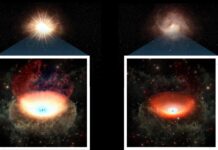




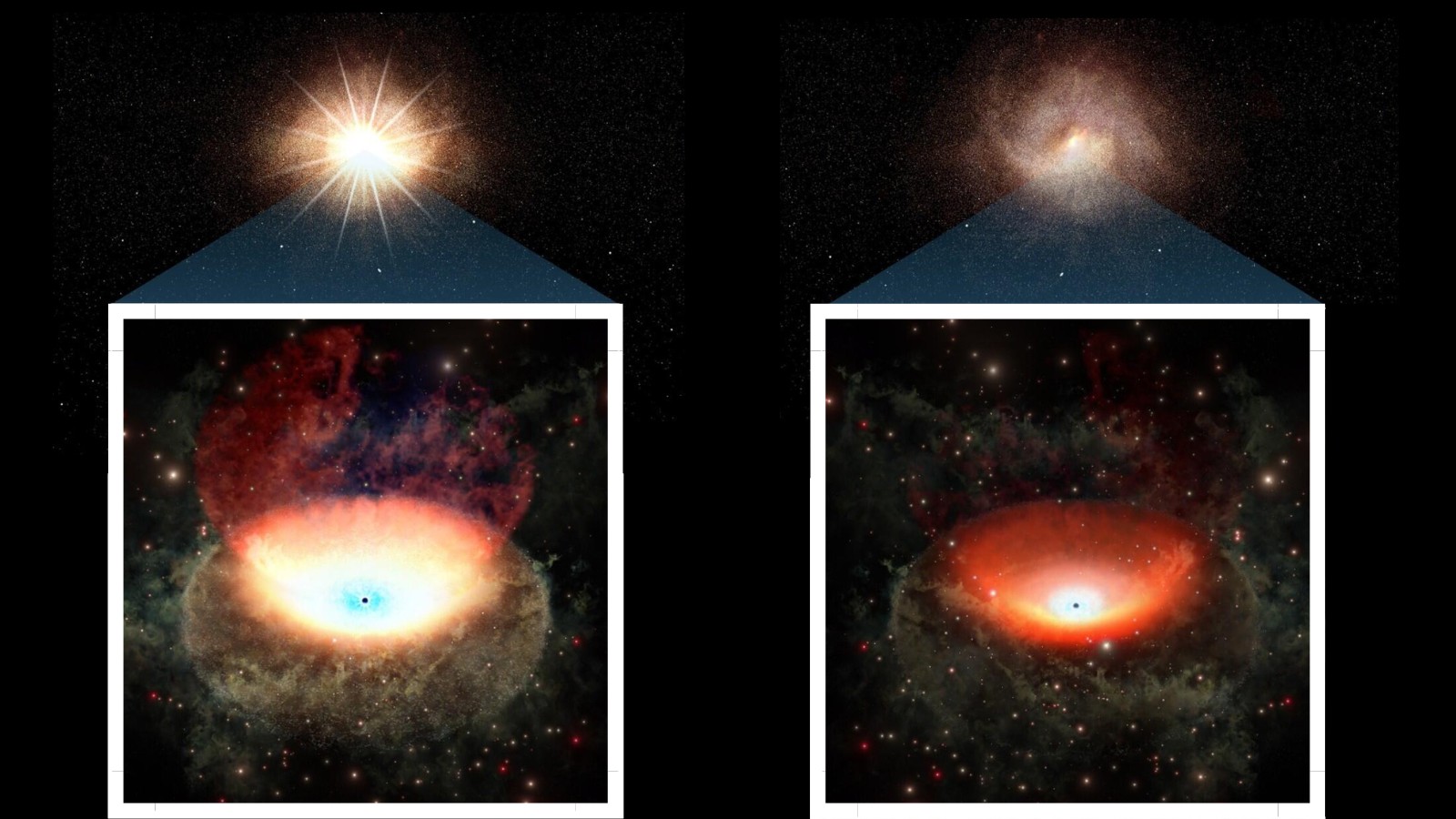
Astronomers have witnessed a dramatic cosmic event: a distant galaxy has undergone a radical transformation, dimming by 95% in just two decades. This sudden collapse in brightness was caused by the starvation of its central supermassive black hole, as the flow of matter required to fuel it abruptly ceased.
The Mechanics of Cosmic Brilliance
To understand why this dimming is so significant, one must look at how these celestial giants operate. Most galaxies harbor a supermassive black hole at their core. When these black holes are surrounded by a vast supply of gas and dust, the material forms a swirling, glowing structure known as an accretion disk.
This process creates an Active Galactic Nucleus (AGN). An AGN can become so intensely bright that it outshines the combined light of every single star within its host galaxy. Essentially, the black hole acts as a cosmic lighthouse, powered by the constant “consumption” of surrounding matter.
A Rapid Decline: The Case of J0218−0036
The discovery centered on a specific galaxy, J0218−0036. By analyzing two decades of archival data—comparing images from the Sloan Digital Sky Survey (SDSS) with those from the Hyper Suprime-Cam (HSC) on the Subaru Telescope—an international team of researchers identified a staggering trend:
- The Scale of Dimming: The galaxy’s brightness plummeted to just 5% of its original level.
- The Feeding Rate: The flow of gas into the accretion disk was reduced by approximately 98% in only seven years.
- Extreme Variability: While most AGNs fluctuate in brightness by about 30%, the change in J0218−0036 was far more violent and rapid.
The researchers went to great lengths to ensure this wasn’t a visual illusion. They ruled out the possibility that a simple cloud of gas had drifted in front of the black hole to block its light, as the dimming was consistent across all observed wavelengths, from X-rays to infrared.
Challenging Existing Astrophysical Models
This observation is a “game-changer” for the scientific community because it defies current theoretical expectations.
“This object shows rapid variability that cannot be explained by standard models,” noted Toshihiro Kawaguchi of the University of Toyama. “It provides an important test case for developing new theoretical models.”
Historically, astronomers believed that the feeding cycles of supermassive black holes—the process of turning “on” or “off”—occurred over thousands of years. The discovery that these changes can happen within a human lifetime (20 years) suggests that our understanding of how matter is distributed and consumed around black holes is incomplete.
Why This Matters
The mystery remains: what caused the supply to stop so suddenly? While the team has confirmed the “food supply” has been cut off, the physical mechanism triggering this cessation is still unknown.
This event highlights a significant gap in our knowledge of galactic evolution. If black holes can starve and reignite on such short timescales, the lifecycle of galaxies may be far more volatile and dynamic than previously imagined.
Conclusion
The rapid dimming of galaxy J0218−0036 proves that supermassive black holes can undergo massive changes in activity much faster than once thought. This discovery forces astronomers to rethink existing models of how galaxies feed and evolve over time.