

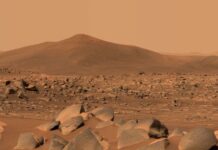



Recent research suggests that Martian soil may possess a natural defense mechanism against terrestrial microbes, creating a sort of “reverse War of the Worlds” scenario. This finding has implications for planetary protection efforts and the future of Martian colonization.
The Unexpected Defense Mechanism
A team led by Penn State microbiologist Corien Bakermans exposed microscopic “water bears” (tardigrades) to simulated Martian soil, called regolith. The goal was to assess the feasibility of converting this barren dirt into fertile ground for plant growth. However, the experiment revealed that one of the regolith simulants, MGS-1, rapidly induced dormancy in the tardigrades – effectively shutting them down within 48 hours.
This inhibitory effect was linked to a water-soluble compound within MGS-1, the exact nature of which remains unknown. Once washed away, the regolith became far less hostile to the tardigrades. The finding is significant because it suggests that Mars may already be equipped to resist contamination from Earth-based life.
Why This Matters
The concern over contaminating other planets with Earth microbes is serious. If life exists on Mars, introducing terrestrial organisms could destroy it. Even if no native life is present, contamination would make future searches for extraterrestrial biology unreliable. NASA’s planetary protection protocols demand extreme sterilization of spacecraft to avoid this scenario, aiming for a one-in-10,000 chance of carrying microbes to another world.
However, if Mars has its own defenses, those protocols could be relaxed, making future missions easier. Moreover, the same compounds that repel terrestrial life could be washed away to create arable soil – a crucial step towards establishing self-sustaining colonies.
From Defense to Opportunity
The study builds on previous research showing that Martian regolith is naturally toxic to living cells. The fact that this toxicity can be mitigated with simple washing suggests a path forward. Mars has ice at its poles and permafrost elsewhere, meaning water extraction for washing the soil is feasible.
“We’re looking at a potential resource for being able to grow planets as part of establishing a healthy community… but we’re also looking at whether there are any inherent damaging conditions in the regolith that could help protect against contamination from Earth.” – Corien Bakermans
Ultimately, Mars’ own chemistry may be both a barrier to contamination and a key to unlocking its potential for human settlement.