


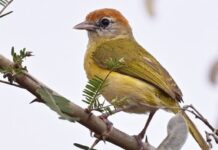

For sixty years, a small, olive-green songbird inhabiting the flooded savannas of Bolivia remained a mystery. Initially dismissed as a regional variation of known Hylophilus greenlets, recent genetic and behavioral analyses have definitively confirmed it as a distinct species: Hylophilus moxensis, or the Beni greenlet. This discovery not only expands South America’s already remarkable avian biodiversity but also highlights how much remains unknown even within well-studied bird families.
The Long Road to Recognition
The Beni greenlet’s story began in 1960 when ornithologists first observed variations in the bird population inhabiting Bolivia’s Beni savannas, a unique wetland ecosystem known as the Llanos de Moxos. For decades, these birds were assumed to be isolated populations of the rufous-crowned (Hylophilus poicilotis ) and gray-eyed (Hylophilus amaurocephalus ) greenlets found in Brazil. The subtle differences in appearance – mostly shades of green, gray, yellow, and brown – made accurate classification difficult using traditional methods.
The turning point came when researchers led by Dr. Paul van Els of the Museo Nacional de Historia Natural de la Paz, analyzed mitochondrial and nuclear genes. The results were clear: the Beni population diverged from its Brazilian relatives approximately 6.6 million years ago, predating the split between the two previously recognized species by over three million years. This makes the Beni greenlet a distinct evolutionary branch within the Hylophilus genus.
Distinguishing Characteristics: Beyond Genetics
Genetic data alone wasn’t enough. Detailed analysis of physical traits and vocalizations further cemented the Beni greenlet’s status as a separate species. Unlike its relatives, H. moxensis lacks the black or brown markings on its ear coverts. It also features uniformly dark brown eyes and produces a unique song containing distinct “V-shaped notes” with harmonic elements similar to female gray-eyed greenlets – a combination unseen in other species.
These subtle differences, once overlooked, now define a new species. The importance of detailed examination cannot be understated. Many birds look superficially alike, but genetic analysis can reveal deep evolutionary divergences that would otherwise go unnoticed.
Conservation Concerns: A Fragile Ecosystem
While the researchers currently believe the Beni greenlet isn’t immediately threatened, they warn that large-scale agricultural burning poses a significant risk to biodiversity in the region. The Llanos de Moxos are increasingly vulnerable to deforestation for farmland, which could quickly decimate the habitat of this newly recognized species.
“The recognition of Hylophilus moxensis as an additional endemic taxon in the region should boost conservation prioritization efforts,” the authors wrote. “Rampant burning for large-scale agriculture is an acute problem in the region for biodiversity.”
Despite currently widespread habitat, the relatively few recorded sightings of the species suggest it may be localized, making it potentially more vulnerable than initially assumed.
The discovery underscores the urgency of conservation in this fragile ecosystem. The Beni greenlet serves as a reminder that even in well-studied regions, hidden biodiversity persists, and its fate rests on proactive conservation efforts.
The team’s research was published January 1, 2026, in Avian Systematics.