
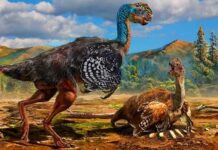


New research suggests that oviraptor dinosaurs, bird-like creatures that lived during the Late Cretaceous period, likely depended on a combination of brooding and solar heat to incubate their eggs. Unlike modern birds, they were not efficient at transferring body heat alone. This finding sheds light on how dinosaur reproductive strategies differed from those of living species.
The Experiment
Paleontologists at Taiwan’s National Museum of Natural Science, led by Dr. Tzu-Ruei Yang, and researchers at Washington High School, including Chun-Yu Su, conducted experiments to simulate oviraptor incubation behavior. They used a life-sized polystyrene and wood model of Heyuannia huangi, a 1.5-meter-long oviraptorid, to test how varying temperatures and parental attendance affected egg temperatures. Resin eggs were arranged in realistic double-ring clutches.
Key Findings
The study revealed that oviraptors may have struggled to maintain consistent egg temperatures through body heat alone. In colder conditions, eggs in the outer rings of the clutch experienced temperature differences of up to 6°C, leading to asynchronous hatching, where eggs hatch at different times. However, in warmer conditions, the temperature variation was minimal, suggesting that sunlight played a crucial role in regulating egg temperature.
“Oviraptors and the Sun may have been co-incubators – a less efficient incubation behavior than that displayed by modern birds.”
Why This Matters
This research highlights a significant difference between dinosaur and modern bird incubation methods. Modern birds rely on direct, thermoregulatory contact to maintain stable egg temperatures. Oviraptors, with their semi-open nests, likely depended more on external heat sources like the sun. This adaptation may have been linked to a shift from buried nests to more exposed environments.
The study demonstrates that different reproductive strategies can be equally viable in different environments. There is no “better” or “worse” method, only different ways of ensuring successful hatching. The findings challenge assumptions about dinosaur behavior and provide valuable insight into the evolution of incubation strategies.
The research was published in Frontiers in Ecology and Evolution in 2026.