






Casting spiders employ a unique hunting strategy: they don’t build traditional orb webs but instead fling sticky, silken lines to ensnare passing insects. This method, detailed in research published by the Proceedings of the National Academy of Sciences, relies on a specialized gland within the spider that produces a highly adhesive silk.
The Mechanics of Sticky Silk 🕸️
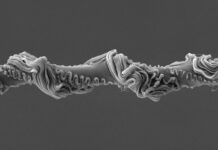
The silk itself isn’t just randomly sticky; it’s engineered for maximum grip. Scientists using a scanning electron microscope have observed that the fibers resemble miniature threads covered in a glue-like substance. This substance is secreted by the spider’s gland and ensures that once an insect touches the line, it’s unlikely to escape.
How it Works: From Gland to Capture 🎯
- The spider releases a strand of silk into the air, often aiming for flying insects.
- The silk drifts on air currents until it makes contact with prey.
- The adhesive properties of the silk immediately trap the insect.
- The spider then reels in the entangled prey for consumption.
Why This Matters 🔎
This hunting method is particularly effective in environments where building complex webs is impractical, such as dense vegetation or windy conditions. It highlights the incredible adaptability of spiders and the evolutionary pressures that shape their behavior. The study also underscores how even seemingly simple biological structures—like a spider’s gland—can be marvels of engineering when viewed under a microscope.
Understanding the Science 🔬
Researchers used high-resolution imaging to analyze the silk’s structure, revealing its fiber -like consistency and the distribution of adhesive droplets. The analysis confirms that the silk is designed not only for strength but also for maximum surface area contact with prey.
The Bigger Picture 🌍
The study of casting spiders provides insights into the broader field of biomimicry—the practice of designing materials and technologies based on natural systems. Understanding how spiders create such effective adhesives could lead to advancements in industrial glues, medical adhesives, or even new types of traps.
In essence, casting spiders showcase a highly efficient and specialized predation technique, demonstrating how natural selection favors even the most unconventional adaptations. This research not only expands our knowledge of spider behavior but also offers potential applications in diverse scientific fields.