

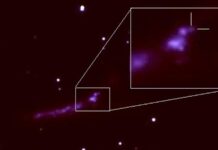


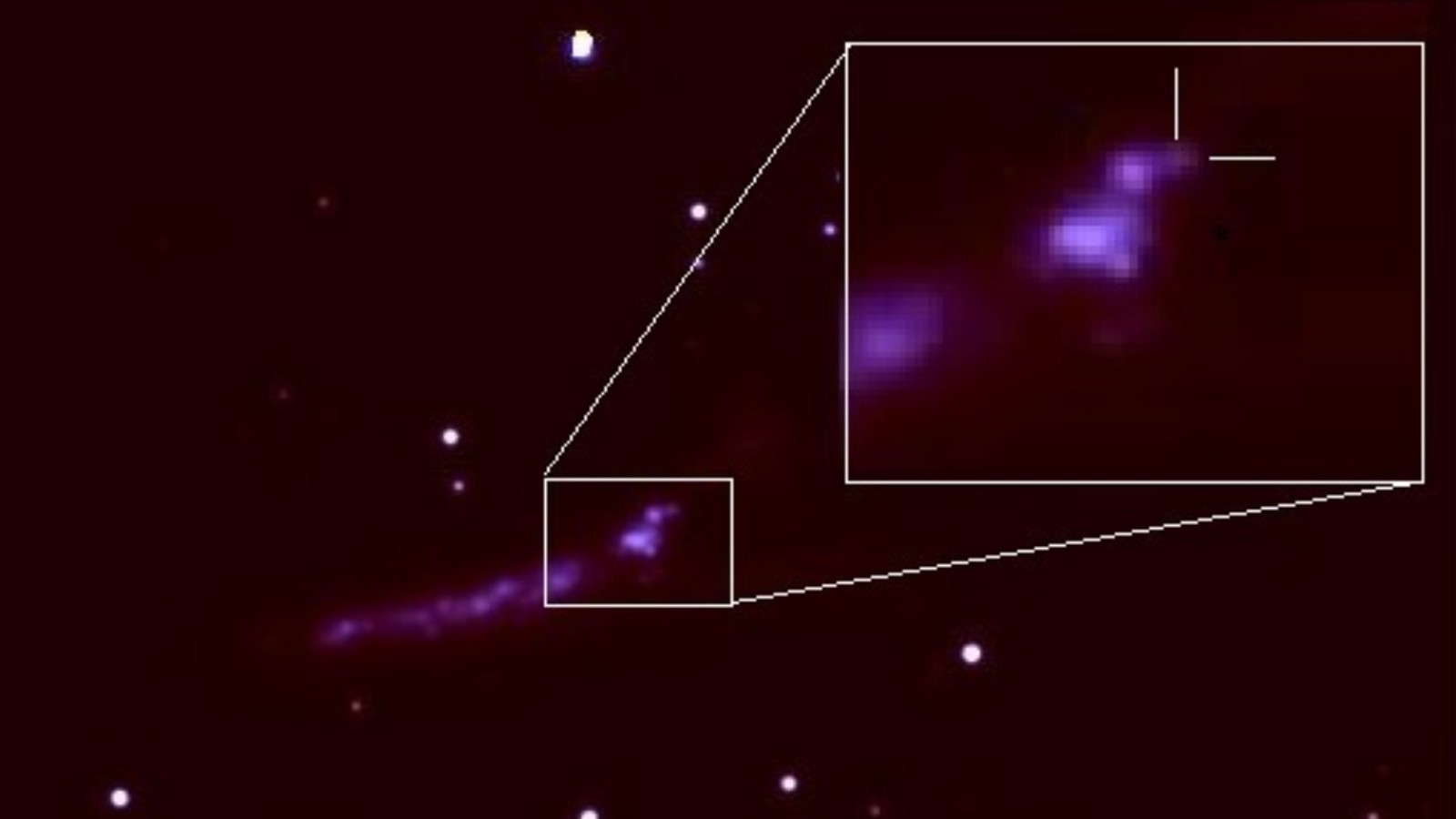
Astronomers have witnessed a supernova explosion that strongly suggests the formation of a binary black hole system, offering new insights into the life cycle of massive stars. The event, designated SN 2022esa, occurred roughly 320 million light-years away in the galaxy 2MFGC 13525.
The Death of a Wolf-Rayet Star
The supernova originated from a Wolf-Rayet star, a rare type of massive, highly evolved star stripped of its outer hydrogen layer. These stars are already nearing the end of their lives, burning through fuel at an accelerated rate. The observed explosion marks the final stage in this process, collapsing the star’s core into a black hole.
Evidence of a Binary System
What sets this supernova apart is the clear, stable periodicity observed in its light curve. The explosion exhibited recurring bursts over roughly one month, suggesting the star was part of a binary system. These periodic bursts could only occur if the doomed Wolf-Rayet star orbited another massive object: either an existing black hole or a companion star destined to become one.
The likely outcome is a binary black hole system, where two black holes orbit each other. Such systems are increasingly recognized as the primary source of gravitational waves detected by observatories like LIGO and Virgo.
Telescopic Synergy Drives Discovery
The discovery was made possible through a collaborative effort using the 8.2-meter Subaru telescope in Hawaii and the nimble Seimei telescope in Japan. This combination allowed researchers to capture both high-resolution, sensitive data (from Subaru) and quick-response observations (from Seimei).
“The fates of massive stars, the birth of a black hole, or even a black hole binary, are very important questions in astronomy,” said Keiichi Maeda, the study’s lead author.
This collaborative approach underscores the growing importance of combining different astronomical tools to unravel complex phenomena. Astronomers expect further discoveries by continuing this dual-telescope strategy.
The confirmation of a supernova directly linked to binary black hole formation offers a crucial glimpse into how these cosmic powerhouses are created, deepening our understanding of stellar evolution and gravitational wave sources.