





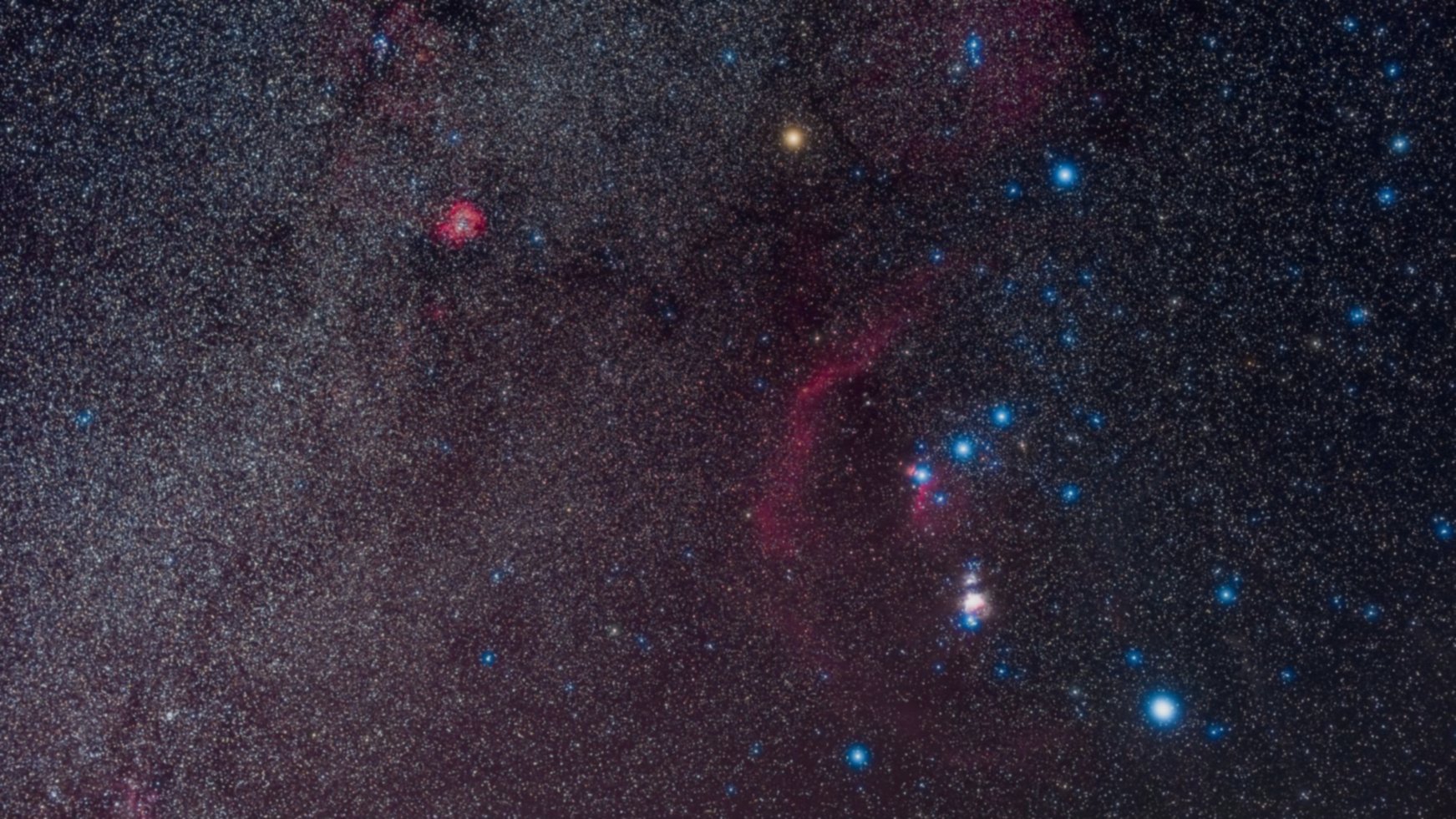
The clearest skies emerge during winter, revealing a breathtaking celestial display led by Orion, the Mighty Hunter. This constellation dominates late-evening skies, rising in the southeast and traversing the heavens before descending below the western horizon. The brilliance of Orion’s stars has captivated observers for millennia, with its belt stars shining up to 200,000 times brighter than our sun.
The Enduring Appeal of Orion
Orion isn’t the only bright star pattern in the sky, but it is arguably the most recognizable. Along the southern Milky Way, constellations like Crux (the Southern Cross) and Centaurus also feature prominent stars. However, Orion’s belt—comprised of Alnitak, Alnilam, and Mintaka—is unique: three equally spaced, second-magnitude stars forming a striking line across the sky.
These stars aren’t just visually arresting; they’ve also captured cultural imagination. Greenlanders once saw them as lost seal hunters, while the Chinese viewed them as a weighing beam. Even the Bible references Orion in Job 38:31, asking whether one can “bind the sweet influences of the Pleiades, or loose the bands of Orion?”
Blue Supergiants and Galactic Structure
Orion’s belt stars are blue supergiants—rare, intensely luminous stars that dominate our galaxy’s disk. These stars reside within Gould’s Belt, a band of bright blue giants discovered in the 19th century. Their distances range from 900 to 2,000 light-years, and their luminosity far exceeds that of our sun.
The winter sky offers a unique perspective: we are gazing away from the galactic center, resulting in a thinner Milky Way band compared to the summer sky. The summer Milky Way appears brighter because our line of sight aligns with the denser concentration of stars in the galactic core.
Stellar Lifecycles and Future Visibility
These brilliant blue stars burn through their fuel quickly, existing for only a few million to tens of millions of years. In contrast, our sun has a projected lifespan of 10 billion years. The longevity of stars depends on their size and temperature; smaller, cooler stars can persist for trillions of years.
Orion’s continued prominence isn’t guaranteed. Our solar system is moving away from the constellation at roughly 12 miles per second, meaning its future appearance will change over millennia.
The stars of Orion offer a glimpse into the vast scale of the cosmos and the dynamic processes that shape it. Their enduring brilliance serves as a reminder of the universe’s immense power and beauty.