
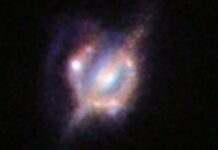

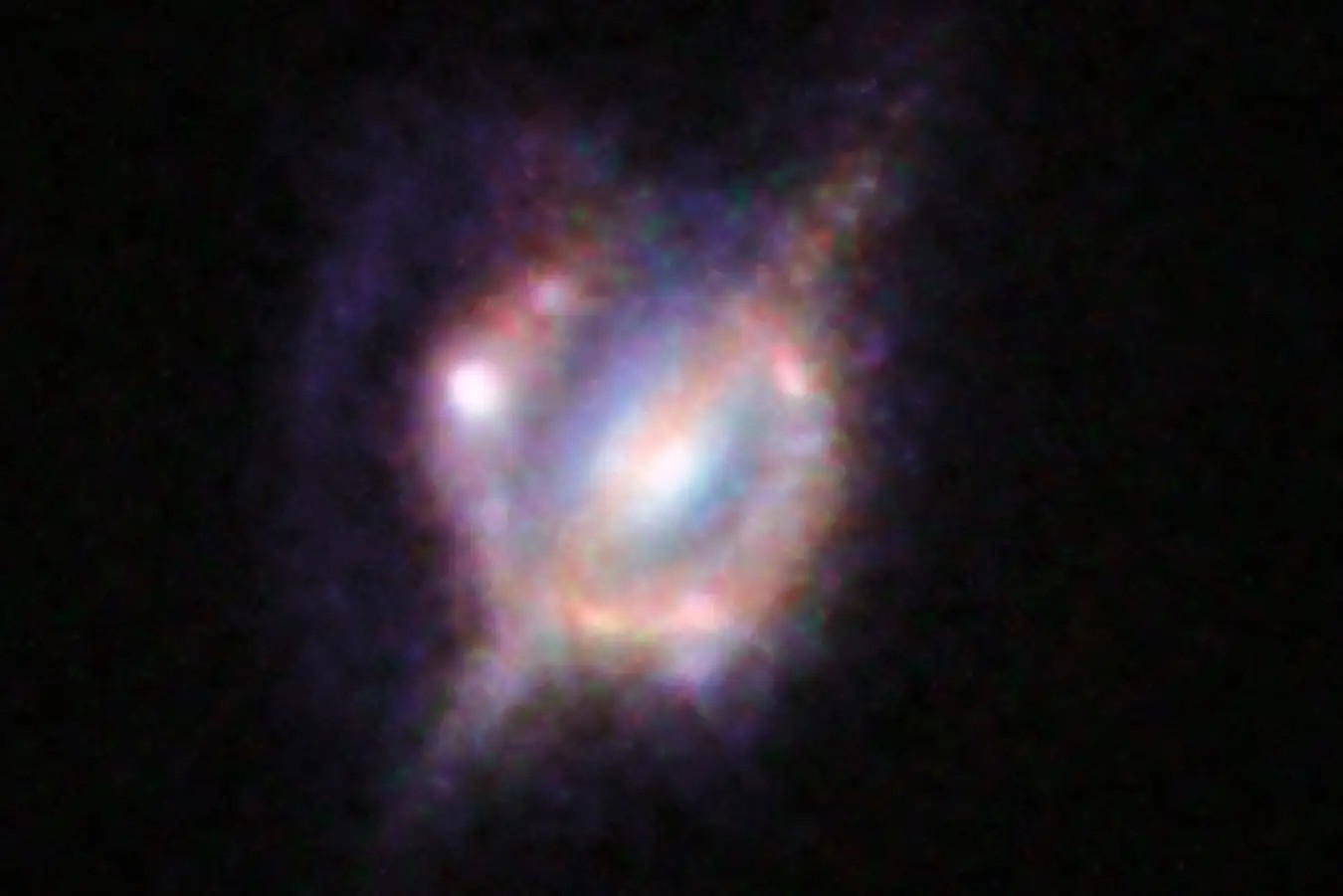
Astronomers have identified the most powerful and distant microwave laser – a phenomenon known as a maser – ever observed, originating from two galaxies merging approximately 8 billion light-years away. This discovery, made using the MeerKAT telescope in South Africa, provides a unique glimpse into the conditions of early galactic collisions and could reshape our understanding of how galaxies evolved in the universe’s infancy.
What is a Maser?
A maser (Microwave Amplification by Stimulated Emission of Radiation) is essentially a laser operating in the microwave part of the electromagnetic spectrum. Just like a laser, it requires a specific set of conditions to form:
- Excited Atoms: Atoms must first be energized to an unstable, high-energy state.
- Stimulated Emission: When photons (light particles) interact with these excited atoms, they trigger them to release additional photons at the same frequency, creating a coherent beam of radiation.
In galaxies, this process occurs when gas clouds are compressed during collisions, leading to increased star formation. The resulting light can excite hydroxyl ions (hydrogen and oxygen combinations) into higher energy levels. When bombarded with radio waves – often from supermassive black holes – these ions suddenly release a concentrated burst of microwave radiation, forming the maser.
The Discovery of H1429-0028
The newly observed maser originates from the galaxy H1429-0028. Its extreme brightness is partly due to gravitational lensing : a massive foreground galaxy bends and magnifies the light from H1429-0028, making it appear even brighter than it would otherwise.
The team, led by Roger Deane at the University of Pretoria, was initially searching for galaxies rich in molecular hydrogen when they stumbled upon the unusually strong maser signal. “It was serendipitous,” Deane said, noting the signal was “immediately the record.”
Gigamasers and Future Prospects
The intensity of this maser suggests it might belong to a new, more powerful category: the gigamaser. This beam is estimated to be 100,000 times more luminous than a star, concentrated within a narrow frequency range.
The Square Kilometre Array, a next-generation radio telescope currently under development, will enable astronomers to detect similar masers at even greater distances. These observations of distant galaxy masers will provide critical insights into how galaxies merged in the early universe, as these conditions are extremely specific:
“You need this radio continuum emission and you need this infrared emission, which you only really get from dust heated around forming stars. In order to get these very specific physical conditions to get the maser in the first place, you need merging galaxies.” – Matt Jarvis, University of Oxford
The conditions necessary for maser formation – intense star formation, radio wave emissions, and specific dust compositions – are indicative of colliding galaxies. By studying these distant signals, scientists hope to reconstruct the timeline of galactic mergers and better understand how large structures formed in the cosmos.
In conclusion, the detection of this record-breaking maser is not just an astronomical feat but also a stepping stone toward unlocking secrets about the early universe. Future observations promise to reveal more about galactic evolution, offering a clearer picture of how the cosmos came to be.