




The SETI@home project, a groundbreaking initiative that harnessed the processing power of millions of home computers, has narrowed down over 12 billion detected radio signals to approximately 100 candidates worthy of further investigation. This comes after two decades of analyzing data from the now-defunct Arecibo Observatory and other telescopes, marking a significant step in the search for extraterrestrial intelligence (SETI).
The Power of Distributed Computing
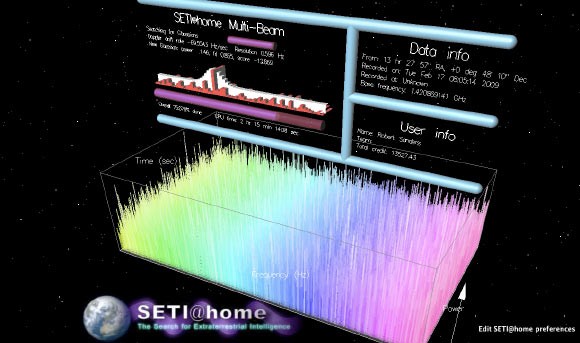
From 1999 to 2020, SETI@home operated on a unique premise: distributing raw radio data to volunteers worldwide. These participants allowed the project’s software to run in the background, analyzing signals for anomalies that could indicate an alien civilization. This approach differed sharply from traditional SETI, which typically analyzes data in real-time at the telescope itself. Instead, SETI@home recorded baseband digital data, then used the collective processing power of millions of CPUs and GPUs to hunt for patterns.
The scale of this effort is remarkable. The project sieved through observations spanning 22 years, primarily from Arecibo, but also including contributions from the Parkes and Green Bank observatories via the Breakthrough Listen initiative. The sheer volume of data required a unique strategy.
From Billions to a Select Few
The initial 12 billion detections were gradually refined through a multi-stage analysis process. First, the team narrowed the field to about one million candidate signals. Then, using advanced signal processing techniques like discrete Fourier transforms, they identified the 100 most promising signals for follow-up.
The key challenge was separating true anomalies from terrestrial interference – a constant source of false positives from satellites, broadcast stations, and even household appliances. The team developed sophisticated methods to filter out noise, looking for clusters of detections consistent with a single origin point across multiple observations.
Current Verification and Future Implications
These 100 signals are now being re-observed using China’s Five-hundred-meter Aperture Spherical Telescope (FAST). The goal is to determine if any of them repeat or exhibit properties inconsistent with natural background noise. While project co-founder Dr. David Anderson acknowledges the low probability of finding a powerful, undiscovered signal, the effort offers valuable lessons for future technosignature hunts.
“If there were a signal above a certain power, we would have found it.” – Dr. David Anderson
The project’s findings, detailed in two papers published in the Astronomical Journal, provide a technical roadmap for leveraging distributed computing in SETI. The success of SETI@home highlights the potential of enlisting public processing power, especially with the availability of faster networks and platforms like BOINC.
The main bottleneck now is funding personnel. While computational resources are increasingly accessible, the cost of salaries for scientists and engineers remains a significant barrier. Despite this, the enduring public interest in extraterrestrial intelligence suggests that similar crowdsourced projects could be viable in the future.
In conclusion, SETI@home’s legacy extends beyond the search for alien signals. It demonstrated the power of citizen science, proving that even the most ambitious scientific endeavors can benefit from the collective effort of millions. The 100 remaining signals now under scrutiny represent a tangible outcome of this collaborative approach, offering a renewed, albeit cautious, hope in the ongoing quest for life beyond Earth.
References:
David P. Anderson et al. 2025. SETI@home: Data Analysis and Findings. AJ 170, 111; doi: 10.3847/1538-3881/ade5ab
E.J. Korpela et al. 2025. SETI@home: Data Acquisition and Front-end Processing. AJ 170, 112; doi: 10.3847/1538-3881/ade5a7