
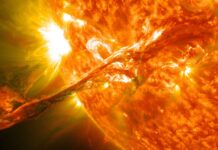

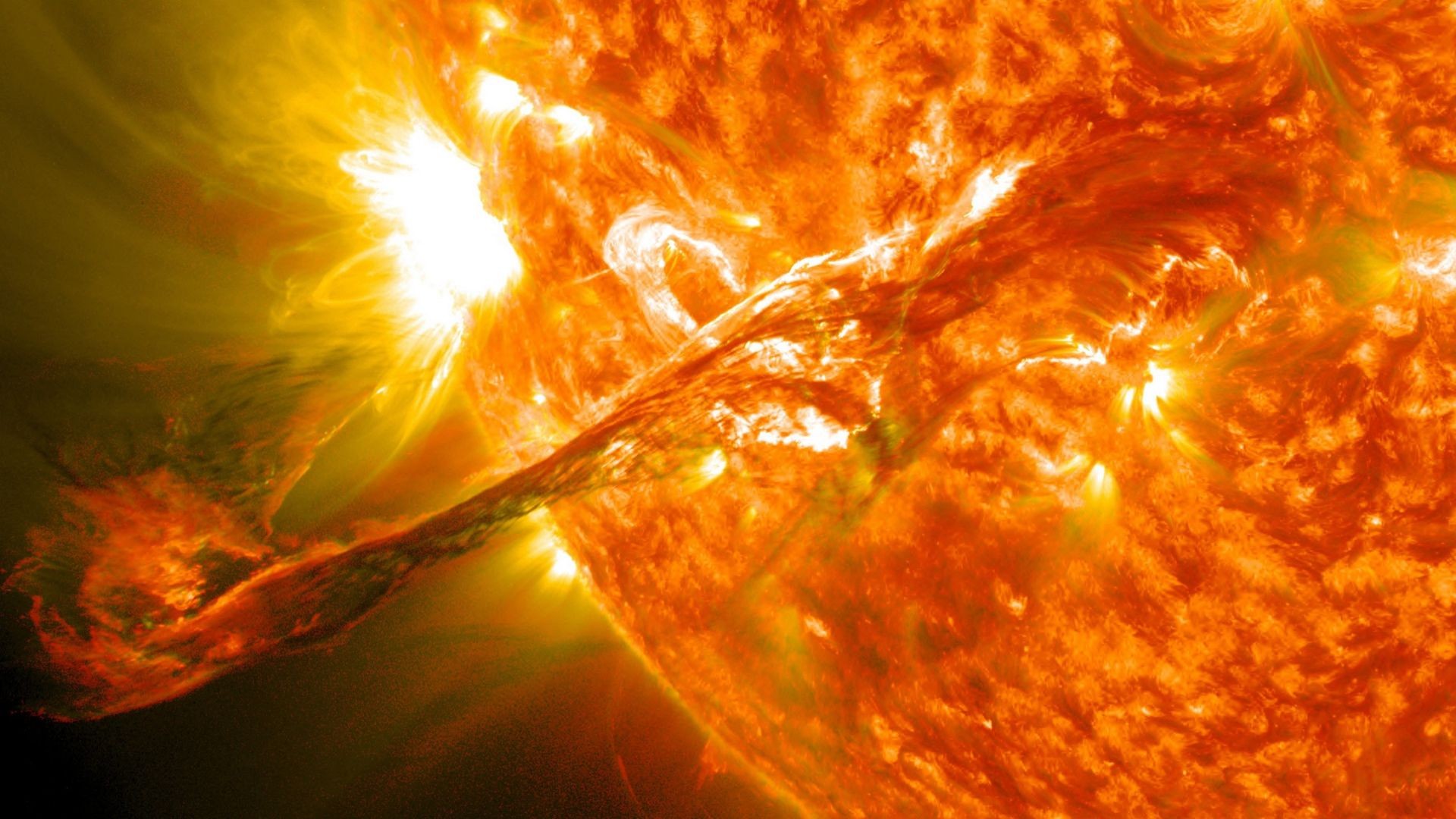
Recent research suggests a surprising link between solar flares—powerful bursts of energy from the sun—and earthquake activity on Earth. While the idea remains highly debated, the study proposes that these flares might subtly influence seismic events by altering electrical forces within the planet’s crust.
The Proposed Mechanism: A Planetary Electrical Circuit
The theory centers around the concept of Earth as a vast electrical system. Highly stressed cracks in the Earth’s crust, particularly along fault lines, contain supercritical fluid—a substance neither liquid nor gas—that is rich in charged ions. These cracks essentially behave like natural capacitors, storing electrical energy.
The study models Earth’s crust and the ionosphere (a charged layer of the upper atmosphere) as the two terminals of a massive, imperfect battery. Solar flares, when directed toward Earth, shift electrons in the ionosphere, creating a concentration of negative charge at lower altitudes. This charge then increases electrostatic force on the charges in the crust, potentially exerting pressure on faults and triggering earthquakes.
Why This Matters: A New Perspective on Earthquake Risk
If this connection holds true, it would represent a significant shift in how we understand earthquake risk. Currently, earthquake prediction relies heavily on geological factors and historical data. A confirmed link between space weather and seismic activity would introduce a new variable into these models, requiring scientists to consider solar activity alongside traditional methods.
However, experts caution against premature conclusions. The model used in the study is simplified, and real-world geological complexities could dampen any effect to insignificance.
Challenges and Counterarguments
One major challenge is proving causation. Earthquakes and solar flares are both frequent events, making coincidental overlaps inevitable. Establishing a direct influence requires rigorous statistical analysis and controlled experiments—difficult to conduct given the scale of the forces involved.
Victor Novikov, a geophysicist at the Russian Academy of Sciences, points out that the study does not fully account for the resistance of various rock layers to electrical conductivity. This resistance could effectively neutralize the electric field before it impacts fault stability.
The 2024 Noto Peninsula Earthquake
The researchers cite the 2024 Noto Peninsula earthquake in Japan as potential supporting evidence, noting that it coincided with strong solar flare activity. However, correlation does not equal causation. The U.S. Geological Survey has previously found no clear, repeating correlation between the sun’s 11-year solar cycle and earthquake occurrences.
Conclusion
The study proposes a novel, if speculative, pathway for solar flares to influence earthquakes. While the model is highly simplified and faces skepticism from other researchers, it highlights the potential for unexpected connections between space weather and geological phenomena. More observational data and deeper analysis are needed to determine whether the sun can reliably jostle Earth’s faults—a question that remains open for now.