



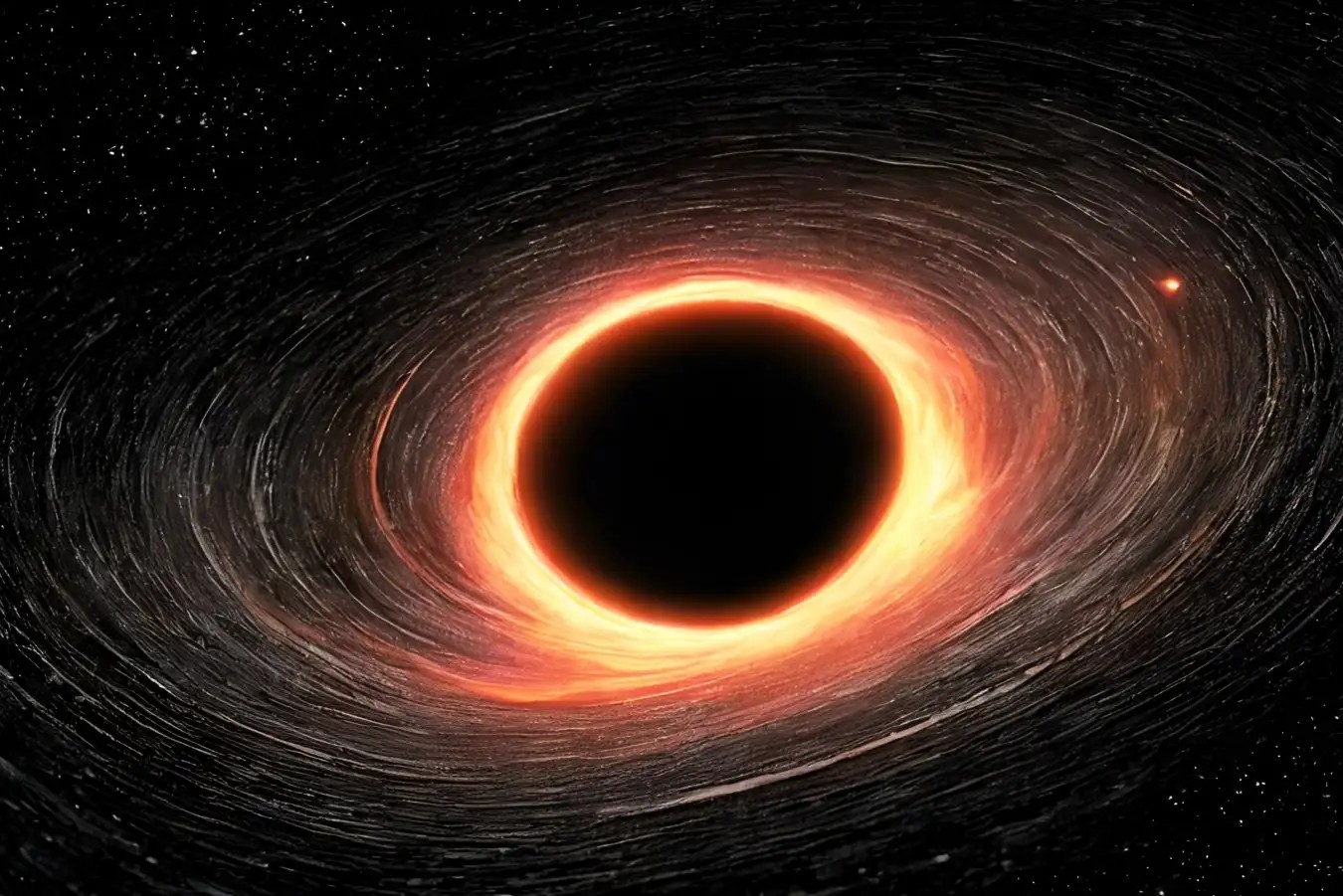
Astronomers have found a massive black hole dating back to the early universe that may be one of the first structures to form after the Big Bang, rather than the collapse of a giant star. This discovery challenges standard theories of black hole formation and suggests the existence of primordial black holes, a hypothetical type theorized decades ago.
Anomaly in Early Galaxy Abell 2744-QSO1
The black hole was identified within the galaxy Abell 2744-QSO1, observed 13 billion years ago using the James Webb Space Telescope (JWST). What makes this black hole unusual is its size – approximately 50 million times the mass of our sun – combined with a near-total lack of stars in its host galaxy. Standard models predict that galaxies and black holes form together or that black holes emerge from the death of massive stars. This galaxy breaks that pattern.
Primordial Black Holes: A Theoretical Revival
The team behind the discovery ran simulations suggesting that this black hole could have originated as a primordial black hole, first proposed by Stephen Hawking and Bernard Carr in 1974. These objects wouldn’t have formed from stars but instead coalesced from density fluctuations in the infant universe. The key difference is that primordial black holes are thought to grow directly from the uneven distribution of matter immediately after the Big Bang, rather than from stellar collapse.
Simulations Support the Primordial Origin
Initial calculations aligned with observations, but lacked detail. Subsequent, more thorough simulations accounted for gas flows, star formation, and interactions between primordial black holes. The results closely matched the observed mass of the black hole, the presence of heavier elements, and other characteristics of Abell 2744-QSO1. This suggests that primordial black holes could be a viable explanation for this early cosmic structure.
Remaining Questions and Challenges
However, some aspects remain unclear. Standard primordial black hole models often produce black holes around 1 million solar masses; QSO1 is five times larger. Another issue is the lack of nearby high-energy radiation sources needed to trigger primordial black hole formation. Despite these challenges, scientists believe that these black holes could have merged rapidly to become extremely massive.
“With these new observations that normal [black hole formation] theories struggle to reproduce, the possibility of having massive primordial black holes in the early universe becomes more permissible,” says Boyuan Liu of Cambridge University.
The discovery doesn’t prove primordial black holes exist, but it provides compelling evidence that they are a serious possibility. Further research is needed to confirm whether this black hole is truly an echo of the Big Bang or a rare anomaly within the established framework of astrophysics.