
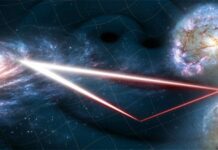


Physicists have identified a potentially groundbreaking method for measuring the universe’s expansion rate, a long-standing cosmological puzzle, using the subtle ripples in spacetime known as gravitational waves. The new approach leverages the collective signal from countless merging black holes across the cosmos – a faint “hum” of gravity – to independently assess how quickly space is stretching. Even without directly detecting this background, researchers have already used current data to refine constraints on the Hubble constant, the value representing the universe’s expansion speed.
The Hubble Tension: A Core Problem in Cosmology
The expansion rate of the universe is a fundamental quantity, but its precise value has become a major point of contention. Measurements derived from early-universe observations (like the cosmic microwave background, the afterglow of the Big Bang) systematically disagree with those from nearby objects (such as supernovas). This discrepancy, dubbed the Hubble tension, is statistically significant, suggesting either unidentified errors in existing methods or the need for fundamentally new physics.
As Yale physicist Chiara Mingarelli explains, “Early-Universe and late-Universe measurements of the expansion rate disagree at over 5 sigma… Either there’s an unidentified systematic error or new physics.” The inability to reconcile these values raises critical questions about our understanding of dark energy, dark matter, and the overall structure of the universe.
Using Black Hole Mergers as Cosmic Rulers
The new study, accepted for publication in Physical Review Letters, proposes a novel method based entirely on gravitational waves. Since 2015, observatories like LIGO and Virgo have detected dozens of black hole mergers, each event providing information about the masses and distances of the colliding bodies. By analyzing the rates at which these mergers occur across the universe, scientists can infer properties of the gravitational wave background—the combined signal from too-distant events to resolve individually.
According to lead author Bryce Cousins, “Because we are observing individual black hole collisions, we can determine the rates of those collisions happening across the universe.” The overall strength of this background signal directly depends on the expansion rate; slower expansion implies larger volumes and more mergers, resulting in a stronger background.
Implications and Future Prospects
The research team demonstrated that the current non-detection of the gravitational wave background already rules out certain lower values for the Hubble constant. While the current constraints are still broad, this method establishes a new, independent framework for cosmological inference. This approach complements existing “standard siren” techniques (using individual gravitational wave events as distance markers) by exploiting the entire unresolved population of black hole collisions.
University of Chicago professor Daniel Holz emphasizes the significance: “It’s not every day that you come up with an entirely new tool for cosmology.” Planned upgrades to gravitational wave detectors should allow for direct detection of the background within a few years, transforming this from a lower bound into a precise measurement.
Ultimately, this stochastic siren method could become a powerful new tool for probing the expansion history of the universe and determining whether the Hubble tension represents a fundamental flaw in our models or merely hidden systematic errors.
This new technique offers a vital independent check on existing cosmological measurements and may ultimately help resolve one of the most pressing mysteries in modern physics.