



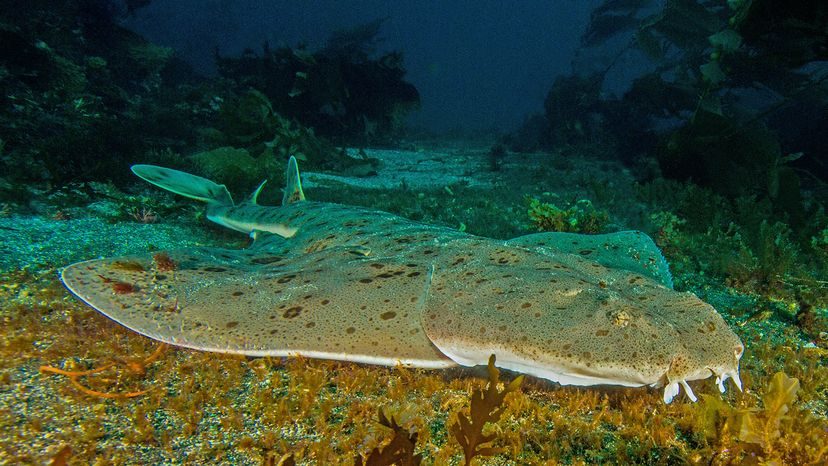
他们看起来像是被卡车撞了。 这是你注意到的关于天使鲨 的第一件事。
虽然大多数人把鲨鱼想象成光滑的鱼雷形捕食者,鳍上发出“危险”的尖叫声,但这些生物看起来就像用来熨床单的扁铁。 它们很广泛。 它们是平的。 它们看起来不太像顶级掠食者,而更像是海底碎片。
这种出现提出了一个逻辑问题。 如果它们看起来一点都不像鲨鱼,为什么它们是鲨鱼呢?
答案在于分类学家争论的一个解剖细节。
Angel Sharks vs. Skates, Rays, and Other Sharks
To understand where the angel shark fits in the aquatic hierarchy, you need to look at its neighbors. Rays and skates are closely related species in the shark world. They have a flat body, bury themselves in the sand and are very similar to angel sharks.
But there is a difference.
The large pectoral fins of skates and skates blend right into the head. There is no neck. There is no difference.
Angel sharks have separate fins.
This small gap may seem insignificant. it is not. It keeps the angel shark in the family Squatinidae. This qualifies them as true sharks.
The genus name Squatina is of Latin origin and roughly means “some shark”. Early scientists were confused by this. These animals are tanaks and tanaks. short. Stocky. It is not as long as a great white or bull shark.
However, the common name refers to the appearance. Their wide pectoral fins resemble wings or halos. It gives this creature a reverent, almost angelic silhouette.
But don’t let the name fool you.
They are ambush hunters. They lie down and wait. They rely on camouflage to blend into the seabed until their prey gets too close. Then they shoot upwards at incredible speeds.
their teeth are sharp. Their bite is tenacious.
Because of this aggressive hunting style, anglers sometimes call them the “sand devil”. Given their sudden and violent attacks, this name seems more appropriate.
Angel Shark Anatomy
Size matters in the deep, but in the case of angel sharks, “small” is relative.
Most species of the Squatina genus are about 1.5 meters long. It is compact. Dense. It is designed for lying still, not long-distance cruising.
Some species push the limit. The Japanese angel shark (Squatina japonica ) can grow up to 6.5 feet (2 meters).
That is about as long as they get.
They don’t have the streamlined body needed for a fast chase. Their anatomy is optimized for stealth. to wait. Perfect moment to launch an attack.
This physical limitation makes them vulnerable. They cannot outrun threats. They cannot escape habitat collapse. They rely on being invisible.
Recently, this invisibility is failing.

Anatomy of an ambush
Most of these animals weigh about 27 kilograms. That’s heavy for something that looks like a discarded carpet.
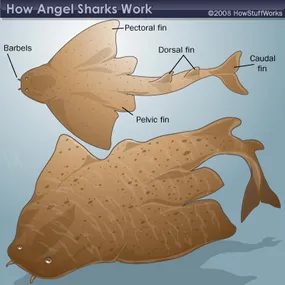
Angel sharks are more like rays than the great white sharks you see in the movies. But underneath that flat, flat body—squeezed dorsoventrally—they have the same basic shark hardware. It’s just arranged differently.
The wide pectoral fins give them their name. They are huge. And they stick out of the body, not the head. This is a key difference from rays. Their pelvic fins are also flattened and spread outward like wings.
The Jaw Trap
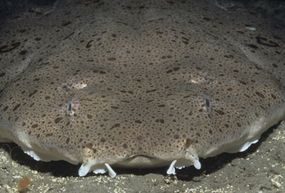
Look at the mouth. It’s right at the tip of the muzzle. Inside? Nightmare fuel. The teeth are triangular. Needle sharp. Sharp as needles.
Barbels border the mouth. Think of them as whiskers. They sense chemical signals from prey buried in the sand of the seabed.
Breathing under pressure
Gill slits border the sides of the head. This is important. Rays and skates have gill slits on the underside. Angel sharks don’t. It’s a structural difference that changes everything.
Most sharks have to keep swimming to push water over their gills. Angel sharks don’t. They use their muscles to absorb water while sitting still on the bottom. They also have a spiracle. It is a tube behind the eye that sucks in water even when the mouth is closed.
The Tail That Launches
The tail tells a different story. Most sharks have a top-heavy tail fin. The upper lobe is larger.
Angel sharks flip the script. The lower lobe is longer. Why? It helps them shoot up. Quickly. When they attack their prey from below, this extra lift is crucial.
Camouflage and location
This body plan is designed for one thing: the ambush. A successful attack from below is the only way to eat. Flat body. The barbels. Upturned tail. Everything is designed for the seabed.
Waiting.
Their color also helps. White. Gray. Brown. Black. They blend into the sand. Some have red spots. It’s not just random. It’s camouflage. Coordination with the habitat.
Where they hide
Angel sharks are global. You can find them on both sides of the Atlantic. On both sides of the Pacific Ocean.
Indian Ocean? Rarely. Except for one place in the southwest corner. You can find them there.

The Pacific angel shark (Squatina californica ) is not only the most famous of its genus; This is probably the most studied. This does not mean that everything else is mysteriously empty. Most species look roughly the same. The difference between the two often comes down to geography. Some species live in cold water. The other is tropically hardy. But they are all looking for the same property.
They want the bottom.
The ocean floor is their environment, be it a shallow bay or 1,300 meters deep. There, they play a waiting game that makes deep-sea predators look like impatient teenagers.
How the Pacific Angel Shark Ambushes Prey
为了有效地狩猎,你必须消失。 这些鲨鱼将自己埋在沙子和泥土中。 他们只露出眼睛。 这是一种如此深刻的寂静,他们可以保持数天。
当猎物游过时——比目鱼或大比目鱼等硬骨鱼、甲壳类动物或软体动物——攻击是爆炸性的。 鲨鱼的前半身突然升起。 它从下面袭击。 整个捕获过程只需十分之一秒。
速度在这里是具有欺骗性的。 这与耐力无关。 这是关于精度的。
他们倾向于坚持一处。 如果当地鱼类群落发现了捕食者的藏身之处,鲨鱼就会卷起来。 它移动了几英里远。 一切重新开始。
是什么引导了这次罢工? 倒刺不断扫过水面,检查是否有振动。 但视力为王。 1999 年的一项研究证明了这一点。 研究人员向太平洋天使鲨展示了橡胶鱼。 没有气味。 无电信号。 没有动静。 只是一个视觉复制品。 鲨鱼几乎袭击了所有人。
他们不关心身体里面有什么。 他们关心他们所看到的。
人类则是另一回事。 如果你激怒它,它就会咬人。 锋利的牙齿已经准备好了。 但总的来说,鲨鱼更让我们害怕。 我们咬得更大。
The Global Cast of 24 Angel Shark Species
The ocean floor is crowded. There are 24 different angel sharks swimming in different sea areas of the world. They share a common body structure. Names and locations differ.
The list is as follows.
- Squatina aculeata : Sawback angel shark. Found on the coast of the Mediterranean and Africa.
- Squatina africana : African angel shark.
- Squatina albipunctata : Eastern angel shark. Found off the coast of Australia.
- Squatina argentina : Argentine angel shark.
- Squatina armata : Chilean angel shark.
–Squatina australis : Australian angel shark. - Squatina caillieta : Caillieta angel shark. Found in the Philippines.
- Squatina californica : Pacific angel shark.
- Squatina david : David’s angel shark. Found in the Caribbean.
- Squatina dumeril : Atlantic angel shark.
- Squatina formosa : Angel shark from Taiwan.
- Squatina guggenheim : Angular angel shark. Found on the coast of South America.
-
Squatina japonica : Japanese angel shark.
-
Squatina legnota : Indonesian angel shark.
- Squatina mapama : Small-crested angel shark. Found near Panama.
- Squatina nebulosa : Clouded angel shark. Lives from Japan to China.
- Squatina occulta : Hidden angel shark. Found on the coast of South America.
- Squatina oculata : Angel shark with a smooth back. Found on the coast of the Mediterranean and Africa.
-**Squitina
Pseudocell: Western angel shark. Found on the northwest coast of Australia.
– Squatina punctata: Angular angel shark. Found on the coast of the Mediterranean and Africa.
– Squatina squatina: common angel shark.
– Squatina tergocellata: Ornate angel shark. Found near South Australia.
– Squatina tergocellatoides: Ocellated angel shark. Found near Taiwan.
– Squatina varii**: Vari’s angel shark. It was found near the coast of Brazil.
It’s a long list. It’s also a shrinking one.
Angel Shark Fishing and Recovery
The numbers tell a grim story. eight are critically endangered. Another four are endangered. These are marked by the International Union for Conservation of Nature (IUCN).
They sit at the bottom. They don’t move fast. They do not hide in open water where they can escape from fishing nets. They are the “sitting ducks” of bottom trawling.
Recovery isn’t just about stopping the nets. It’s about understanding the environment. These sharks need sand. They need silence. They need time to bury themselves and wait for the perfect meal. Without these conditions, the list of 24 becomes shorter. Quieter.

The hidden costs of a “Junk Fish” Status
The biggest threat to angel sharks is not a predator. That’s us. More specifically, it’s about fishing. Whether intentional or accidental, human activity is the main cause of their decline. These bottom sharks are masters of camouflage and blend in with the sand. This makes them easy victims. They are swept into nets for flounder, shrimp or sole. Habitat loss due to pollution and coastal development exacerbates the problem.
But the real danger lies in their biology. Angel sharks are slow breeders. They grow slowly. Their reproduction rate is low. Most species give birth to only six pups. Some may have as many as twenty-five. The gestation period is long. It usually lasts eight to ten months.
They are ovoviviparous. The female carries the eggs. They hatch inside her. The pups are born live. They are small at birth. About nine inches long. Twenty-three centimeters. Adults try to protect them. They seek deeper waters to give birth. It’s a fragile start to life.
The collapse of the Pacific angel shark
Until the 1970s, Pacific angel sharks were considered trash. The fishermen got it by accident. They threw it back. It was a “”junk fish””. Nobody wanted it.
Then came Michael Wagner. He was a seafood processor in Santa Barbara, California. He saw opportunity where others saw waste. Wagner began to spread the word. He told people that the Pacific angel shark tasted good. His campaign was almost single-handedly responsible for changing public perception. Millions of people started eating them.
Data from the Monterey Bay Aquarium shows the speed of the crash. In 1977 only about 366 pounds were caught. By 1984, that number had exploded to 700,000 pounds. The peak was reached in 1985 and 1986. Fishermen caught about 1.2 million pounds of Pacific angel sharks each year.
Finally, the regulations came into effect. In 1989, a minimum size limit was set. The use of inshore gill net was banned in 1994. These measures helped the Pacific population recover. However, other species are still in a critical state. Protection is far from over.
Ancient medicines and modern reality
Today, only divers and daring diners can encounter an angel shark. This was not always the case. In 77 BC Pliny the Elder wrote his Natural History. This encyclopedia was the leading scientific text until the Middle Ages. It contained strange uses for natural ingredients.
Pliny suggested angel shark skin for cleaning. It did wonders for dusting. He also mentioned medicinal properties. Meat could relieve swollen breasts. Burnt shark meat has been cited as a cure for acne.
“According to Pliny, the skin of an angel shark worked wonders for dusting… and when burned, it cured acne.”
It is a stark contrast to the modern view. Once upon a time there was a home cleaning and beauty product. Now the species is fighting for survival.
Frequently asked questions
What are the main threats to angel sharks?
Habitat destruction, commercial fishing bycatch and illegal fishing practices are the main threats.
How do angel sharks reproduce?
They are ovoviviparous. The eggs hatch inside the female. She gives birth to live young.

