
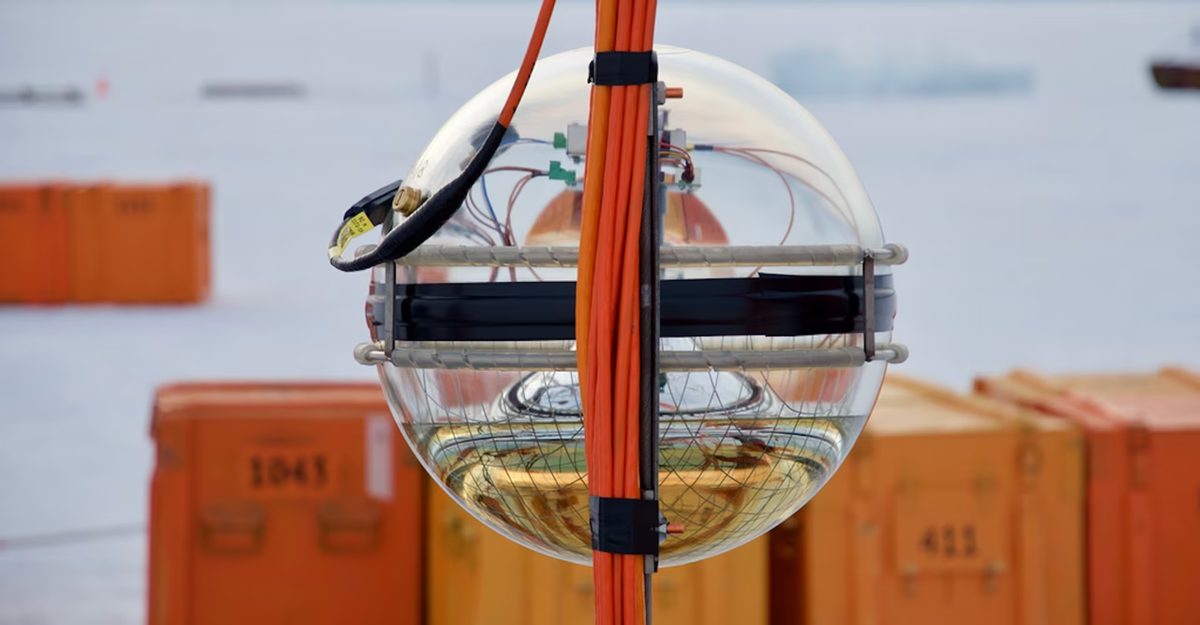
It has been years of waiting. The scientific community held its breath for this specific moment. The device bears a modest name: Baikal-GVD. The acronym stands for Gigaton Volume Detector. Today, it is finally submerged. This is no ordinary telescope. It occupies a half-kilometer cube of space beneath the surface. The deployment happened in the deep waters of Lake Baikal. Specifically, about four kilometers from the Russian coast. Engineers drilled a hole through the thick ice sheet to lower the apparatus. A delicate operation. Ice makes everything harder.
Baikal-GVD is classified as an underwater telescope. Its job is to hunt high-energy neutrinos. These particles are nearly massless. They are born from violent cosmic events. They barely interact with other matter. That makes them incredibly difficult to track. Most pass right through Earth without a trace.
Why Lake Baikal?
Researchers insist that Lake Baikal is the only lake on Earth deep enough to host this instrument. The detector now rests at depths between 750 and 1,300 meters. Depth matters. It provides the shielding needed to block out noise from the surface.
The lake offers other distinct advantages. The water is remarkably clear. Clarity is essential. Light signals from neutrino interactions must travel unimpeded to the sensors. Other lakes suffer from sediment or biological clutter. Baikal is pristine. It also freezes for two to three months each year. That ice layer creates a natural lid. It allows access for installation while blocking light.
“Baikal-GVD is the only lake on Earth deep enough to host this instrument.”
The implications are significant. By tracking these elusive particles, scientists can map cosmic phenomena that remain invisible to traditional optical telescopes. Neutrinos tell stories about the universe’s most energetic corners. Black holes. Supernovae. Gamma-ray bursts. They carry information directly from their source. Light often gets scattered or absorbed. Neutrinos do not. They arrive intact.
The GVD detector represents a leap in our ability to listen to the cosmos. It uses a vast array of light sensors. When a neutrino interacts with water molecules, it produces a flash of Cherenkov radiation. This blue light is captured by the detector’s eyes. The array is spread out. It covers a large volume. This increases the chances of catching a rare interaction.
Previous attempts to build similar detectors faced limitations. Depth was a major constraint. Shallow waters require more shielding. They introduce more background noise. Baikal’s depth solves that problem. The clarity ensures the signal is clean. The ice provides logistical ease.
This deployment marks a shift in neutrino astronomy. We are moving from passive observation to active hunting. The Gigaton Volume Detector is ready to look deeper into the dark corners of space. It waits in the cold, dark press of the lake. It watches for the faintest hints of high-energy matter. The universe is full of ghosts. Baikal-GVD is built to catch them.


The digital landscape is shifting under our feet. You are not just scrolling anymore. You are being herded.
The prompt you see above isn’t just a pleasantry. It is a migration strategy.
Suivez Futura sur WhatsApp et Google Actualités
This call to action reveals a deeper fracture in how we consume science and technology news. The open web is dying. Or at least, it is becoming harder to find things on it.
We used to rely on search engines. Google was the librarian. You asked a question. It gave you a link. You clicked. You read.
Now, the librarian is gone. The links are gone. What remains is the walled garden.
Why the shift to messaging apps?
People are tired of the algorithmic feed. Facebook and Twitter are noisy. They are loud. They are filled with arguments about things you do not care about.
WhatsApp offers something different. It offers privacy. It offers intimacy.
When you join a WhatsApp channel for Futura, you are not shouting into a void. You are receiving a message in your pocket. It feels personal. It feels safe.
This is not just about convenience. It is about control.
Users want to curate their own reality. They want to decide who talks to them. They do not want a feed that tells them what to think. They want a notification that tells them what happened.
The Google News alternative
Then there is Google News.
It is not a social network. It is a aggregator. But it is a curated one.
Instead of searching for “quantum computing breakthrough,” you let Google News do the heavy lifting. It pulls from trusted sources. It filters out the noise.
This appeals to a specific type of reader. The busy reader. The skeptical reader.
They do not have time to vet every source. They trust the brand. Futura has a reputation. Science is serious. Technology is complex. You need a filter.
The death of the homepage
Remember your homepage?
You used to have a page full of links. Your favorite blogs. Your news sites. Your forums.
That page is gone.
It has been replaced by the app icon. The notification badge. The ping.
This is a fundamental change in human behavior.
We are moving from passive browsing to active receiving.
Think about it.
When you open your browser, you are searching. You are looking for something specific. Or you are lost.
When you open WhatsApp, you are waiting. You are expecting.
The expectation changes the content.
Content designed for WhatsApp must be concise. It must be digestible. It must be shareable.
You cannot put a 10,000-word essay into a WhatsApp message. You can put a link. Or a summary. Or a video.
This changes how science is communicated.
Complex ideas must be distilled.
The trade-off
There is a cost to this convenience.
You lose the context.
When you read an article on a website, you see the sidebar. You see the comments. You see related stories. You stumble upon something new.
In a WhatsApp group, you get what the admin sends you.
Your worldview narrows.
But it feels safer.
It feels quieter.
Where does this leave science journalism?