



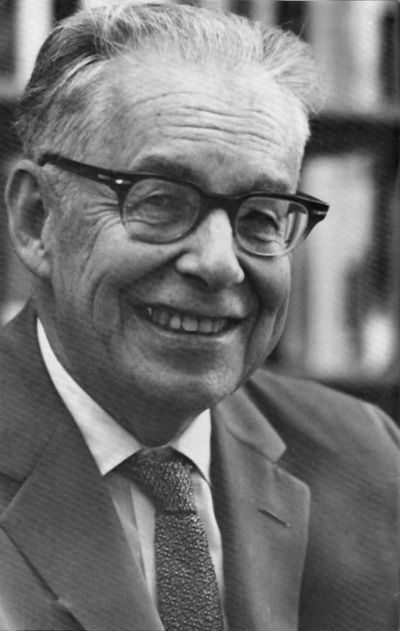
Charles Richter didn’t just study earthquakes. He invented the language used to describe them.
Born in 1900 on a farm near Hamilton, Ohio, he traded rural life for the seismic risks of California. His mother moved the family to Los Angeles in 1916. The young Richter bounced around higher education, hitting the University of Southern California before landing at Stanford for his undergraduate degree. He finished strong at the California Institute of Technology (Caltech), earning his Ph.D. in 1928.
By then, the ground beneath him was already a professional obsession.
He joined the Seismological Laboratory of the Carnegie Institution in Pasadena. It was a hub for serious science. He stayed there until 1936, then moved his focus to Caltech. There, he taught physics and seismology while continuing his research at the newly founded Seismological Laboratory. He remained there for decades, shaping the field until his retirement in 1970.
The big break came in 1935.
Richter wasn’t working alone. He teamed up with Beno Gutenberg, a German-born professor also at Caltech. Together, they needed a way to quantify the chaos. Existing methods were messy. The Mercalli scale relied on human reports—how badly a building fell, whether people felt it. It was subjective. It didn’t work well for distant quakes or direct comparisons.
Richter and Gutenberg looked at the machines.
They used instrumental recordings of ground motion to create a numerical scale. It was quantitative. It was consistent. It measured the actual energy released. They called it the magnitude scale. History would attach Richter’s name to it. He would become the face of earthquake measurement, even though the collaboration was truly shared.
This new scale did more than just rank shaking. It allowed seismologists to map quake-prone areas across the United States with precision. It turned a terrifying natural event into data that could be managed, studied, and understood.
Richter was pragmatic about the limits of science. He mapped the risks. He quantified the power. But he was skeptical about prediction. He openly disparaged attempts to forecast exactly when and where the next big one would hit. The earth doesn’t keep a schedule.
His academic output was substantial. He co-authored Seismicity of Earth and Associated Phenomena in 1949. Then came Elementary Seismology in 1958. Both became standard references. He even penned the entry on “Earthquakes” for the 15th edition of the Encyclopædia Britannica, published in 1974.
He died in Pasadena on September 30, 1985.
The scale remains. It’s embedded in our culture now. A magnitude 7.0 isn’t just a number on a graph. It’s a warning. It’s a measure of force. Richter gave us the tool to understand the violent pulses of the planet. We still use it every time the ground moves.
Does knowing the magnitude help us survive? Maybe not directly. But it helps us prepare. And that has to count for something.