



As the winter of 2026 drew to a close, southern Alaska experienced a dramatic meteorological finale. Far from a quiet transition into spring, the region was gripped by a burst of cold air, heavy snowfall, and turbulent atmospheric conditions that created some of the most striking weather imagery captured from space.
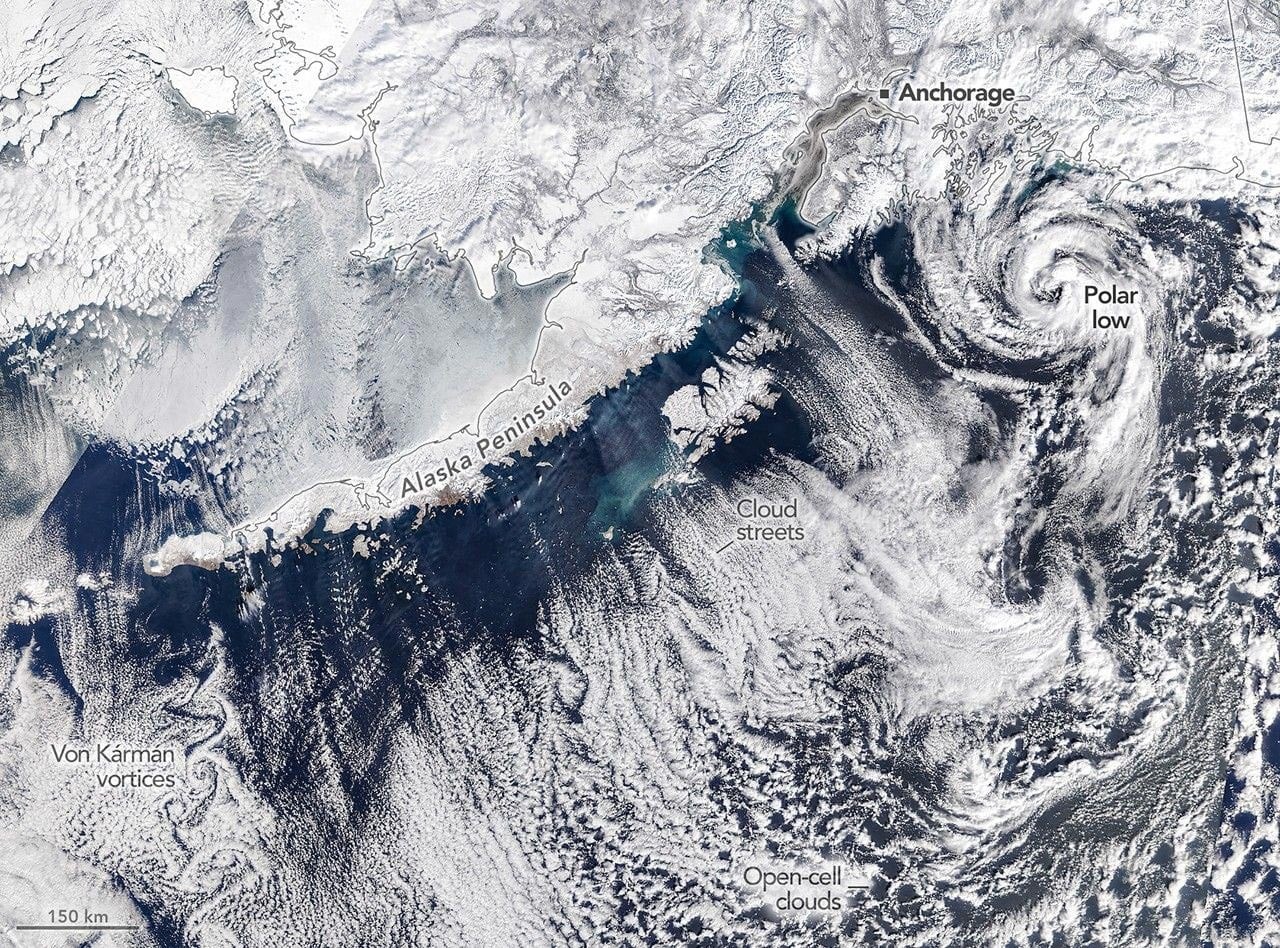
On March 19, 2026—the final day of astronomical winter—a NASA satellite recorded a complex dance of cloud formations over the Gulf of Alaska. These visuals offer more than just aesthetic appeal; they reveal the intense energy exchange between frigid Arctic air and relatively warm ocean waters, a dynamic that drives the region’s volatile weather patterns.
The Mechanics of Cloud Streets
The primary driver of this activity was a clash of pressure systems. According to a NOAA weather briefing, an area of low pressure over the Gulf of Alaska interacted with high pressure situated across eastern Russia and northern Alaska. This configuration funneled dry, frigid air from the Arctic southeastward across the Alaska Peninsula.
As this cold air mass traveled over the comparatively warmer ocean surface, it began to absorb heat and moisture. This thermal exchange triggered the formation of cloud streets —long, parallel rows of clouds aligned with the wind direction.
- How they form: Warmer, moist air rises and condenses into clouds, while cooler air sinks nearby. This creates alternating bands of cloud cover and clear sky.
- Location matters: These formations did not appear immediately near the coast. The air required time over the open water to gather sufficient warmth and moisture. Consequently, areas closest to the shoreline remained largely cloud-free, often obscured instead by hazy stratus clouds or sea fog.
Farther out in the gulf, these initial cloud streets evolved into open-cell clouds, characterized by delicate, ring-like structures surrounding clear spaces.
Vortex Streets and Polar Lows
Beyond the linear cloud streets, the satellite imagery revealed two other distinct and powerful weather phenomena.
Von Kármán Vortex Streets
Near Unimak Island, the easternmost of the Aleutian Islands, observers noted a series of staggered, counter-rotating swirls. Known as von Kármán vortex streets, these patterns formed in the “lee” (downwind side) of the island. They occur when strong winds are forced to flow around elevated terrain rising from the ocean, creating a wake of rotating eddies similar to the ripples behind a rock in a stream.
A Rare Polar Low
Perhaps the most dramatic feature was a massive cloud vortex located approximately 180 miles (300 kilometers) southwest of Anchorage. Meteorologist Matthew Cappucci identified this system as a polar low —a compact, intense cyclone that forms when cold polar air moves over warmer water.
This particular storm was exceptionally powerful:
* It generated winds reaching tropical storm force.
* It produced both snow and thunderstorms around its center, a phenomenon sometimes referred to as “thundersnow.”
A Pattern of Persistence
The dramatic conditions observed on March 19 were not an isolated event but part of a broader, persistent weather pattern that plagued Alaska throughout the month. The state endured ongoing cold temperatures and repeated storm systems.
Although temperatures began to rise by late April, the unsettled atmosphere showed no signs of stabilizing. Forecasts indicated that an approaching atmospheric river would bring additional wet weather to Southcentral and Southeast Alaska, suggesting that the region’s transition to spring would remain turbulent.
Key Insight: The imagery captured by NASA’s MODIS instrument highlights the critical role of ocean-atmosphere interactions in shaping regional weather. When cold air meets warm water, the resulting energy release can fuel everything from organized cloud streets to violent polar lows.
The winter of 2026 concluded not with a whimper, but with a roar of atmospheric activity. As Alaska navigated its transition into spring, the interplay between Arctic air and ocean warmth continued to drive significant weather events, underscoring the region’s unique and volatile climate dynamics.