


Look at a photograph. It captures a moment. A frozen instant. Your wedding day. The sunset. The snapshot assumes that every photon hitting the sensor left the subject at the exact same time. It’s a comforting lie. Sort of.
Reality is messier. Even in a normal picture, the light from the person on the left started its journey a split second earlier than the light from the person on right. But we ignore this. We don’t think about it. Why? Because the speed of light is insanely fast. The delay is negligible. The image is a single “now.”
Black holes ruin that logic.
There, spacetime is so warped that “now” doesn’t exist as a uniform layer. A single image from a black hole combines light that left at different times. Some photons took the direct route. Others looped around the abyss for who knows how long before hitting your detector. The image is a collage of past and present. A time capsule.
Daniel Rojas-Paternina and Alejandro Cárdenas-Avenado have been thinking about this. Their paper, soon in Physical Review D, sorts out the mess. They tell us when those hidden time differences matter and when we can just ignore them.
“A useful starting point is an ordinary photograph… But because the speed of light is large, we normally treat the photo as a record of one instant.”
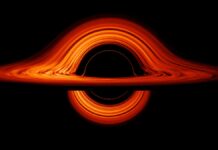
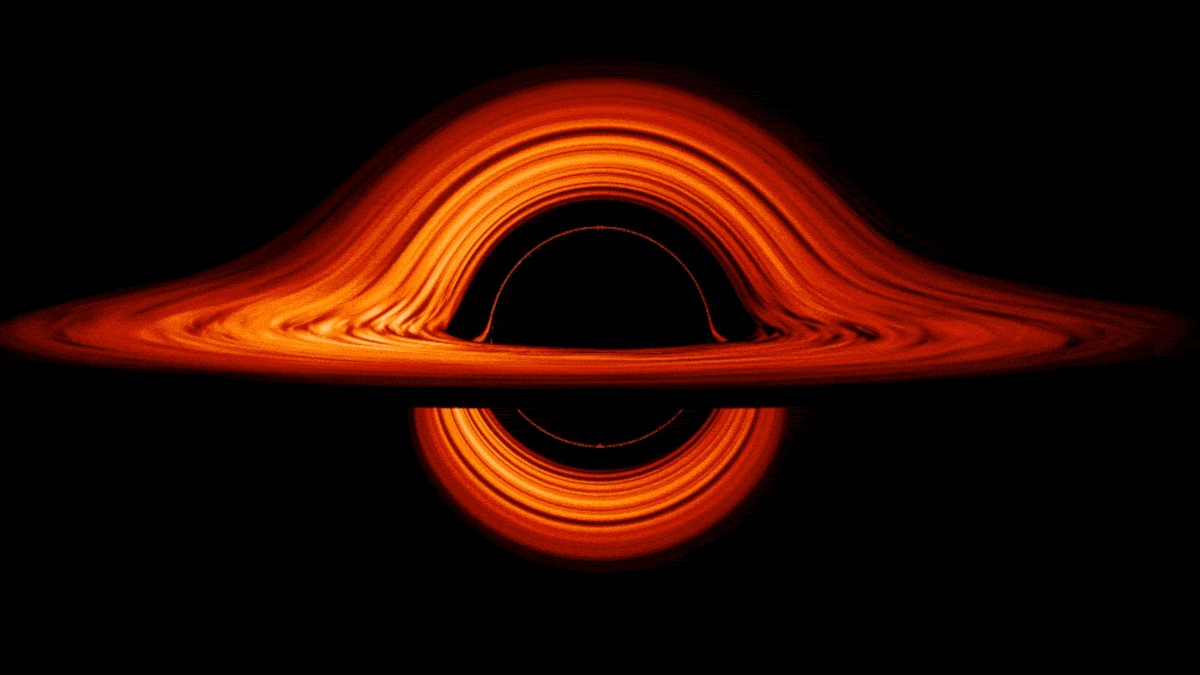
Let’s be clear. We have imaged two black holes so far. M87. Sgr A. Neither image shows the black hole itself. You see a shadow. A hole in the universe. Around it is an orange glow. Superheated gas. An accretion disk spinning out of control. It’s bright. It’s loud. It screams from millions of light-years away
To model this, physicists use two approaches.
First: the Fast-Light model.
It treats the black hole image like a dog photo. Snap. Done. You pretend every photon arrived from the same instant. You take one snapshot of the gas. You image it. You move to the next. It is fast. It is cheap computationally. It is lazy. But is it wrong? Not necessarily. If the gas is steady, it works fine.
Then: the Slow-Light model.
This keeps the delays. It accounts for the photon that circled the event horizon twice while another zipped straight to Earth. It says: This pixel is from Tuesday. That pixel is from Thursday. The problem? It is a nightmare for computers. Calculating the time-delay map for every single pixel costs a fortune in processing power. One image frame requires thousands of snapshots of the flow.
Which should you use?
It depends on the chaos.
If the gas around the black hole is calm, the Fast-Light approximation holds. The scene hasn’t changed much since the last photon left. It’s all the same soup. But what if the gas is flickering? Violent eddies? Bright flares exploding in a millisecond? Then the time difference becomes critical. You are comparing yesterday’s quiet with today’s boom in the same frame.
The physics boils down to a race.
Two clocks tick. One measures how fast the gas changes. The other measures the spread in travel time for the photons.
Rojas-Paternina and Cárdenas-Avendo found a middle path. They call it Brisk-Light.
It isn’t fully Fast. It isn’t fully Slow. It keeps the dominant time-delay structures—the big loops and bends—but trims the computational fat. It approaches the accuracy of Slow-Light without requiring supercomputer days. A compromise. A hack that actually works.
So do we need to scrap the iconic Event Horizon Telescope images?
No.
We got lucky with the angles. M87 and Sgr A were viewed such that the Fast-Light model was close enough. The timing errors were hidden by the geometry.
The real test is coming.
Next-gen observatories, like the proposed Black Hole Explorer, want to look at the photon rings. These are narrow bands of light shaped not by the gas, but by spacetime itself. Photons orbiting the hole before escaping.
Here, timing is everything. The ring is made of ghosts. Light emitted at different moments, taking different paths. A movie of a black hole isn’t just a video. It’s stranger. Each frame blends history.
“A black-hole movie is stranger than anordinary movie.”
The Event Horizon Telescope is trying to make that movie now. We are still blurry. Still grainy. But we are closer to seeing the engine turn than ever before.
When the frames finally align, we won’t just be seeing light. We will be looking back. Not just through space. But through time.
The paper is pending in Physical Review D. You can read the preprint on arXiv if you like.