



Astronomers using the Atacama Large Millimeter/submillimeter Array (ALMA) have uncovered evidence that the interstellar comet 3I/ATLAS originated in a region of the Milky Way far colder than our own solar system. By analyzing the chemical composition of this “interstellar invader,” scientists have gained a rare glimpse into the vastly different environmental conditions present in other parts of our galaxy.
The Chemical Fingerprint of Deep Space
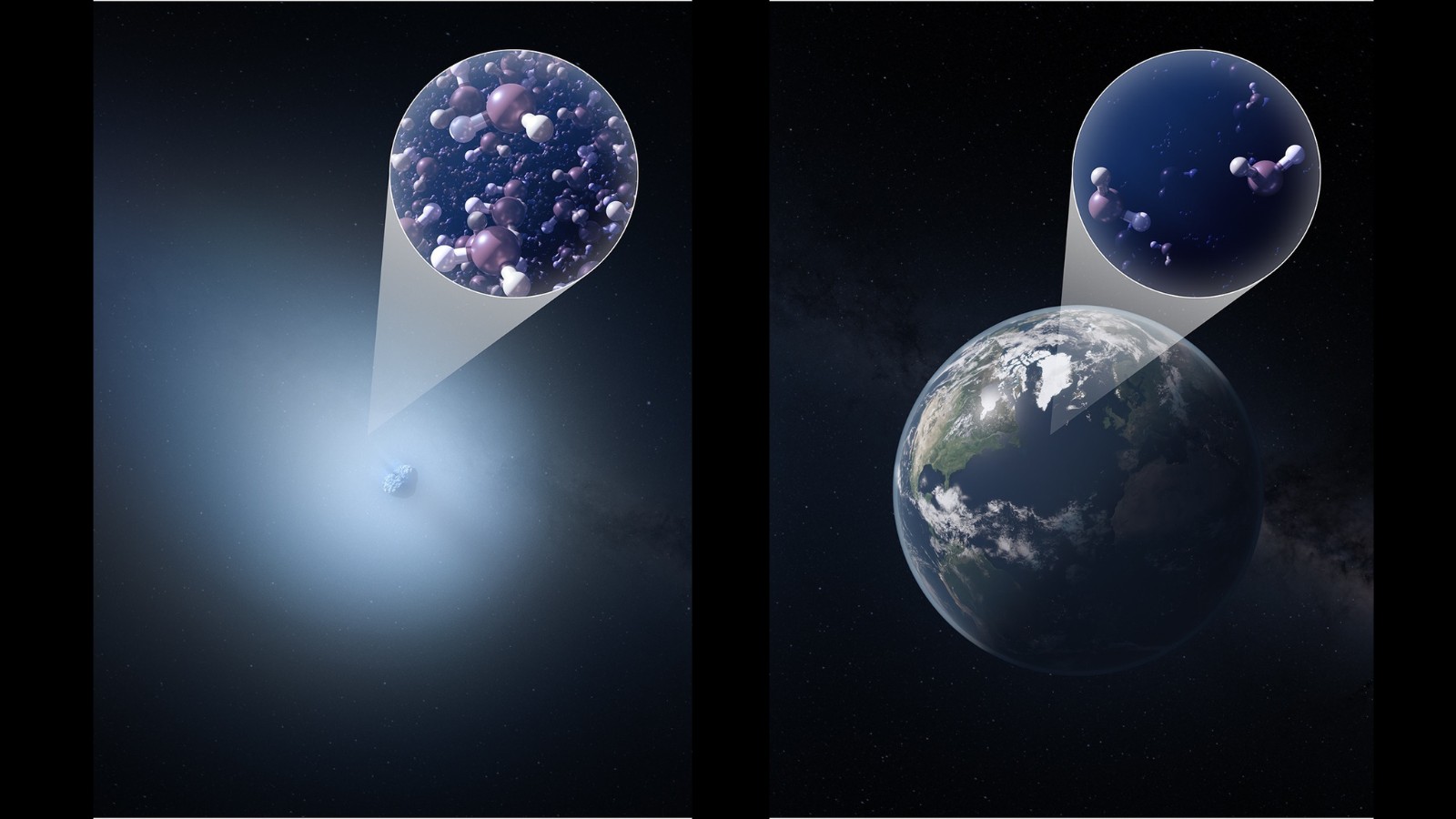
The breakthrough came through the measurement of deuterated water (often called “semi-heavy water”). While standard water consists of two hydrogen atoms and one oxygen atom, deuterated water replaces one hydrogen atom with deuterium —a heavier isotope containing both a proton and a neutron.
The ratio of these isotopes acts as a cosmic thermometer. Because the chemical processes that increase the concentration of deuterated water are highly sensitive to temperature, the levels found in a comet serve as a permanent record of its birthplace.
The findings for 3I/ATLAS are striking:
– It contains 30 times more deuterated water than comets originating in our solar system.
– This ratio is 40 times higher than the ratio found in Earth’s oceans.
– Such high concentrations require environments colder than 30 Kelvin (approximately -406°F or -243°C ).
Why This Matters: Comparing Solar Systems
This discovery is significant because it challenges the idea that planetary systems evolve under uniform conditions.
In our solar system, comets are often described as “dirty snowballs.” Their water content provides a chemical archive of the environment present 4.6 billion years ago during the birth of our Sun and planets. However, the data from 3I/ATLAS suggests that the “recipe” for planetary systems varies wildly depending on their location in the galaxy.
“Our new observations show that the conditions that led to the formation of our solar system are much different from how planetary systems evolved in different parts of our galaxy,” noted Luis E. Salazar Manzano, team leader at the University of Michigan.
Technical Mastery: Observing Near the Sun
Detecting these chemical signatures was a significant technical challenge. To capture this data, the team studied 3I/ATLAS as it reached its perihelion (its closest point to the Sun).
While traditional optical telescopes are blinded by the intense glare of sunlight, ALMA’s 66 radio antennas possess the unique capability to point toward the Sun. This allowed researchers to observe the comet at its most critical phase without the interference that typically hampers space observation.
A Cosmic Record of the Big Bang
Beyond identifying the comet’s home temperature, the study of deuterium is fundamental to understanding the universe itself. The abundance of deuterium and hydrogen is believed to have been established during the Big Bang. By studying how these elements are distributed and utilized in different star systems, scientists can better map the chemical evolution of the Milky Way from the dawn of time to the present.
Conclusion
The extreme chemical signature of 3I/ATLAS proves that our solar system is not a universal blueprint, but rather one of many diverse environments in a galaxy where planetary formation can occur in much more extreme, frigid conditions.