


While artificial intelligence has long dominated virtual arenas—conquering games like Chess, Go, and StarCraft II—the transition from digital logic to physical movement has remained a massive hurdle. Moving a digital cursor is one thing; moving a mechanical arm to intercept a spinning ball in milliseconds is another entirely.
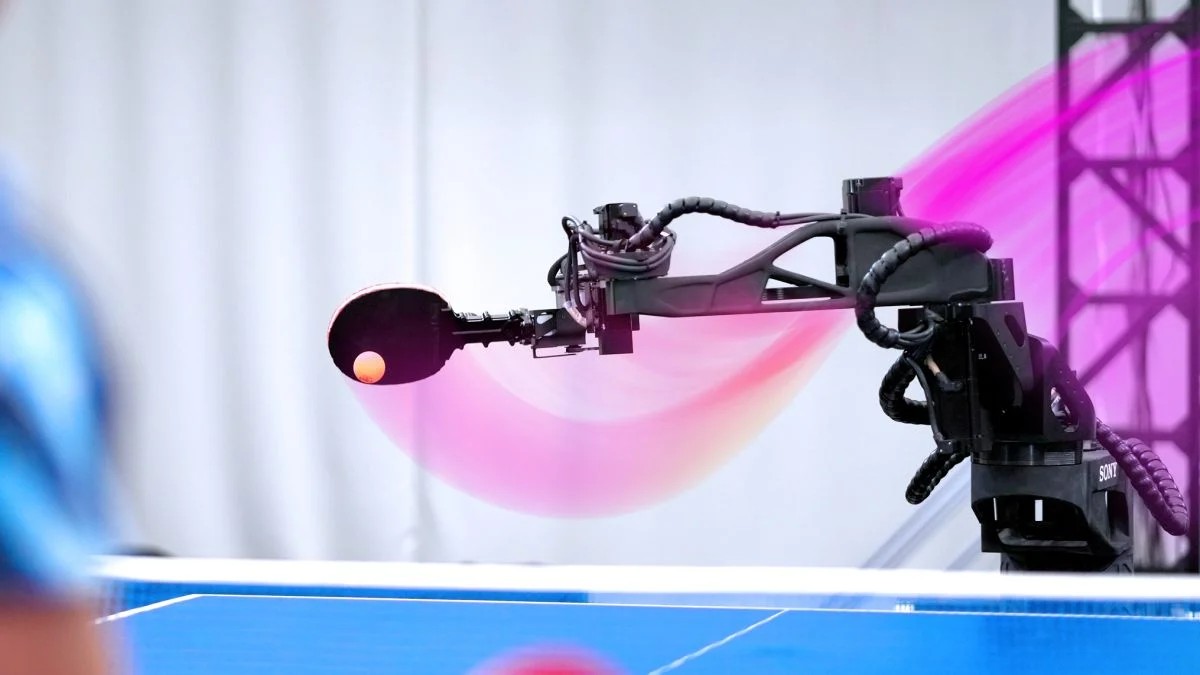
Sony AI has now bridged this gap with Ace, a robotic system capable of competing against high-level human table tennis players. This isn’t just a win for sports enthusiasts; it is a landmark achievement in physical AI, proving that machines can now perceive, reason, and react to the unpredictable chaos of the real world.
The Challenge of the “Meatspace”
In a computer simulation, every variable is defined. In the “meatspace”—the physical world—variables are infinite and unpredictable. To succeed at table tennis, a robot cannot simply follow a pre-programmed script. It must master three distinct, high-speed disciplines simultaneously:
- Advanced Perception: Ace uses a vision system capable of tracking the ball and, crucially, detecting its spin. In table tennis, spin dictates the ball’s trajectory and bounce; without mastering this, a robot is essentially playing blind.
- Deep Reinforcement Learning: Rather than being told how to play, Ace’s “brain” was trained through millions of simulated trials. By learning through trial and error, the AI developed the ability to make autonomous, real-time tactical decisions.
- High-Speed Actuation: The AI’s decisions are executed by an agile, eight-jointed robotic arm designed for extreme precision and rapid movement.
Performance: Elite Amateurs vs. Professionals
To test its limits, Sony AI pitted Ace against various tiers of human skill. The results highlight the robot’s current capabilities and its remaining frontiers:
- Against Elite Amateurs: (Players practicing ~20 hours/week for over a decade). Ace proved highly competitive, winning three out of five matches in a best-of-five series.
- Against Professionals: (Japanese league players). The gap remains wider here. Ace won only one game out of seven, losing both matches played against these top-tier athletes.
Why the difference? Analysis suggests Ace’s strength lies in control rather than raw power. The robot successfully returned 75% of spinning balls, a feat that baffled human observers. It didn’t necessarily overpower its opponents; it outmaneuvered them by mastering the physics of spin that often trip up human players.
Why This Matters: The Future of Physical AI
The implications of Ace extend far beyond the ping-pong table. As Sony AI Chief Scientist Peter Stone notes, this is a “landmark moment” for the industry.
The ability to combine high-speed sensing with real-time decision-making is the “holy grail” for robotics. If an AI can master the split-second, high-precision demands of a table tennis match, that same technology can be applied to:
* Precision Manufacturing: Robots that adapt to moving parts on an assembly line.
* Assisted Surgery: Systems that can react to the subtle, real-time movements of human tissue.
* Emergency Response: Drones or robots capable of navigating unpredictable, fast-changing environments like disaster zones.
Even more intriguing is the potential for human enhancement. Former Olympian Kinjiro Nakamura noted that Ace performed shots previously thought impossible, suggesting that these machines might eventually help humans discover entirely new techniques and physical capabilities.
“This research has shown that an autonomous robot can, in fact, win at a competitive sport, matching or exceeding the reaction time and decision making of humans in a physical space.” — Peter Dürr, Director of Sony AI in Zürich
Conclusion
Ace represents a fundamental shift in AI development, moving intelligence out of the computer and into the physical world. While it has yet to reach the absolute pinnacle of professional human play, it has proven that machines can now navigate the complex, high-speed realities of physical interaction.