

We didn’t even know this puzzle existed until just now. Two worlds. One near Saturn. The other hiding at the edge of everything we map. They are lightyears apart in spirit and scale but share a ghost. A chemical signature neither can shake off.
The unknown molecule appears on both Titan and Pluto. It is strong. It is consistent. And we have no idea what it is.
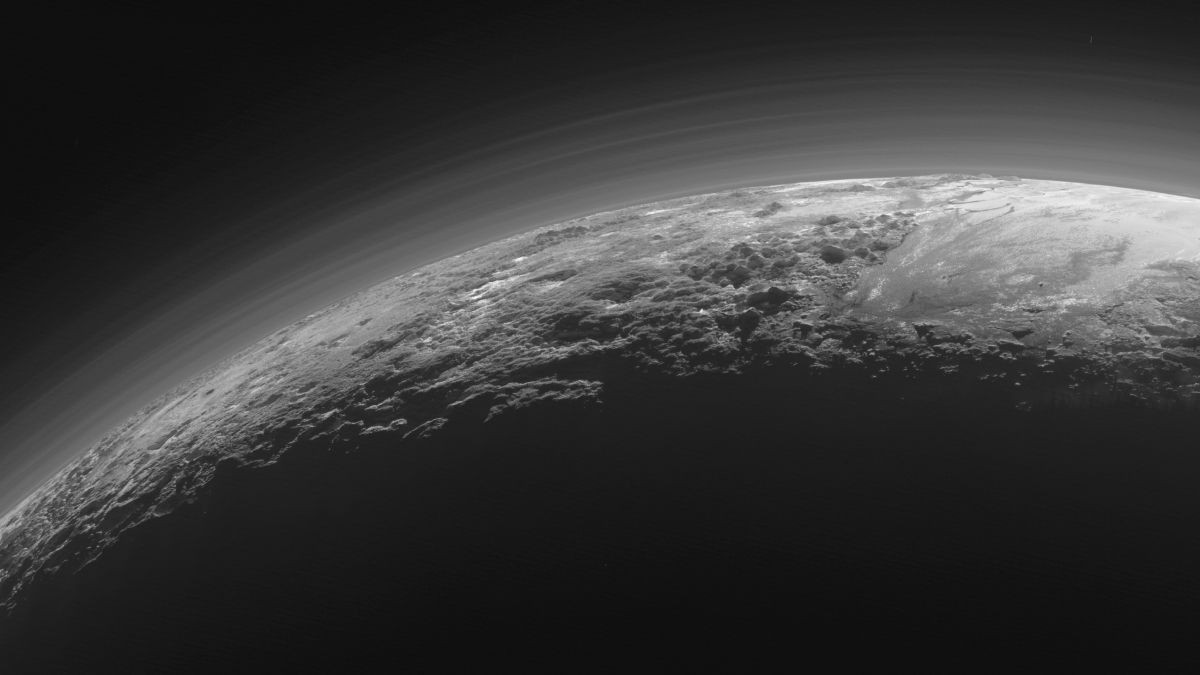
Titan is messy. A moon of Saturn wrapped in haze, with lakes of liquid methane and a crust made of water ice. It rains organic soup there. Seasons turn. Then you have Pluto. Frozen. Distant. Four times further from the Sun than Saturn is. Volcanoes that erupt ice instead of lava. A glittering desert at the bottom of the gravity well.
Different vibes. Similar chemistry. Both are choked with nitrogen and hydrocarbons. The Sun’s rays beat down, triggering reactions that thicken the air into a perpetual haze. Or at least, that was the theory until James Webb Space Telescope (JWST) decided to complicate things.
The Ghost In The Data
Bruno Bézard from France’s National Center for Scientific Research led a team that looked closer. Much closer. Their paper is sitting in Astronomy & Astrophysics right now. Available on arXiv for the curious.
Here’s the backstory. Titan was spotted by Christiaan Huygens back in 1655. We couldn’t see the ground though. The haze blocked everything until Gerard Kuiper sniffed out methane in 1944 even then, it was like staring through a frosted window.
Cassini changed that. The probe mapped dunes. Mountains. Rivers. It gave us geography. But chemistry? That stayed stubborn. This is frustrating because Titan should be a playground for prebiotic chemists. It has nitrogen. Methane. Rain. Sunlight. All the ingredients for the messy chemistry that might have birthed life on Earth. Or something like it.
So Bézard and crew booked time on JWST. The infrared giant. Good at piercing fog. Under the proposal “Titan Climate, Composition and Clouds,” they peered through the gloom.
The data came back. And it didn’t match anything in the book.
An absorption feature. A dark line in the spectrum where light gets eaten by a molecule. But which one? None of the knowns fit. Not really.
The kicker? It showed up in two different JWST instruments. If it were a glitch, the tools would likely disagree. They agreed. That means the signal is real. It’s there. It’s eating photons.
Same Mystery. Two Worlds.
Wait. It gets stranger.
In a completely different observation run, JWST looked at Pluto. Way out there in the cold dark.
Same feature. Thicker. Stronger.
That wasn’t expected. Titan and Pluto share a DNA of nitrogen and methane but everything else is different. The pressure. The temperature. The geology. They are siblings from different parents, so to speak. Yet here is the same fingerprint on both surfaces.
What creates that line in the light?
We don’t know yet. But it’s not atmospheric. It’s surface-based.
Bézard’s team ran it through the mill. Benzene? Close. Propadiene? Maybe. Ketene? Acetylene? All of them are almost right. All of them miss by just enough to say “nope, not definitely this one.”
So what’s left?
Perhaps we’re seeing known chemistry acting in unknown ways. Molecules don’t behave alone in nature. They clump. They mix. They shift.
A lab sample of a chemical absorbs light one way. That same chemical, frozen solid or mixed with dirt on an alien moon, might sing a slightly different note. A harmonic we haven’t cataloged.
The fact that it appears on two different worlds changes the game. It’s not a fluke on Titan. It’s a shared trait of cold, nitrogen-heavy worlds with methane breathing room. A universal whisper in the infrared spectrum.
Still Listening
We’re stuck with questions.
Where on Titan’s surface is it brightest? JWST might map it next. Maybe that helps narrow the suspect list. Maybe it doesn’t.
We’ll have to wait. NASA’s Dragonfly mission lands in the 2030s. It brings a mass spectrometer. It will go up close and smell the air. It might catch the culprit in the act.
Until then?
There is a shadow in the data. A faint, stubborn anomaly on Pluto and Titan. It hints that our understanding of complex organic chemistry is still shallow. That we are walking through a forest and only seeing the trunks.
The branches? We haven’t looked up enough yet.