16.5 million.
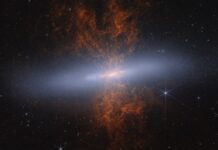
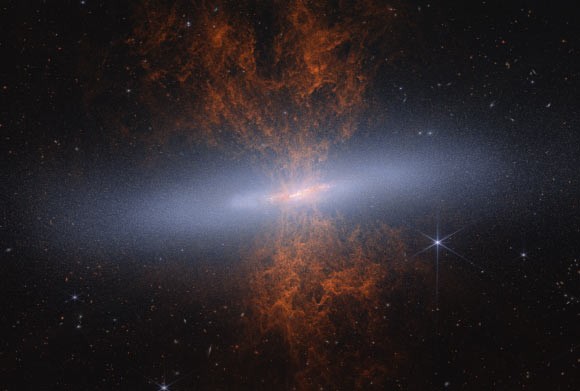
That’s how many stars the James Webb Space Telescope spotted in Messier 81… wait. M82. The Cigar Galaxy. It looks sideways from Earth, an edge-on spiral hiding in Ursa Major. It is about 12 million light-years distant. Discovered by Johann Elert Bode back in 1774.
It is not a tidy place.
“We don’t fully understand what’s happening here,” admits Dr. Adam Smercina. “Especially regarding its evolutionary history.”
It is beautiful, though. A messy, star-making factory. M82 births new stars at 10x the pace of our own Milky Way.
Why?
That is the question. Something triggered this burst. Something drove plumes of material screaming out from the galaxy’s core. It has been happening for a long time. Webb finally gave us a window into that chaos. No other nearby galaxy lets us look this closely at the machinery of evolution.
Counting the Granules
NIRCam saw what other eyes missed. It peeled back the dust. It revealed a distended disk.
Blue dots. Luminous, blue granules in the data.
“It’s a whole different world.” — Dr. Benjamin Williams
These dots add up to roughly 16.5 individual stellar sources. A small fraction of the whole, most of M82 remains too faint for even Webb’s mighty eyes. But those counted? They are fossils. They hold the record of how this galaxy formed. How it aged.
Eric Bell from Michigan notes the disk looks surprisingly quiet at first. Because Webb sees through the dust that obscures the visible spectrum.
But the complexity underneath is high. How did star formation move through the disk over the last billion years? Where did the fuel come from? The new image forces astronomers to rethink the timeline.
The Bipolar Explosion
All this birth creates noise. Violence.
The extreme star-formation rate disrupts itself. It blows the galaxy apart. Bipolar plumes eject material above and below the stellar disk. It looks like an hourglass.
Turbulent, yes. But layered.
The yellow tendrils closest to the disk are ionized gas. Hot. Agitated.
Further out? Orange material. These are dust grains. Polycyclic aromatic hydrocarbons, or PAHs.
PAHs help map the interstellar medium, the empty space between the stars where new stuff begins. They trace the debris of creation.
“One mission cannot fully answer the questions.” — Dr. Kristen McQuinn
We need more than just Webb.
We need Hubble data. We need archives from older telescopes. We need to marry the datasets. Only then does the ecosystem reveal itself. Only then can we ask harder, darker, more complex questions.
The picture is clearer. But the galaxy still resists a simple explanation.
What else is hiding in the blue granules?