
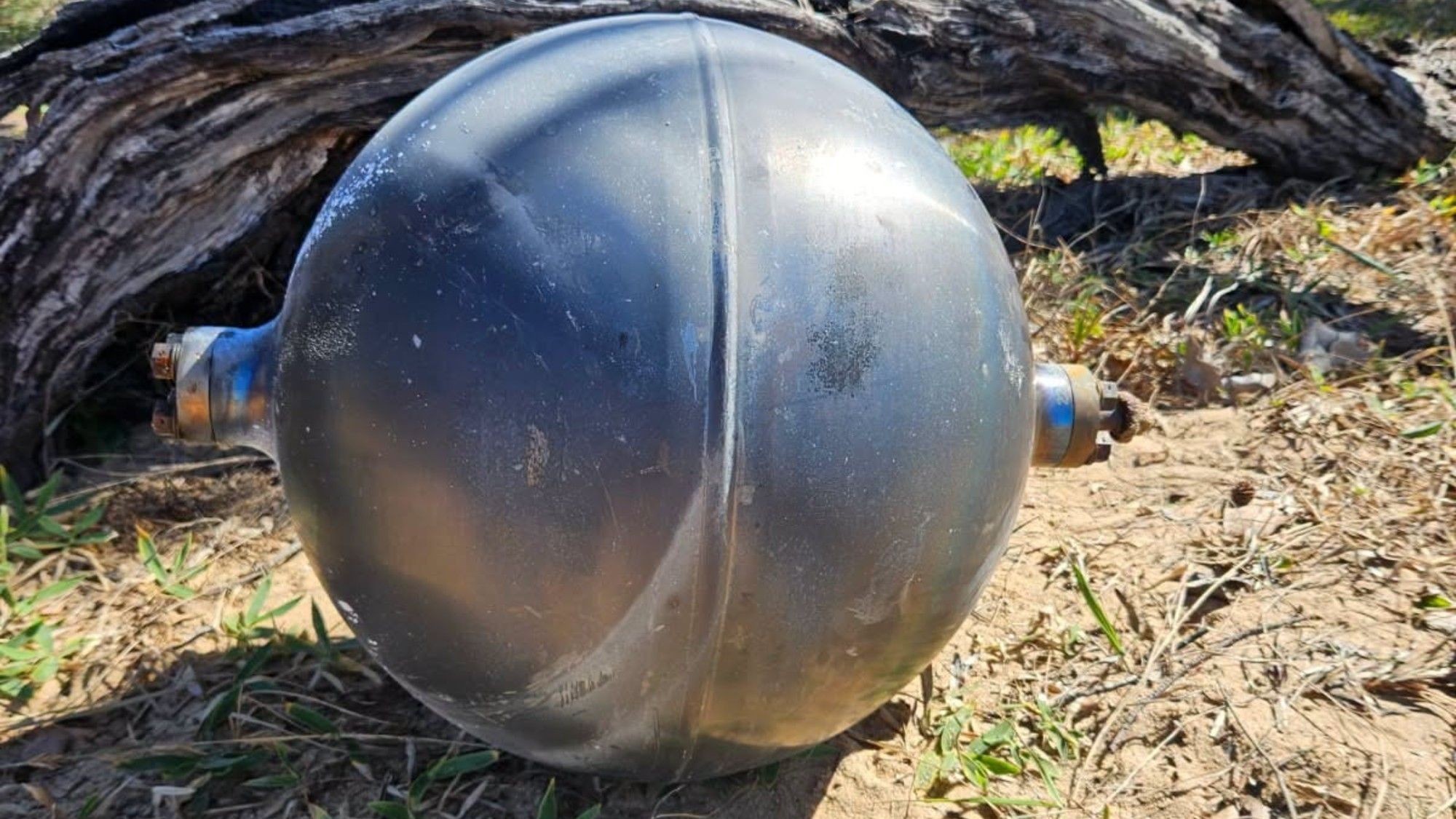
Forrest Beach. A quiet spot in Queensland. Until early July, that is. Then six metal spheres washed up on the shore. Or rather, were found near the coast by locals, then secured by emergency crews. The Australian Space Agency (ASA) stepped in quickly. They dubbed them “space balls.” And while they look like odd artifacts, experts say they are likely pressure vessels from a defunct rocket stage.
It’s a reminder that space is getting crowded, and falling debris is a persistent problem. Australia, it seems, is becoming a catch basin for orbital leftovers. This isn’t the first time. Skylab debris crashed here in 1979. A SpaceX Dragon trunk showed up in New South Wales in 2020. A piece from an Indian booster landed in Perth in 2023. Now, this latest batch of spheres adds another chapter to a strange legacy.
But what exactly are these objects? How do they survive reentry? And why does it matter?
Identifying Space Balls and Pressure Vessels
The initial reaction from the Australian Queensland Fire and Emergency Service was to cordon off the area. A 50-meter exclusion zone was established. Safety first. These objects, they noted, could be hazardous. You don’t just pick up metal from the sky.
Scientific teams secured the items. But the investigation is ongoing. So far, we know they are spherical. They are metallic. And they likely came from a launch vehicle. But pinpointing the exact rocket? That’s harder.
“Even if they heat up, they don’t care.”
That’s the refrain from Marlon Sorge, executive director at the Aerospace Corporation’s Center for Orbital and Entry Debris Studies (CORDS). He tells Space.com that materials like titanium are tough. Really tough.
“Very often they will be made of something really good at surviving,” Sorge says. “In spite of them being metal, they tending to decelerate more than a solid hunk of metal.”
Think of it this way. A jagged chunk of aluminum burns up or breaks apart. But a smooth, spherical tank? It can “float down” with a bit more grace. The shape matters. The material matters. And if it’s titanium? It laughs at friction heat. These vessels are designed to hold enormous pressure. Surviving the intense heat of reentry is almost a side effect.
How to Handle Suspicious Space Debris
Because these events are happening more often, the ASA has created a protocol. It’s simple, but strict. If you see something that looks like it fell from space:
- Don’t touch it. Seriously. It might be hazardous. The metals used in aerospace hardware are not always safe to handle. Leave it for professionals.
- Call the police. If there’s an immediate threat, call local authorities. If it’s just weird metal, hit up the Police Assistance Line for advice.
- Notify the Australian Space Agency. They have the technical expertise. They can talk to the foreign launch operators. They handle the legal side of things, including international treaty obligations.
And there are treaties involved. Under the Outer Space Treaty, countries are liable for damage caused by their space objects. If the debris is confirmed, Australia has a global duty to notify the launching state. In some cases, they might even have to send it back.
It’s messy. It’s diplomatic. It’s also a reminder that “space junk” has legal weight.
Why Titanium Tanks Survive Reentry
Why do we keep finding these specific objects?
It comes down to engineering. Pressure vessels are built to withstand high pressure. That makes them dense and robust. Composite Overwrapped Pressure Vessels, or COPVs, are common in space hardware. When they fall, they don’t break into confetti. They land as recognizable chunks.
Sorge points out that studying these recovered items gives data we can’t get from simulations. We learn about the temperatures they endured. We see what survived and what didn’t. It’s forensic science for the upper atmosphere.
But here’s the rub. We still don’t fully understand it all.
“The real challenge is that this is an area that we don’t completely understand,” Sorge admits. “We get surprises now and again… because we know only so much.”
We’re better than we were a decade ago. Proactive measures are being discussed. But the sky is still full of surprises.
Why Do Space Objects Land in Random Places?
It feels like bad luck. One month it’s Australia. The next, a farm in Canada. Or a field in Africa.
Michelle Hanlon, executive director of the University of Mississippi’s Center for Air and Space Law, says this is actually predictable. Physics. Not fate.
Objects in Low Earth Orbit (LEO) circle the planet constantly. The Earth rotates beneath them. When an uncontrolled reentry happens, the exact landing point shifts based on atmospheric drag. Small changes in air density at high altitudes can shift the impact zone by thousands of kilometers.
Since the Earth is mostly ocean, most debris splashes down in water. But when a tough object like a titanium tank survives the plunge? It might wash up on a beach. Or crash into a backyard.
“Every now and then, a tough piece survives,” Hanlon says. “And lands somewhere people can find it.”
Can We Identify Country of Origin?
Finding the debris is one thing. Figuring out who owns it is another.
Hanlon suggests that we already have better ways to trace objects than slapping a “Made in [Country]” label on them. Design. Serial numbers. Registration records. These things can often identify the launch vehicle. Plus, a label might melt during reentry anyway.
The bigger issue is traceability and information sharing.
“Can authorities quickly figure out what the object is? Which state should be contacted?” Hanlon asks. Better tracking and open data lines between space agencies would help far more than a physical stamp.
We are seeing more debris landings simply because we are launching more stuff. It’s a volume game. More launches mean more reentries. More chances for a survivor to slip through.
“More launches mean more chances that a particularly durable piece survives,” Hanlon notes.
The Bigger Picture of Space Responsibility
There is a solution to this, technically. Controlled reentries.
Sorge argues that rocket upper stages should be guided into the ocean. If they have to be deorbited, do it deliberately. Land them where no one lives. Or where no one is looking.
“Forget the random reentry,” Sorge says. “Bring them down via controlled reentry.”
But currently, we’re relying on luck. The Australian spheres? They were random drops. No control. Just gravity and aerodynamics taking over.
Hanlon sees a shift in mindset. Responsible space operations now include end-of-life disposal. It’s no longer just about launch. It’s about what happens when the mission ends.
“This is a sobering reminder that space activities don’t end when a mission does,” she says.
There’s a strange cultural echo to this, too. As these metal spheres wash up on Australian beaches, a new movie about space balls hits theaters. Coincidence? Maybe. Or just a reflection of a world that is increasingly aware of the clutter we’re leaving in the sky.
The debris is out there. It’s coming down. And we’re still learning how to catch it before it hits us.