



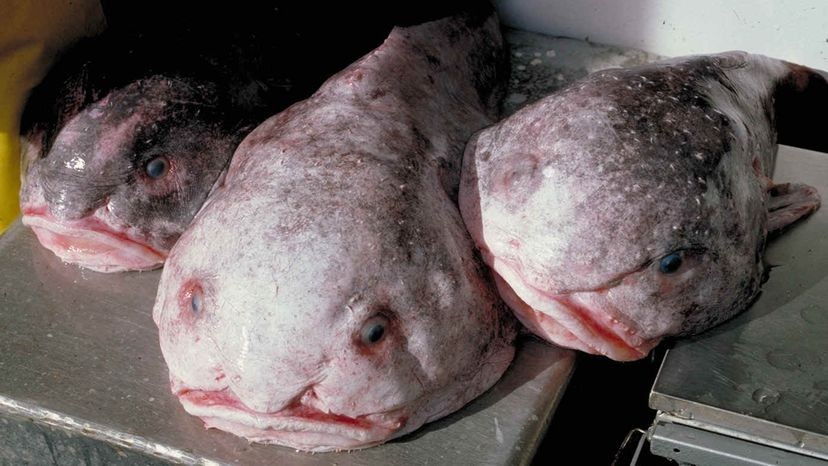
You would be furious if someone crowned you the ugliest person at work. It’s a humiliating title. Yet, the blobfish (Psychrolutes marcidus) didn’t mind being voted the World’s Ugliest Animal by The Ugly Animal Preservation Society in 2013. Why? Because it can’t speak English. It also lives 3,300 feet (1,000 meters) down off the coasts of Australia, Tasmania, and New Zealand, far away from internet comment sections.
The creature’s reputation began long before the award. In 2003, the NORFANZ deep-sea expedition dragged a large, pink blobfish up from the northwest coast of New Zealand. The fish had a parasitic copepod hanging from its mouth. It looked like the cartoon character Ziggy after a month-long binge. The crew dubbed it Mr. Blobby. They took a photo of the bulbous fish out of the water. That image went viral.
The Truth About Its “Ugly” Appearance
Part of the blobfish’s appeal lies in the uncanny valley. It looks almost human, but something is wrong. Here is the reality: we were never meant to see it like this.
“Blobfish are pretty ‘normal’-looking underwater,” says Gareth Fraser, a professor in the Department of Biology at the University of Florida. He studies the evolutionary development of marine fishes. “They only really become a blob when they transition from the pressure at depth to the surface. In my opinion they were awarded the ugliest animal status unjustly.”
The fish looks grotesque only because it has been pulled into an environment it cannot survive in physically.
Why Is the Blobfish So Blobby?
In its natural dark depths, the blobfish faces extreme pressure. It is about 120 times the amount we experience on dry land. Near the sea floor, it resembles a pufferfish with feathery pectoral fins.
It does not grow longer than 12 inches (30.5 centimeters). It has only enough muscle for short bursts of swimming. It has very little bone to give its body form. The bones are extremely thin and fragile compared to surface fish. Building strong bones takes too much energy in that environment.
The blobfish has quite a bit of fat. The jelly layer of flesh closest to the skin contains a ton of water. Pick one up by the tail and most of its innards slosh to the face like a water balloon.
Its physique is an adaptation. The pressure near the ocean floor maintains its form. In the air, nothing keeps the body from melting into a formless pink or yellowish blob.
Where Do Blobfish Breed?
Researchers rarely observe blobfish breeding. They believe female deep-sea fish arrange themselves in groups. They lay up to 100,000 eggs together in rocky pits along the seabed.
This allows male blobfish ample opportunity to fertilize the eggs. It also helps mothers protect the large brood as it develops.
How Do They Float Without a Swim Bladder?
The texture of blobfish flesh is unique. Lots of fish stay afloat using a gas-filled sac called a swim bladder. This allows them to adjust buoyancy. But in high pressures, a swim bladder would burst.
The blobfish found a workaround. Its flesh evolved into a buoyant, gelatinous mass. It is less dense than water. This keeps them cruising around in the bottom of the ocean. It is the depth at which they are most comfortable.
What Do Blobfish Eat?
Marine biologists know very little about the blobfish’s life history. It does not seem to move around much. They are not muscular. They are not ferocious predators.
Blobfish eat crustaceans like hermit crabs. They eat whatever floats into their mouths while they loom over the sea bed. Scientists have found brittle stars, sea pens, anemones, plastic bags, rocks, and octopus beaks in their bellies.
Octopus species are smart. Catching one requires special talent. For a blobfish, that talent is large, powerful jaws. They open extra wide and snap shut. They swallow large prey whole. Curious octopi should beware.
Are Blobfish Lonely?
Blobfish appear to be loners. Every blobfish ever spotted by researchers has been alone. Scientists know little about how they reproduce or how often they encounter others.
The scarcity of blobfish in their known habitat concerns some scientists. They might be caught in trawling nets. It is not likely. Those nets are vast, but not that big.
Rising ocean temperatures pose a bigger threat. Blobfish need to live in very deep, cold water or extreme latitudes.
You can buy stuffed blobfish. You can fill a bathtub with them for $649. Really.


