




A 59,000-year-old Neanderthal tooth discovered in Siberia reveals evidence of deliberate dental drilling, pushing back the earliest known instance of dentistry by approximately 45,000 years. This discovery challenges long-held assumptions about Neanderthal cognitive abilities, suggesting they possessed the causal reasoning necessary to diagnose and treat disease.
The finding indicates that these ancient humans were not merely reacting to pain but were executing a sophisticated, multi-stage medical procedure to alleviate suffering—a capability previously attributed only to Homo sapiens.
A Tooth That Tells a Story of Survival
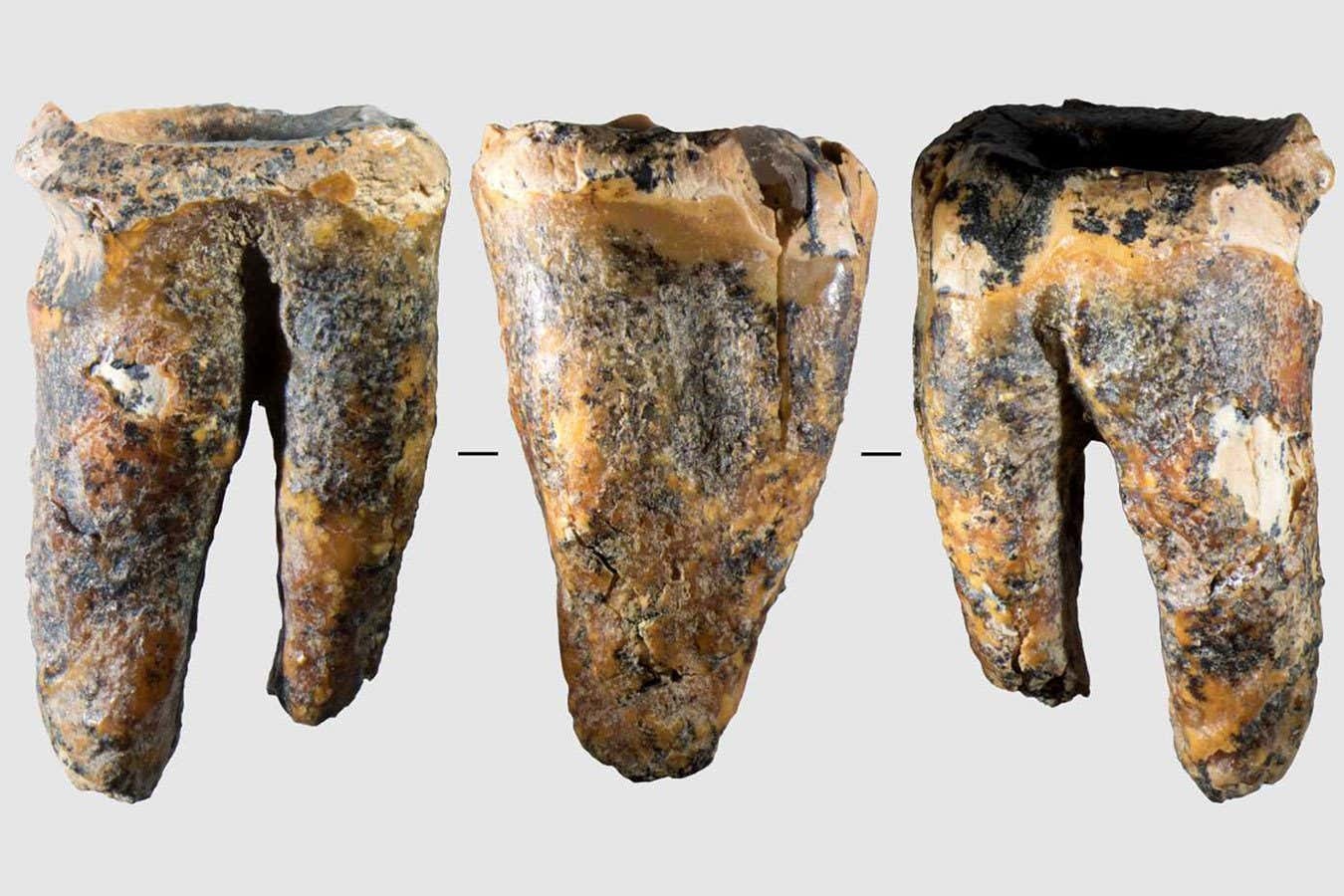
The artifact in question is a lower second molar recovered from a cave in the Altai Mountains of southwestern Siberia. At first glance, the tooth appeared damaged by natural decay or post-mortem breakage. However, closer inspection by researchers at the Russian Academy of Sciences revealed intricate marks consistent with deliberate stone-tool boring.
The cavity, likely caused by bacterial decay, shows three distinct stages of drilling that penetrated deep into the pulp chamber. The precision of the work suggests the operator knew exactly where to drill, how deep to go, and when to stop to avoid fracturing the tooth.
“Our discovery challenges prejudices about Neanderthal cognition directly, showing that they were capable of causal reasoning about disease,” says Kseniya Kolobova of the Russian Academy of Sciences. “We trust the evidence from our microscopes.”
Evidence of Skill, Not Accident
To distinguish between accidental damage and intentional treatment, the team employed advanced imaging and conducted experimental archaeology. They replicated the drilling process using fine-pointed jasper tools—similar to those found in the same cave—on modern and prehistoric Homo sapiens molars.
The experiments confirmed that creating such precise holes required significant skill and practice. The process took about 50 minutes and demanded a steady hand to prevent the tooth from shattering. The resulting marks on the Neanderthal tooth matched those created in the lab, ruling out natural erosion or post-mortem damage.
Key indicators of intentional treatment include:
* Rotational Marks: Traces showing the use of pointed stone tools rotating within the cavity.
* Polished Contours: The smooth, rounded edges of the hole suggest the individual continued to chew with the tooth for years after the procedure.
* Strategic Depth: The drilling reached the pulp chamber, likely aiming to remove infected tissue and relieve pressure.
Pain, Precision, and Proto-Dentistry
The procedure would have been excruciating. Genetic evidence suggests Neanderthals had a higher sensitivity to pain than modern humans. For the patient to endure such an invasive treatment without anesthesia implies either extraordinary stoicism, a very quick operator, or both.
Despite the pain, the treatment appears to have been functionally successful. By drilling into the pulp, the Neanderthal likely caused the nerve to die, providing immediate relief from the throbbing pain of the cavity. The individual survived the procedure and continued to use the tooth, as evidenced by wear patterns.
Stefano Benazzi from the University of Bologna notes that while the findings are convincing, they should be viewed with nuance. He suggests the term “proto-dentistry” may be more appropriate than advanced dental care, arguing that the intervention was likely a desperate attempt to scrape away painful infection rather than a refined medical practice.
“Regardless of who held the tool, the intervention demonstrates a remarkable level of cognitive and motor sophistication,” says Andrey Krivoshapkin. “This was not a fumbling first attempt.”
Why This Matters
This discovery fundamentally shifts our understanding of Neanderthal intelligence. Previously, the oldest evidence of purposeful dental work dated to 14,000 years ago in Italy, involving Homo sapiens who used scratching techniques rather than drilling.
The Siberian find proves that Neanderthals:
1. Understood Cause and Effect: They linked dental pain to physical decay and devised a mechanical solution.
2. Possessed Fine Motor Skills: They could manipulate delicate stone tools with precision on a hard, sensitive surface.
3. Engaged in Self-Care or Social Care: The treatment required a patient and an operator, suggesting social cooperation or advanced self-awareness.
Conclusion
The drilled Neanderthal tooth is more than a medical curiosity; it is a testament to the cognitive complexity of our ancient cousins. By performing invasive surgery to alleviate pain, these individuals demonstrated that the roots of human medicine and causal reasoning extend much deeper into our evolutionary past than previously believed. This finding forces a reevaluation of Neanderthals not as brutish predecessors, but as sophisticated beings capable of advanced problem-solving and healthcare.