



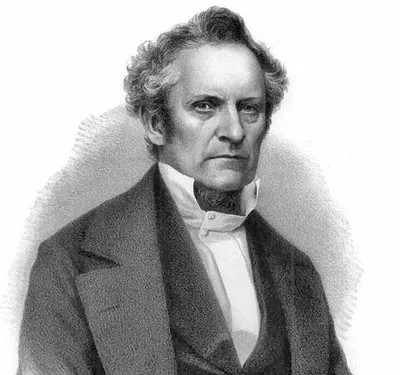
Julius Plücker was a German physicist and mathematician who changed the shape of geometry and physics. He was born in Elberfeld in 1801 and died in Bonn in 1868. He spent his career crossing borders. He studied at the universities of Heidelberg, Berlin, Paris and Bonn. His early work focused on analytic and projective geometry. But his real legacy is that his move into experimental physics laid the foundation for our understanding of electricity and light.
Rewrite the geometry rules
Plücker became a professor at the University of Bonn in 1829. Before that, he worked for four years as an unpaid lecturer. He published Analytisch-geometrische Entwicklungen between 1828 and 1831. This two-volume work introduced a flexible system of mathematical shorthand. More importantly, the basic building blocks of geometry are changed.
Most mathematicians at the time considered points to be basic elements. Plücker used lines as a basis. With this approach, he developed the dual principle of projective geometry. This principle says that if a statement is true, then its duality statement is also true. Duality is achieved by exchanging lines and dots and adjusting corresponding sentences. This is an elegant way to look at geometric relationships from different perspectives.
In 1834, he transferred to the University of Halle. Two years later he returned to Bonn. During this time, he wrote The Theory of Algebraic Curves in 1839. This book proposed what is now known as Plücker formulas. These formulas relate the number of singularities of an algebraic curve to the number of singularities of a dual curve. A singularity is the point where a function becomes undefined or infinite. His System of Analytical Geometry, published in 1835, also introduced linear functions as an alternative to standard coordinate systems. In 1846 he published Neuer Analytischer Behandlungsweise* in System der Geometrie des Raumes. This study provided a more complete and systematic version of his earlier work.
Look at physics
Plücker’s geometric works faced stiff competition. It opposed the strong current of the synthetic school of the Berlin mathematician Jakob Steiner. Steiner focused on synthetic geometry rather than analytical methods. Plücker sensed this resistance. He decided to abandon pure geometry and focus on physics.
This pivot is not a retreat. This is a strategic move that leads to great discoveries. In 1847, Plücker began to study the behavior of crystals in magnetic fields. The results he produced were very important in understanding magnetic phenomena. This research shows that magnetic fields can physically affect matter in measurable ways.
The birth of spectroscopy and cathode rays
Plücker did not operate in a vacuum. He started out alone, but later collaborated with the German physicist Johann W. Hittorf. Together they studied the magnetic deflection of cathode rays. This work is important. Before people knew what an electron was, they were observing particle beams.
Their experiments also greatly advanced the development of spectroscopy. Plucker and Hittorf’s important discoveries foreshadowed the later work of German chemist Robert Bunsen and German physicist Gustav Kirchhoff. Bunsen and Kirchhoff later reported that spectral lines are characteristic of all chemical substances. Plücker had already laid the foundations for this view.
In 1862, Plücker pointed out that the same element can have different spectra at different temperatures. This observation highlights the dynamic nature of atomic emissions. Hittorf said Plücker was the first to identify three lines in the hydrogen spectrum. These lines were identified in the spectrum of solar radiation only a few months after Plücker’s death in 1868. The relationship between Earth’s laboratory experiments and celestial bodies is finally becoming clear.
The last mathematical gesture
Steiner died in 1863. After the death of his rival, Plücker returned to mathematics. He did pioneering work in line geometry. The name of the book is “Neue Geometrie des Raumes gegenerung auf die Betrachtung der gerade Linie als Raumelement*”. Literally translated, it means “a new spatial geometry based on straight lines as spatial elements”.
He published the first volume in 1868, but died before the second volume was completed. His young and talented student Felix Klein supplied the rest of the materials and finished the work. Klein became one of the most influential mathematicians of the late 19th century. The completion of Plücker’s final work ensured that his geometric theory remained part of the academic canon.
Plücker’s career shows how different fields influence each other. The simplified notation he developed for geometry breathed new life into physics. The cathode rays he studied were the first glimpse of electrons. The spectral lines he drew explained the composition of the stars. He did not want to create the world of modern physics. He just followed the math, even if it led him into uncharted territory.