



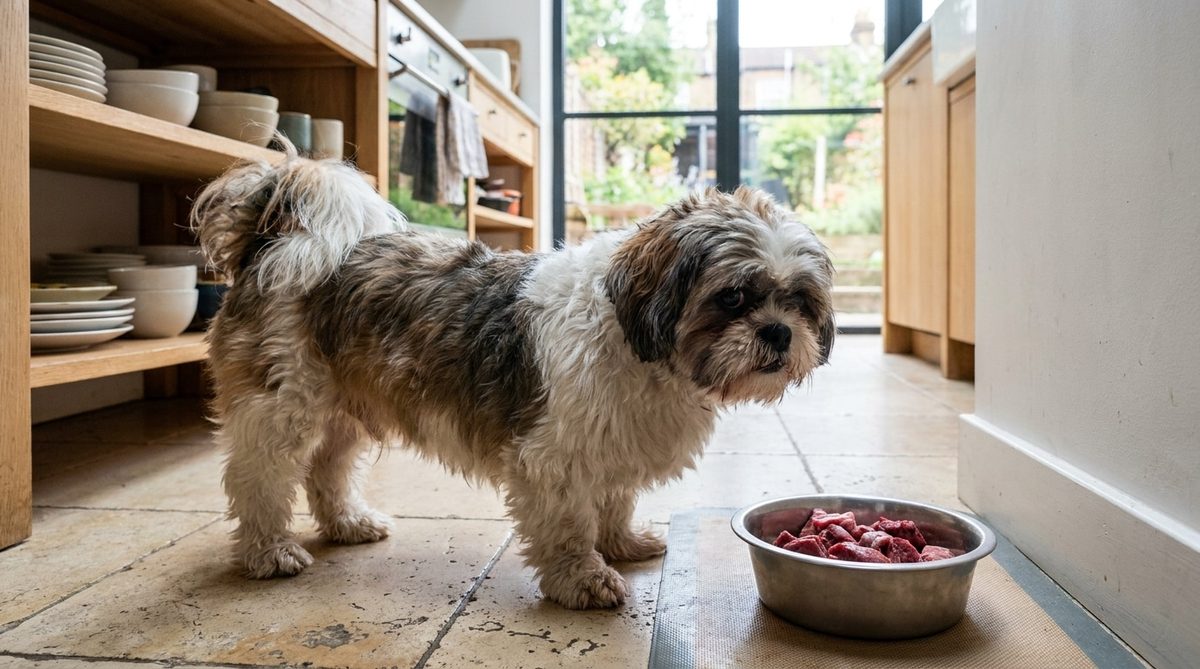
You thought you were giving your dog the purest diet possible by switching to the raw BARF (Biologically Appropriate Raw Food) regimen. In 2026, raw meat and homemade preparations are increasingly seducing demanding owners who are exhausted by the opacity of the agri-food industry. They are happy to see their companion devouring his meal with primitive enthusiasm. The image is beautiful, almost comforting.
However, if you slide the bottom of this shining bowl under the ruthless lens of a microscope, the organic reality immediately gives you cold sweats. Let’s untangle the real benefits of this quest for natural food and the invisible threats that lurk within it, in order to adjust your faithful friend’s menu with discernment.
The Pleasure of a Highly Appetizing Bowl
Just observe the scene once to be convinced: the dog facing a beautiful piece of raw meat reawakens deeply buried instincts. The palatability of this type of meal is undeniable, transforming the most capricious dog in front of a bowl of kibble into a formidable kitchen predator. This renewed interest in food flatters the owner’s ego, persuaded that he has finally deciphered the enigma of canine well-being.
Chewing on bony meat and shredding muscle tissues provide vital physical and mental exertion. It’s the thrill of the living room wolf, served every evening on a plate.
The Reassuring Power of Controlling Every Ingredient
Beyond the obvious joy of the animal, the great victory of raw feeding lies in transparency. The endless list of ingredients, dotted with unpronounceable names and mysterious preservatives, is swept away in favor of a minimalist approach. The owner carefully chooses the protein source, the quality of offal, the origin of the oil, or added vegetables. This total control of the composition brings invaluable peace of mind in the face of regular food scandals.
Controlling raw materials then becomes a true declaration of care for the animal.
The Invisible and Toxic Balancing Act Playing Out at the Bacterial Level
The Rapid Multiplication of Salmonella and Campylobacter in Your Kitchen
Nature is not just a green meadow; it is also a formidable culture broth. As temperatures slowly soften in our interiors this spring, a piece of raw turkey or beef left at room temperature quickly becomes an amusement park for microorganisms. The microscope does not lie: it reveals a frenetic proliferation of severe pathogens, with Salmonella and Campylobacter leading the pack.
These unwanted guests do not just multiply in the bowl. They spread to the worktop, the knife blade, the cutting board, and inevitably to the affectionate snout of the dog, which will then come to ask for caresses.
The Dangerous Illusion of a Complete Diet Hiding Severe Deficiencies
The other terrible trap of raw food snaps shut quietly, far from infectious concerns: it is that of nutritional imbalance. Assembling a few beautiful pieces of meat, some liver, and two grated carrots is more culinary poetry than dietetics. The dog is not a strict carnivore, and a bowl composed exclusively of good feelings quickly transforms into a gap of deficiencies.
The calcium-phosphorus ratio, essential for bone strength, is dramatically complex to stabilize without empirical knowledge. A haphazard menu, distributed over time, paves the way inexorably to serious joint, cardiac, or thyroid problems.
Strict hygiene protocols are non-negotiable for safe raw pet food
Switching to a raw diet in 2026 isn’t just a trend; it’s a biological shift that demands lab-grade cleanliness in your kitchen. You cannot treat raw dog food like leftover steak. The risk of cross-contamination is real, especially if you have kids or elderly family members with weaker immune systems. Seasonal changes make this even more critical.
The margin for error is zero.
You need a rigid routine. Here is what that looks like in practice:
- Dedicated cutting boards and knives. Never use the same blade for raw meat and your vegetables.
- Hot water and soap. Wash your hands thoroughly after every single interaction with the food.
- Sanitize surfaces. Every counter, every bowl, every spoon. After every meal.
- Safe thawing. Always in the bottom of the fridge. Never on the counter. Never under hot water.
These steps feel tedious. They are. But they are the only barrier between a healthy dog and a sick household. If you skip these, you aren’t feeding your pet. You are gambling with their health.
Veterinary-calculated rations prevent long-term nutritional gaps
Enthusiasm for natural diets often outpaces scientific knowledge. That is a dangerous gap. BARF diets can provide superior nutrients, but only if they are balanced. And balancing them is not intuitive.
You cannot eyeball calcium-to-phosphorus ratios. You cannot guess the right amount of taurine or zinc based on a blog post.
The only safe route is a ration formulated by a veterinarian specializing in nutrition. This is the single most important factor in making raw feeding viable. A vet calculates needs based on:
- Body weight and breed size
- Age and life stage
- Activity level and metabolic rate
This precision matters. A deficiency in amino acids or vitamins can cause irreversible damage over time. It happens slowly. You won’t see it in the first week. You will see it in the second year.
The cost of a natural diet is high
Feeding raw is not a casual choice. It is a commitment. It requires the same seriousness you apply to your own diet. Maybe even more.
You are looking at strict hygiene. You are looking at custom nutritional math. You are looking at a lifestyle change that demands discipline.
The reward is visible. Your dog’s coat shines. Their energy levels stabilize. Their digestive health improves. But this result is not guaranteed by goodwill. It is guaranteed by rigor.
Ask yourself this: Are you willing to treat your dog’s food with the same scrutiny as your own? Or is the convenience of kibble too hard to give up?
The answer determines whether this diet is a lifeline or a liability.