



Getting to Europa’s hidden ocean just got a whole lot harder.
Astrobiologists have dreamed of sampling its waters for decades. The subsurface ocean is the holy grail for finding life beyond Earth. New research suggests that bridge from surface to sea might be more of a wall than a highway.
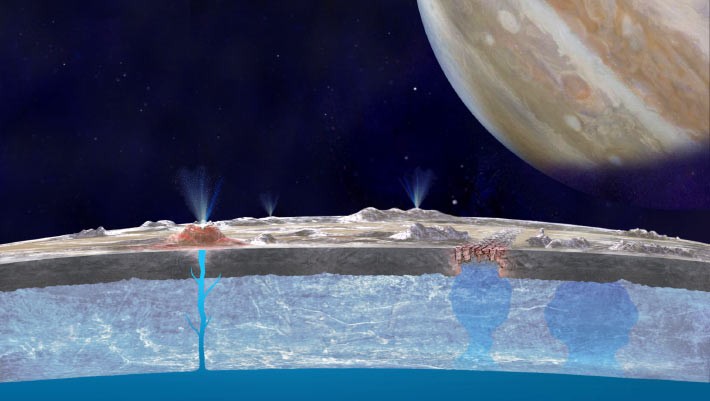
A team led by Rutgers University’s Lujendra Ojha ran simulations. They wanted to see if liquid water from Europa’s global deep ocean could rise through cracks and pool in shallow reservoirs.
Why does this matter?
Those shallow pockets would be easy targets for spacecraft. They are detectable. Accessible. The deep ocean sits tens of kilometers down. It is not. If the shallow water is just melted ice from the shell itself, it tells us nothing about the chemistry or habitability of the ocean below.
The study, published in Nature Astronomy, found a problem with that easy commute.
The Physics of Frozen Clogs
The researchers asked a simple question. Can water rise from the deep ocean to the surface without freezing first?
The answer is mostly no.
As liquid water shoots up through fractures in the ice shell, it doesn’t glide. It moves turbulently. It swirls. It churns against the freezing walls of the cracks. This agitation causes rapid heat loss.
The water supercools. It drops below its normal freezing point while still liquid.
Then comes the trap. Tiny ice crystals called frazil ice form. They clog the pathway.
The simulations showed narrow fractures sealing shut in hours. Even wide fractures would need to be unnaturally long or extremely numerous to move enough water upward to create the surface features scientists observe.
“The mystery we wanted to solve was whether this Journey is actually possible,” Dr. Ojja said.
It isn’t really. Not easily.
Earth Volcanoes Are a Bad Comparison
Planetary scientists often look to Earth for models. Cryovolcanism is frequently compared to terrestrial volcanism. Molten rock up versus water and ice up.
That comparison is flawed.
Ice and liquid water do not behave like lava. They are fundamentally different. They carry away heat too quickly. The physics that drive terrestrial volcanoes don’t map onto Europa’s icy crust.
“I think there’s some fundamental physics missing here,” Dr. Ojha noted. “And so I wanted to explore that.”
What This Means for Future Missions
If shallow liquid water does exist on Europa, it likely isn’t connected to the deep ocean. It probably forms locally as the shell melts.
This changes the game.
Shallow reservoirs cannot serve as a proxy for the deep ocean’s habitability. They are isolated. They are dead ends.
Europa’s ice shell is a stronger barrier between the ocean and surface than previously assumed. It blocks direct fluid exchange.
This reality forces a shift in strategy. Future missions need to interpret their findings differently. They need to understand that finding water on the surface doesn’t guarantee access to the ocean. Or even tell us much about it.
Where should we look for signs of life now? The path isn’t as direct as we hoped.