




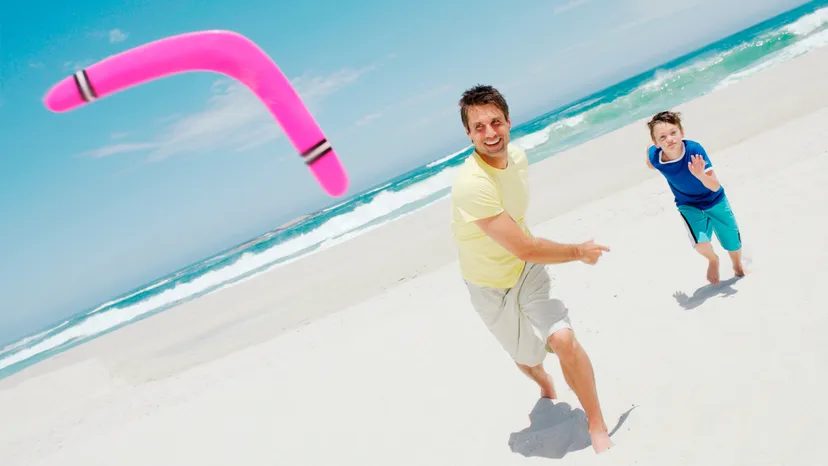
Boomerangs are likely the result of a long, messy process of trial and error. It wasn’t a sudden flash of inspiration. People fiddled with sticks until something worked. Most of us imagine a cartoon character dragging a piece of wood shaped like a banana. You throw it. It turns around. It hits another cartoon character on the head. It ends up back in the thrower’s hand.
It looks like magic. As children, we probably thought the stick was possessed. That wasn’t it. It was just physics. Complex physics.
We’re going to break down exactly how these things fly. Let’s look at aerodynamics. We figure out how to throw it properly so it doesn’t just hit a tree and break. And let’s get to the story. How are these things even invented? Boomeranging is a great mix of science and individual sport.
When people say “boomerang” they usually mean curved devices that come back at you. However, there are two main types. You have the returning boomerangs we all know. These are lightweight. Wood, plastic, sometimes other materials. Traditionally, they look like two wings joined at the hip. Banana shaped. Modern models vary. Some have three wings. Some have four. Most are 1-2 feet in diameter.
If you throw one correctly, it won’t go straight. It flies in a circular path. It completes the loop. It ends right where it started.
These returning boomerangs are useless for hunting. They cannot be aimed well. If you actually hit the target, the boomerang will no longer return. That defeats the whole point. It’s a design flaw if your goal is to grab dinner.
Returning boomerangs evolved from non-returning boomerangs. These are different. Harder. longer. Typically 3 feet wide or more. They lack the special wing design that creates lift and return. But their curved shape helps them cut through the air. They fly straight and fast.
These are powerful hunting weapons. You can aim them. They travel a good distance at high speed. There is also a battle boomerang. Basically a non-returning boomerang used in close combat. It’s a blunt instrument. Simply. Effective.
Why does it fly?
Why don’t boomerangs just fly away
Throw a straight stick of the same weight and size, and the physics are simple. It spins end-over-end. It cuts through the air in one direction. Then gravity wins and it falls.
But change this form? Suddenly it lingers. It curves. It will come back to your hand.
Why does a curved piece of wood resist a straight line?
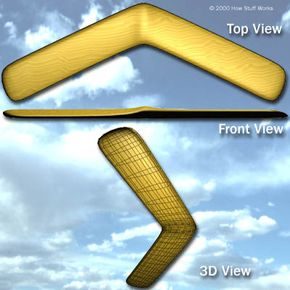
The difference starts with the structure. A stick is one unit. A boomerang is a system. It consists of at least two different, interconnected parts. This is not just aesthetic. It creates a central point around which the entire object rotates. This rotation stabilizes the flight. Without it, you’re just throwing a jagged branch. This puts you in control. Non-returning boomerangs use this stability to fly further and hit targets more accurately. They are basically better spears.
But the returning variety? This is a completely different animal.
Take the classic banana shape. It’s not just a curved stick. It’s two wings that are fused together to form a rigid frame. This geometry is the secret.
These wings are not flat. They are set at a specific tilt relative to the axis of rotation. More importantly, they have an airfoil. Round at the top. Flat bottom.
If you know how airplanes stay in the air, you’re halfway there. This shape forces air to flow faster across the curved top than along the flatter bottom. Faster air means lower pressure. Slower air means higher pressure.
The result is lift.
Greater pressure pushes from the bottom up. Less pressure pulling from the top down. The net force? Upward lift.
But here’s where things get weird. The boomerang spins. So one wing always moves forward with the rotation, while the other wing moves backward against the rotation. A forward moving wing produces more lift than a backward moving wing. This imbalance not only drives the boomerang upwards. It pushes it aside. Into a turn.
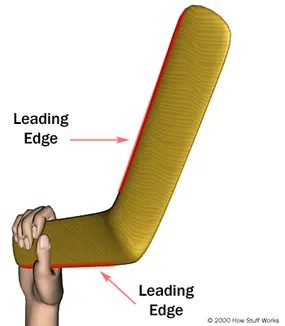
Think of the boomerang as an unattached propeller. Both blades are angled so that their leading edges point in the same direction, mimicking the blades of a standard propeller. In aviation, propellers rotate to generate propulsion power. This force acts on the central axis and allows the airplane or helicopter to move. A boomerang has no a physical axle attached to the vehicle. To move through the air, it relies solely on the lift created by its rotating wings.
Logic would suggest that it should behave like any other rotary wing. Throw it horizontally and it should fly upwards like a helicopter taking off. Throw it vertically and it should move straight left or right. That is not the case. The classic boomerang spins and returns to the thrower. Why?
Speed difference
The difference starts with how it is thrown. An airplane propeller spins while the vehicle is stationary. The boomerang is thrown forward as it spins. This adds two motions: rotation and translation.
Look at the spin. At any time, the wing at the top of the rotation moves in the same direction as the forward throw. The wing below moves against it. Both wings rotate at the same rotational speed, but the upper wing moves faster in the air. The lower wing moves more slowly relative to the air flow.
Faster airflow increases lift. The upper wing produces significantly more lift than the lower wing. Imagine someone pushing down on the top of a continuously rotating propeller. If you push a standing chair, it will crashes. Why doesn’t the boomerang fall?
Gyroscopic precession
This is where gyroscopes come into play. If you’ve studied how gyroscopes work, the answer is obvious. When you apply force to a point on a rotating object, the reaction occurs 90 degrees later in the direction of rotation.
Roll a bicycle wheel next to you. Press the top. The wheel won’t crashes. It turns sideways. The point you pressed will turn away as the force is continued. The effect is visible in the front of the wheel. This is called gyroscopic precession. The force is delayed.
In a bicycle, the force rotates arotation the rim. Eventually it hits the other side and canceling out the initial push. The wheel straightens up. However, with the boomerang, uneven lift creates constant pressure on the upper wing. This force doesn’t cancel out. It results in steady turn.
Arotation the corner
This shows how to steer a bicycle without handlebars. Tilt the wheel. The top of the wheel changes, but the wheel doesn’t fall off. It turns. the boomerang behaves the same way. The higher lift of the upper wing applies constant force. Due to precession, this force acts on the leading edge of the spin.
The boomerang leans on the curve. It won’t fall. It curves. The uneven lift leads to a constant change in direction. the boomerang moves in circles. It loops back. The physics is simple. The difference in airspeed creates lift. The spin converts that lift into a turn.
So when you throw that wooden bird, remember: you’re not just throwing a stick. You are launching a gyroscope. The air pushes on the fast wing. The spin moves that force by 90 degrees. The boomerang turns. It comes home.
Or at least, it tries to. If you throw it wrong, it will just crashes. But when it works, it’s a perfect loop of aerodynamics and angular momentum. The end result is rarely linear.
Return mechanisms
Gravity, lift, drag, wind and your own hand all fight for control as the boomerang leaves your hand. Five different forces determine its path. For this classic arc to close and bring the weapon back to you, these variables must align perfectly. You need a properly balanced tool and a technique that doesn’t suck. In the cartoons it looks easy – like you throw it and it obeys. In reality, consistent returns require serious practice. Before you buy a replica museum piece, you need to master the basics of how to throw a boomerang properly.
Start with the grip. Hold the boomerang at the end of the lower wing. Your fingers should pinch it lightly. The “elbow” or V point where the wings meet should be facing you. The flat side of the wing should face outwards. This setup assumes you are right-handed. If you hold it in your right hand, the curved edge is on the left. The leading edge of the upper wing points away from the body. Throw a right-handed boomerang with your left hand, and it probably won’t come back. It just goes away and stays gone.
Left-handers need a mirror image tool. Colorado Boomerangs, a major supplier, offers left-handed versions of their models. If you throw to the left, you will tilt the boomerang to the left. The curved side points to the right. The right-hand disk moves counter-clockwise. A left-handed one clockwise.
Wind is a variable that cannot be ignored. If you stand directly into it, the boomerang will be thrown off course. Aim for a position that is 45-50 degrees from the direction of the wind. Target the wind and then turn your body. Adjust the angle according to the strength of the wind. More wind means you can expect more drift.
Once your grip is firm and the stance is aimed, bring the boomerang back behind you. Snap it forward like a baseball pitch. The wrist snap is not negotiable. You need to impart significant must be given a significant rotation. Spin is the most critical factor when throwing a boomerang. Without it, there is no gyroscopic stability. No stability means no curved path. It just falls.
When a boomerang flies vertically, the uneven aerodynamic forces at the top of the spin tilt the axis downward. This causes the boomerang to return horizontally. It lies flat as it lands, it lays flat, like a frisbee. Do not try to catch it with one hand. Rotating blades will cut your fingers. Clap your hands to catch it. Always watch the boomerang. Heavy models have a lot of kinetic energy. If you lose sight of it, duck. Cover your head. Don’t try to guess where it is. It moves fast and hits hard.
Your first three throws will probably hit the ground. It’s normal. Don’t start with an expensive, hand-carved wooden model. Buy a cheap plastic model from a toy store. If you break it, you won’t cry. Boomeranging is a difficult skill. It takes patience. But when it finally works, when you see it arc back and catch it cleanly, it feels like magic.
The Origins of the boomerang
The boomerang is often associated with Australian Aboriginal culture, but it isn’t exclusive on the continent. The oldest known boomerangs were found in Poland , dating back 40,000 years.
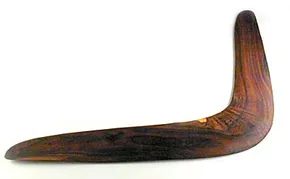
The accidental invention of the flying stick
It seems unlikely that early humans encountered the idea of a boomerang returning from nowhere. The physics involved are complex. But trial and error likely led to discoveries.
Let’s start with the non-returning version. Early hunters used clubs. Throwing the club is just an extension of the swing. But curved sticks? These behaved differently. Nature offers plenty of bent wood. When two branches are thrown, they stabilize the flight. It stayed in the air longer. It went where you wanted it to go.
Prehistoric people noticed this. They stopped using random sticks. They strive to find the perfect curve. Thinner, longer sticks work best. They tailor these tools for taking down prey. Archaeologists have found non-returning boomerangs around the world. The oldest known object found in Poland is about 20,000 years old.
Who Actually Invented the Returning Boomerang?
Experts debate the exact origin of the returning type. Most credit Australian Aborigines. In hunting, they used non-returning boomerangs, known as kylies.
At one point, an Aboriginal hunter threw a kylie with a specific curve. It flew in an arc. This might have been accidental. Or it could have been a deliberate design. One theory is that the hunter modeled the curve after the bird’s wings. The pronounced V-shape of the bird in flight inspired the new tool.
The return flight didn’t help much with hunting. It was harder to aim. But it was cool. So the aborigines perfected the design for fun. The boomerang became sports equipment. The goal? Throw it as far as possible and catch it when it comes back.
There was a hunting trick. The hunters set nets into the trees. They threw the boomerang in the air, imitating the call of a hawk. The noise and movement scared the birds into the nets.
More than just a toy
Boomerang is the first man-made flying machine. It precedes the airplane. Helicopter. Airship. Even the space shuttle is conceptually owes a conceptual debt to it.
A simple piece of wood can harness complex physics. It seems like magic until you understand the mechanics. It is a great learning tool for physics enthusiasts. And historically, it remains one of the most remarkable toys ever made.
Boomerang FAQ
Do all boomerangs come back?
No. There are returning and non-returning types. Returning ones are made of light wood or plastic. Non-returning ones are usually heavier, longer and curved differently.
What is a boomerang used for?
Aborigines used kylies for hunting. Returning boomerangs were perfected for sport and pleasure. Today it is mainly recreational items.
Who invented the boomerang?
The origin of the returning boomerang is unclear. However, the invention is usually credited with its invention.
What does the word mean?
Basically, it describes two wings combined into one unit. This structure creates spin. Spin stabilizes flight in the air.
How do you throw a boomerang?
Hold the V-point toward you. Keep the flat side out. Grip the end of the bottom wing. Facing the wind. Pull back and snap forward like you’re throwing a baseball.
Related articles
- How gyroscopes work
- How yo-yos work
- How airplanes work
- How Flying Wings Will Work
- How helicopters work
- How force, power, torque and energy work
- How Football works
- How do you throw a boomerang so that it comes back to you?
- How does gravity work?
- History of Australia
More great links
- How to make boomerangs that come back
- Spin the boomerang free
- Boomerang history and physics
- Gel boomerangs
- Homemade MX boomerangs