




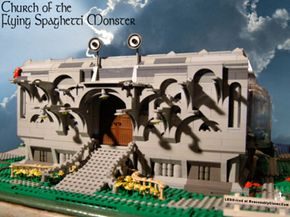
Doyle did not plan his Church of the Flying Spaghetti Monster down to the last stud. It started like most Lego Town-style buildings: a few sketches of the facade, some rough floor plans, and a sense of direction. Then came the spare card table in his workshop. He laid out baseplates, blocked in the outer walls and just started stacking bricks.
“Most of my Lego creations are made in this rather unstructured way… the end result usually surprises me.”
This is the secret behind many minifigure sized Lego sculptures. You have a general idea of the goal, but the build itself dictates the details. The construction of the church took about four months. It wasn’t a marathon. It was a start-stop rhythm. He finished a section, stood back and waited for inspiration to strike before moving on to the next section.
Actual hands-on construction time? Closer to 30 hours.
He doesn’t have an exact number of parts used as he went. However, according to a reasonable estimate, the total amount is about 3,000 bricks. Not bad for a process based on intuition rather than plans.

The Plastic Revolution
It didn’t start as a toy empire. It started as a garage business in Billund, Denmark, in the mid-1930s. Ole Kirk Christiansen, a carpenter, made wooden toys. They sold. Then the Great Depression hit. He kept making toys because people needed cheap joy. He even named the company Leg Godt, which means “play well.” He shortened it to Lego later. Simple enough.
But the wooden blocks were fragile. They broke. They didn’t lock together with precision. Christiansen’s son, Godtfred, saw the potential for plastic. Injection molding was new. Expensive. Risky. But plastic could be durable. Reproducible. And most importantly, it could be standardized.
By 1949, Lego was selling “Automatic Binding Building Bricks.” They looked a bit different. The studs were on top, but they didn’t quite grip. They slipped. They were clunky. Not the smooth interlocking system we know today. The problem was the hollow bottom. It lacked stability.
The Moment Everything Clicked
The real breakthrough came in 1958. Godtfred Christiansen, now leading the company, patented the modern design. It was subtle. Revolutionary, but subtle. Two things changed the game. First, the hollow tubes on the underside of the brick. Second, the improved curvature of the studs.
“The tubes on the bottom provide grip, while the curves on the studs prevent wobbling.”
This design created the “Clutch Power.” That’s the industry term. It’s why a Lego wall stands tall. It’s why you can build a tower of bricks and then pull the bottom one out without collapsing the whole thing. It’s physics and plastic working in harmony. The patent was filed in Denmark. It was the foundation of the billion-dollar empire that followed.
Why This Matters
Before 1958, Lego was just another toy maker. After that patent, it became a system. A universal language of construction. The bricks became compatible. Not just with other Lego bricks, but with the concept of endless possibility. You could build a house, then tear it down, then build a spaceship. The bricks survived. They didn’t wear out. They didn’t change.
This durability is why Lego bricks are still relevant today. They’re not just plastic. They’re cultural artifacts. They’re engineering lessons. They’re creativity encoded in polyethylene. And they all trace back to a single patent in Denmark. A small moment. A big idea. The rest is history. Or is it? The bricks are still being made. The designs keep evolving. But the core remains. The clutch power. The simplicity. The joy of making something from nothing. One brick at a time.