



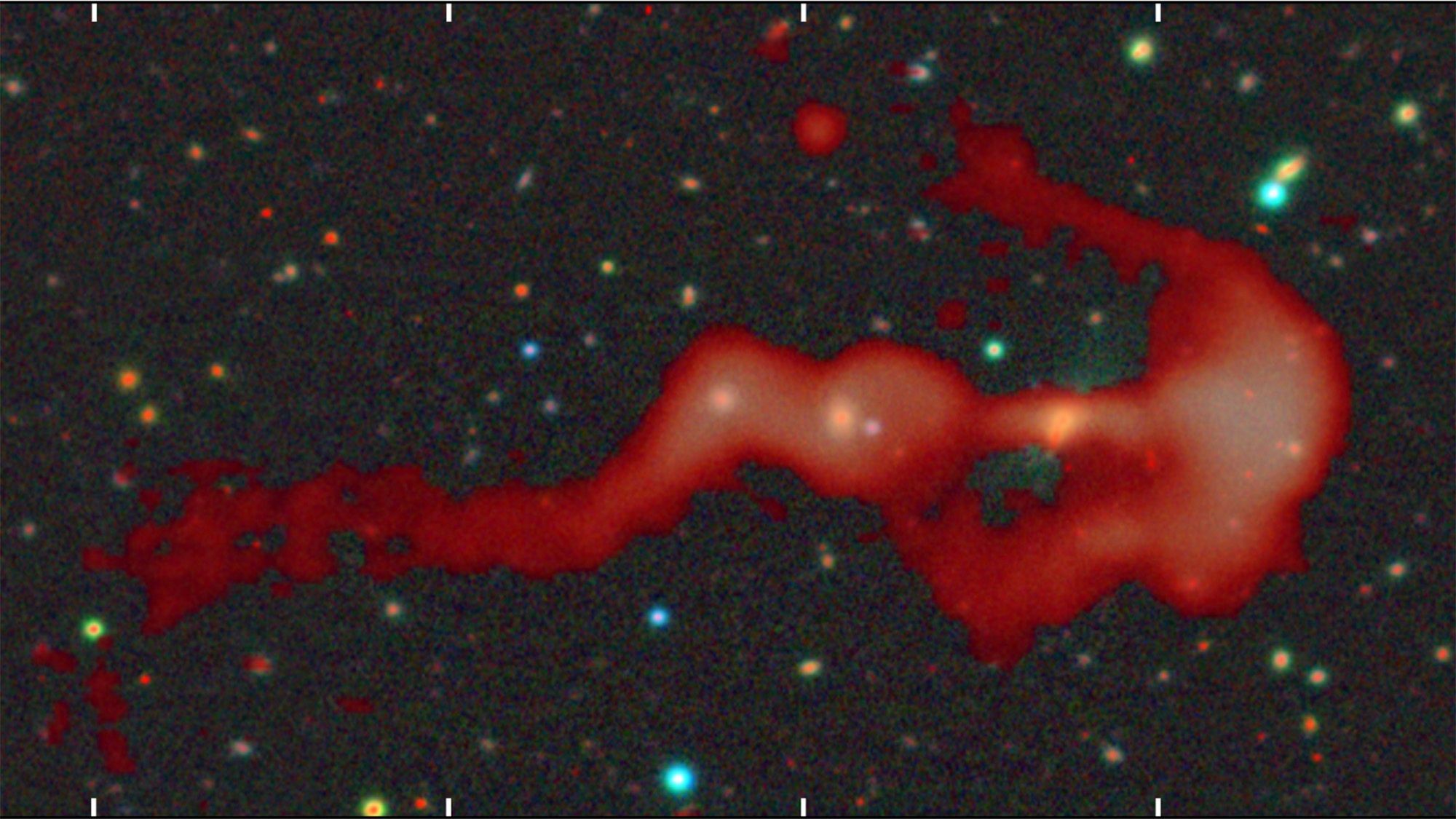
It looks like something out of a medieval tournament.
A bow. An arrow. Floating in the void, 2 billion light-years away.
We name cosmic things after household items all the time. The Crab. The Cat’s Eye. A “hamburger” made of gas. But RAD-BAARG? This is different.
Formal name: The RAD-Bow-And-Arrrow Radio Galaxy. It is, frankly, absurdly shaped.
Most radio galaxies are boring symmetries. You get a supermassive black hole in the middle. It eats. It launches two jets of charged particles back-to-back. They inflate huge, matching balloon lobes of plasma. Poof. Poof. Mirror images. Clean.
RAD-BAARG is messy. It is lopsided. It is weird.
“The structure of this source is unlike any radio galaxy I have seen in last 25 years,” said Ananda Hota, lead author and PI of the RAD@home project.
Hota has been looking at radio galaxies since the Reagan administration. He hadn’t seen this.
How did we find it? Citizen science. Pranim Limbo was sifting through ultra-sensitive images from the LOFAR Sky Survey. India-based RAD@home collaboratory helps ordinary people spot the extraordinary. Limbo saw it. The team followed up.
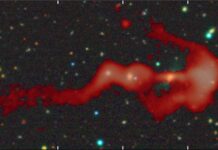
The resulting image is gorgeous. Red traces the radio screams captured by LOFAR; optical data from Beijing-Arizona adds the optical context.
So why does it look like an archery set?
Environment.
RAD-BAARG is falling. Not gently. It’s plunging toward a nearby cluster of galaxies. As it drops, it smashes into the intracluster medium—the thin, hot gas filling the spaces between stars.
Fast movement creates pressure.
Think of a fighter jet breaking the sound barrier. Boom. Shock waves. When this galaxy moves through the cluster’s gas faster than the speed of that gas can move, it builds a shock front ahead of itself. A compressed wall of stuff.
One jet from the central black hole slams directly into that wall.
Resistance bends things. The jet gets compressed, curved back on itself. It forms the bow. It spans nearly 1.8 million light-across. That is a long arc.
The other jet? No resistance there.
It flows freely. Twists. Turns into an S-curve before fading out into a faint tail. The arrow.
The whole structure stretches about 2.3 million years across.
That puts it in the Giant Radio Galaxy class. Some of the biggest single objects we know.
Astronomers knew infalling galaxies should create these bow shocks. Theory says yes. Practice says good luck finding one. The gas is diffuse. It’s faint. It’s easy to miss in the noise.
RAD-BAARG didn’t miss. It sits there. Clear. Chaotic. Direct evidence of a phenomenon we only suspected existed in this clarity.
Is it just a one-off oddity? Or a preview of what’s hidden in every cluster?
We might have to keep watching the dark to find out.