






Lions and tigers are cultural symbols of raw power and determination. From the idiom “lionhearted” to having the “eye of the tiger,” these big cats occupy a similar space in the human imagination. Biologically, they share a lineage as large, muscular felines, but they are distinct species with unique evolutionary paths, social structures, and physical adaptations.
Understanding the differences between Panthera leo (the lion) and Panthera tigris (the tiger) reveals how evolution shapes animals to thrive in specific environments. While they may look similar to the casual observer, their anatomy, behavior, and history tell two very different stories.
Appearance and Anatomy
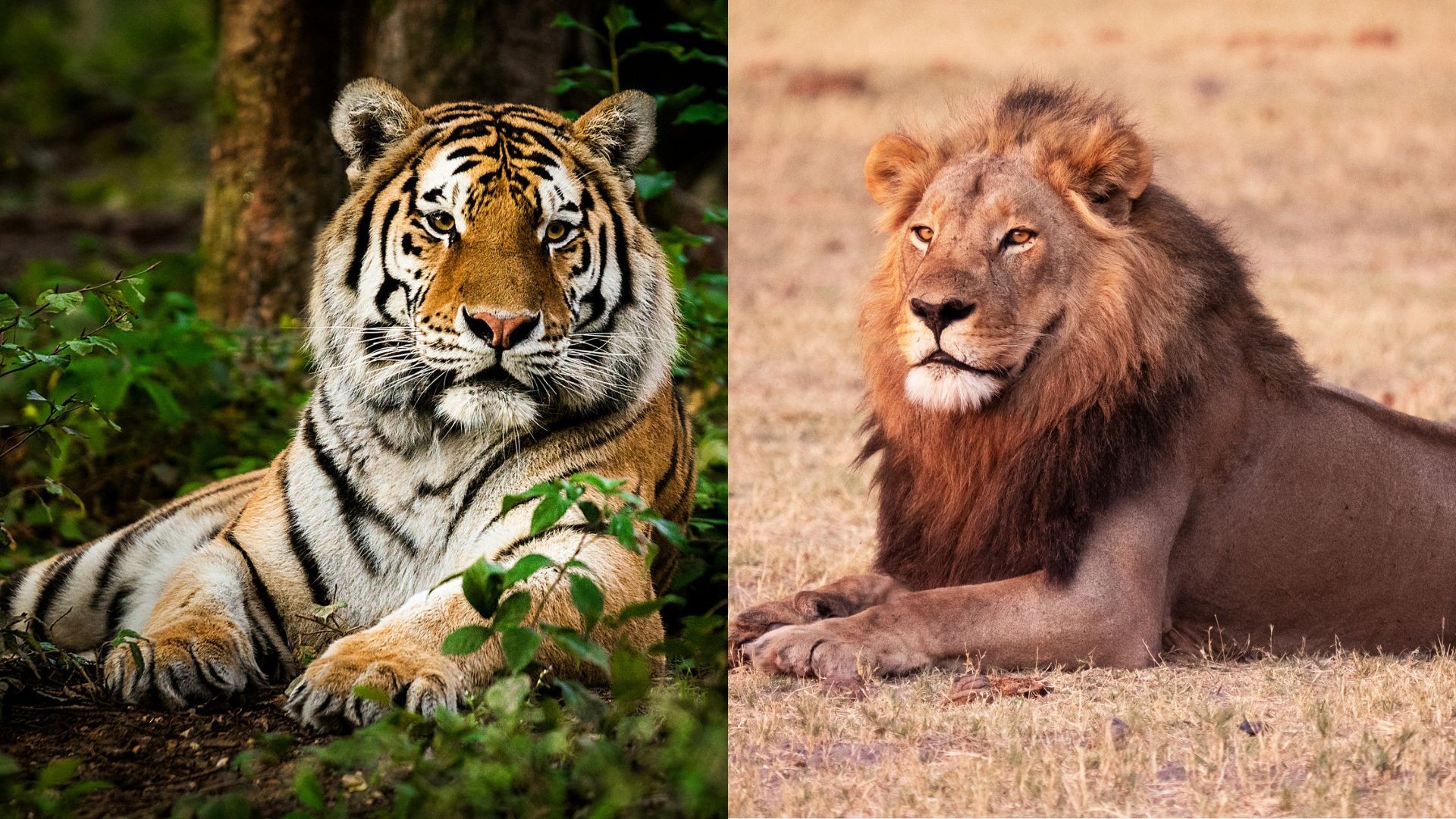
The most immediate distinction between the two species is their coat and sexual dimorphism.
- Tigers: Male and female tigers look nearly identical. They feature an orange coat with black stripes. These stripes are not just on the fur but are pigmented into the skin, ensuring the pattern remains even after the cat sheds or is shaved. Crucially, the stripes serve as camouflage in the dense temperate and tropical forests of Asia. While the stripes stand out to human eyes, they break up the tiger’s outline against the dappled light and shadow of the forest floor. To many prey animals, which are often colorblind, the orange fur appears greenish, blending seamlessly with the vegetation. Each tiger’s stripe pattern is unique, much like a human fingerprint.
- Lions: Lions exhibit clear sexual dimorphism. Males possess a prominent mane, while females do not. Both sexes have a tawny, yellowish-brown coat designed to blend into the dry grasses of the African savannas.
Despite these external differences, their internal biology is strikingly similar. Z. Jack Tseng, an associate professor of integrative biology at the University of California, Berkeley, notes that skeletally, all cats are essentially built the same way. “A cat is a cat is a cat,” is a common saying among fossil researchers. The primary difference between a domestic house cat and a lion or tiger is simply scale; the underlying skeletal structure remains proportional.
Evolutionary History and Lineage
Although lions and tigers belong to the same genus, Panthera, they are not each other’s closest relatives. Genetic modeling and anatomical data suggest their evolutionary paths diverged significantly.
- Tigers are more closely related to snow leopards.
- Lions share a closer kinship with leopards and jaguars.
Tigers also emerged as a distinct species much earlier than lions. The oldest putative tiger fossils date back approximately 2 million years, whereas lion fossils are likely no older than 1 million years.
The last common ancestor of all five Panthera species (lions, tigers, leopards, jaguars, and snow leopards) likely existed at least 5.57 million years ago. This ancestor was probably smaller than modern lions and tigers. Both species independently evolved to reach their current massive sizes. This growth may be linked to environmental factors; for instance, larger body size can help retain heat in cooler climates by reducing the surface-area-to-volume ratio. However, the fossil record is not detailed enough to confirm if climate was the sole driver for both species.
Social Behavior and Communication
The most profound difference between lions and tigers lies in their social structures.
Lions: The Social Hunters
Lions are the only truly social cats. They live in matriarchal groups called prides, consisting of related females and their offspring, along with one or two adult males. This social dynamic necessitates frequent conflict over territory and mating rights.
The male lion’s mane serves a critical function in this context. Jacob Shanks, a wildlife care manager at San Diego Zoo Wildlife Alliance, explains that during fights, cats often target the neck. The thick mane acts as armor, protecting the male’s neck from fatal wounds during battles with rival males.
Tigers: The Solitary Stalkers
Tigers are solitary animals. Cubs stay with their mothers for about two years before venturing out on their own. Adult tigers generally avoid each other, interacting primarily for mating.
To navigate this solitary life without constant conflict, tigers have developed a unique form of communication called chuffing. By pushing air through their nose, a tiger makes a puff-like sound to signal non-aggressive intent. If the other tiger responds with a chuff, it indicates acceptance, allowing them to approach safely. Lions do not use this vocalization; they rely more on body language or direct confrontation.
Habitat and Hybridization
In the wild, lions and tigers have never naturally met. Lions are native to Africa (and a small population in India’s Gir Forest), while tigers are found across various parts of Asia. Their ranges do not overlap, preventing natural competition or interbreeding.
“Hybridization doesn’t exist in the wild,” Shanks notes. “I’ve never seen a case of wild lion-tiger hybridization.”
However, humans have artificially bred these species in captivity, creating hybrids known as ligers (lion father, tiger mother) and tigons (tiger father, lion mother). Experts emphasize that this practice offers no biological benefit to either species and is purely a human-driven phenomenon.
Shared Threats
Despite their differences, lions and tigers face a common existential crisis. Both species are threatened by human expansion, habitat loss, and climate change.
- Tigers are classified as Endangered.
- Lions are classified as Vulnerable.
According to the International Union for Conservation of Nature (IUCN), both species require active conservation efforts to prevent their decline. Without significant intervention to protect their habitats and mitigate human-wildlife conflict, these iconic apex predators risk disappearing from the wild.
Conclusion
While lions and tigers share a common ancestry and skeletal structure, they have evolved into distinct species shaped by their environments. Lions developed social structures and protective manes for life on the open savanna, while tigers evolved solitary habits and striped camouflage for the dense Asian forests. Ultimately, both species stand as testaments to evolutionary diversity, yet both now depend on human-led conservation efforts for their survival.