



We’ve always believed carpenter ants were simple. Chemical simple. They don’t sting. No needle to deliver a painful jab.
Instead they squirt formic acid from the tip of their bellies.
The Formicinae — one of nature’s most successful ant groups — basically turned acid spray into an art form. It can make up 70% of what comes out of that opening at the rear.
It works for defense. For sure. But it does other things too. Ants smear this acidic gunk on their babies to keep mold off. They eat it to adjust the pH of their guts. It signals alarm. It calls the troops.
Scientists figured formic acid handled all of it. Just one ingredient. One trick.
That assumption was wrong.
The hidden arsenal
There were whispers before. Scattered papers. A footnote in a decades-old study that nobody really read. It mentioned peptides. Small proteins. Nobody pursued the lead.
Professor Timo Niedermeyer from Freie Universität Berlin decided to look again.
He dug up an old publication. “The paper mentioned that these venoms also contained peptidic compounds,” he said. Most people had forgotten. He hadn’t.
His team picked eight carpenter ant species. They weren’t neighbors. These ants lived in different parts of the world. The result?
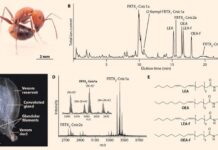
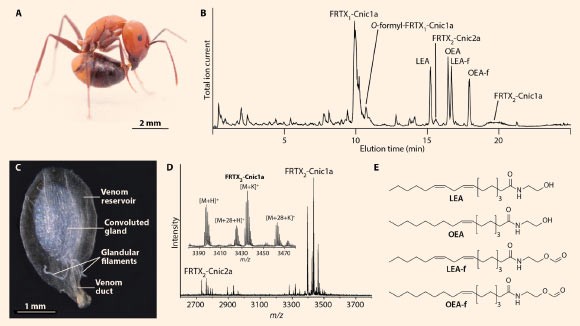
They found thirty-five new venom peptides.
They called them formicitoxins.
Thirty-five of them.
That changes everything we thought about how these bugs work. It proves carpenter ant venom isn’t just acid rain in miniature. It’s a complex chemical library. The exact mix varies by species. The peptides themselves are everywhere in the Formicinae group.
Peptides for protection
So what do they do?
The researchers mixed biology with chemistry and pharmacy methods. They used a proteotranscriptomic approach. That’s a heavy term. It basically means they looked at the RNA and protein data together. They tracked the genetic sequences. Then they synthesized the stuff in the lab.
They ran bioactivity tests.
The answer turned out to be hygiene.
The ants coat their brood. They spray the nest floor. “Formicitoxins likely strengthen an external immune defense,” the team concluded. This kicks in when the initial antimicrobial punch of formic acid wears off.
Think about that for a second. Formic acid burns fast. It evaporates. It fades.
These peptides stick around. They keep killing fungi long after the acid is gone.
Dr. Simon Tragust at Martin Luther University Halle-Wittenbridge found the antifungal effects to be remarkable. It’s a serious advantage. Ants live in damp dirt. They huddle in tight crowds. Disease moves fast in a colony. Pathogens are everywhere.
Why does this matter to us?
Human microbial resistance is getting worse. We are running out of tricks against resistant bacteria and fungi. Nature has been working on solutions for millions of years. There are over 3,700 Formicinae species.
Each one might hold a different bioactive key.
We barely scratched the surface. Only eight species studied. So many left to find. The Science Advances publication by Lukas Koch and his colleagues is just a start. The real story might be waiting in the nest of the next ant they look at.
Lukas Koch et al. “Beyond formic acid: Peptides in carpenter ant venums aid in disease protection.” Science Advances 12 (20), 2026; doi: 10.112/sciadv.aed478.