


A new artificial intelligence method is transforming how we observe the Earth’s oceans, turning standard weather satellites into high-resolution trackers of underwater motion. By leveraging existing satellite data, researchers have developed a way to map ocean currents with unprecedented detail and frequency, filling a critical gap in our understanding of the planet’s climate systems.
The Gap in Ocean Observation
For decades, scientists have struggled to balance two conflicting needs in oceanography: wide-scale coverage and high-frequency detail.
Traditionally, observing the ocean has relied on two main methods, both of which have significant drawbacks:
– Satellite Altimetry: These satellites measure sea surface height to estimate currents, but they only revisit the same spot roughly every 10 days. This is far too slow to capture “transient” events—currents that emerge and vanish within hours.
– Local Sensors: Ships and coastal radar provide excellent detail, but they are limited to small, localized areas.
This lack of data creates a “blind spot” regarding vertical mixing —the process where surface water sinks or deep water rises. This movement is vital because it acts as the ocean’s circulatory system, transporting nutrients to marine life and sequestering carbon dioxide from the atmosphere into the deep ocean. Without real-time data on the small, fast-moving currents that drive this mixing, our climate models remain incomplete.
Enter GOFLOW: Turning Temperature into Motion
The solution, dubbed GOFLOW (Geostationary Ocean Flow), was developed by a research team led by Luc Lenain (UC San Diego’s Scripps Institution of Oceanography) and Kaushik Srinivasan (UCLA).
The breakthrough lies in how the system uses data. Rather than requiring expensive new hardware, GOFLOW utilizes thermal imagery from existing geostationary weather satellites (such as GOES-East). These satellites capture temperature patterns across the ocean surface as often as every five minutes.
How the AI Works
The researchers trained a deep-learning neural network to solve a complex visual puzzle. The process works as follows:
1. Pattern Recognition: The AI was trained using high-resolution computer simulations to recognize how temperature patterns “bend, stretch, and move” under the influence of water velocity.
2. Temporal Tracking: By analyzing sequences of thermal images, the AI tracks how these heat patterns deform over time.
3. Inference: The system then infers the underlying ocean currents responsible for those specific movements, effectively turning a “time-lapse” of temperatures into a map of water motion.
Validating the Results
To ensure the AI wasn’t just “hallucinating” patterns, the team compared GOFLOW’s outputs against real-world measurements taken by ships in the Gulf Stream and traditional satellite topography data.
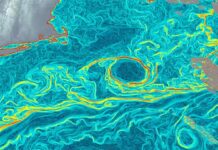
The results were highly successful. GOFLOW not only matched existing data but also revealed fine-scale features —such as small eddies and boundary layers—that previous methods tended to smooth out or ignore. These small, intense currents are the primary drivers of vertical mixing, and for the first time, they can be observed in real-world settings rather than just in computer simulations.
Implications for the Future
The ability to track ocean currents in near real-time has far-reaching consequences:
– Climate Science: Improved understanding of how the ocean absorbs heat and carbon.
– Environmental Protection: Better tracking of oil spills and the movement of marine debris (such as plastic).
– Safety: Enhanced data for search and rescue operations.
– Weather Forecasting: More accurate models of air-sea interactions.
“This opens the door to testing long-standing ideas about how the ocean takes up heat and carbon,” notes Luc Lenain.
Challenges and Next Steps
While revolutionary, GOFLOW is not without its hurdles. Because the system relies on thermal imagery, cloud cover can obstruct the view, creating gaps in the data. To solve this, the research team is working on integrating additional types of satellite data to provide seamless, continuous coverage.
The team has already made their code and data products public, inviting the global scientific community to expand this technology across the world’s oceans.
Conclusion: By repurposing existing weather satellite data through AI, GOFLOW provides a low-cost, high-detail window into the ocean’s movement, offering a vital new tool for monitoring the heartbeat of our planet’s climate.