Artificial intelligence is fundamentally changing how we see the universe. Having already revolutionized the way we process data from the James Webb Space Telescope (JWST), AI is now being deployed to solve one of the oldest problems in astronomy: the blurring effect of Earth’s atmosphere.
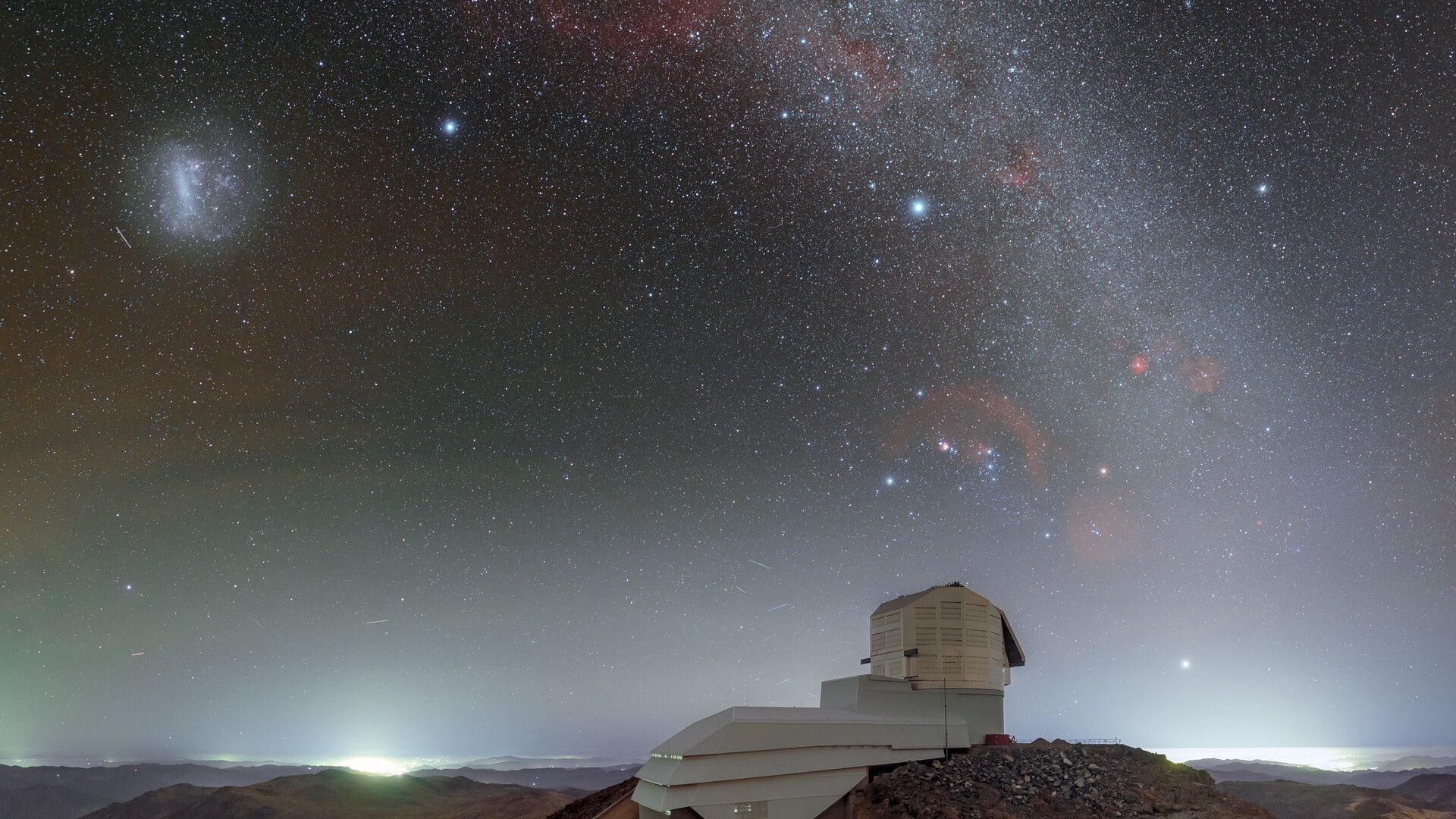
A new AI algorithm, developed by researchers at the University of California, Santa Cruz (UCSC), aims to transform images from the Vera C. Rubin Observatory in Chile, making ground-based observations appear as sharp and clear as those taken from the vacuum of space.
The Atmospheric Hurdle
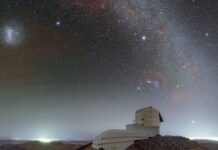
Even the most advanced ground-based observatories face a significant obstacle: the atmosphere. The Vera C. Rubin Observatory, located atop Cerro Pachón in the Chilean Andes, sits in one of the driest places on Earth to minimize interference. However, as light from distant galaxies travels through our atmosphere, it encounters turbulence that distorts and blurs the image.
While astronomers invest heavily in hardware to correct these distortions, UCSC professor Brant Robertson and his team are turning to a different kind of high-performance technology: machine learning.
Enter “Neo”: The AI Image Enhancer
The researchers have developed a generative model named Neo. To train this system, the team used a clever comparative method:
1. They fed the AI images from the Subaru Telescope (ground-based).
2. They paired them with high-resolution snapshots of the same sky regions from the Hubble Space Telescope (space-based).
By comparing the two, Neo learned how to “fill in” the missing details lost to atmospheric blurring. The results are transformative. According to the research team, Neo can improve the accuracy of measured galaxy shapes and parameters by 2 to 10 times.
In practical terms, this means:
– Vague smudges are converted into distinct, individual stars.
– Blurry shapes are resolved into precise galactic structures.
– Data quality is elevated to a level that statistically mimics space-based photography.
Maximizing the Scientific Return
This technological leap is not just about better pictures; it is about economic and scientific efficiency. Building a space telescope like Hubble or Webb costs billions of dollars. In contrast, the Vera C. Rubin Observatory cost approximately $800 million.
By using AI to “super-charge” the data coming from Rubin, scientists can extract much higher value from their investment. As Robertson notes, the goal is to leverage public and community resources to ensure we get every possible bit of information out of our most expensive instruments.
How Neo Works: A Dual-Network Approach
Neo utilizes a Conditional Generative Adversarial Network (GAN). This involves two neural networks working in a constant loop:
– The Generator: Creates an improved, high-resolution version of the original image.
– The Evaluator: Critically analyzes the generated image to check for accuracy and quality.
This process is powered by NVIDIA’s GPU-driven supercomputers, allowing the AI to analyze every single pixel to distinguish between empty sky, stars, and complex galactic structures like disks or spheroids.
The Future of Discovery: Humans + AI
There is often a fear that AI will replace scientists, but the researchers argue the opposite. The sheer volume of data produced by modern telescopes—such as the massive data streams from the JWST—is too vast for human eyes alone to process.
“We’re being inundated with such an amount of data that it’s very difficult to keep up with,” says Robertson. “Our standard approaches to analyzing these images are just really not sufficient.”
AI acts as a force multiplier. It handles the heavy lifting of pattern recognition and data cleaning, allowing astronomers to focus on interpreting the most profound discoveries.
Conclusion
By bridging the gap between ground-based limitations and space-based clarity, AI is enabling a new era of rapid, high-resolution astronomy. This technology ensures that even as we face an overwhelming deluge of cosmic data, our ability to understand the universe keeps pace.