




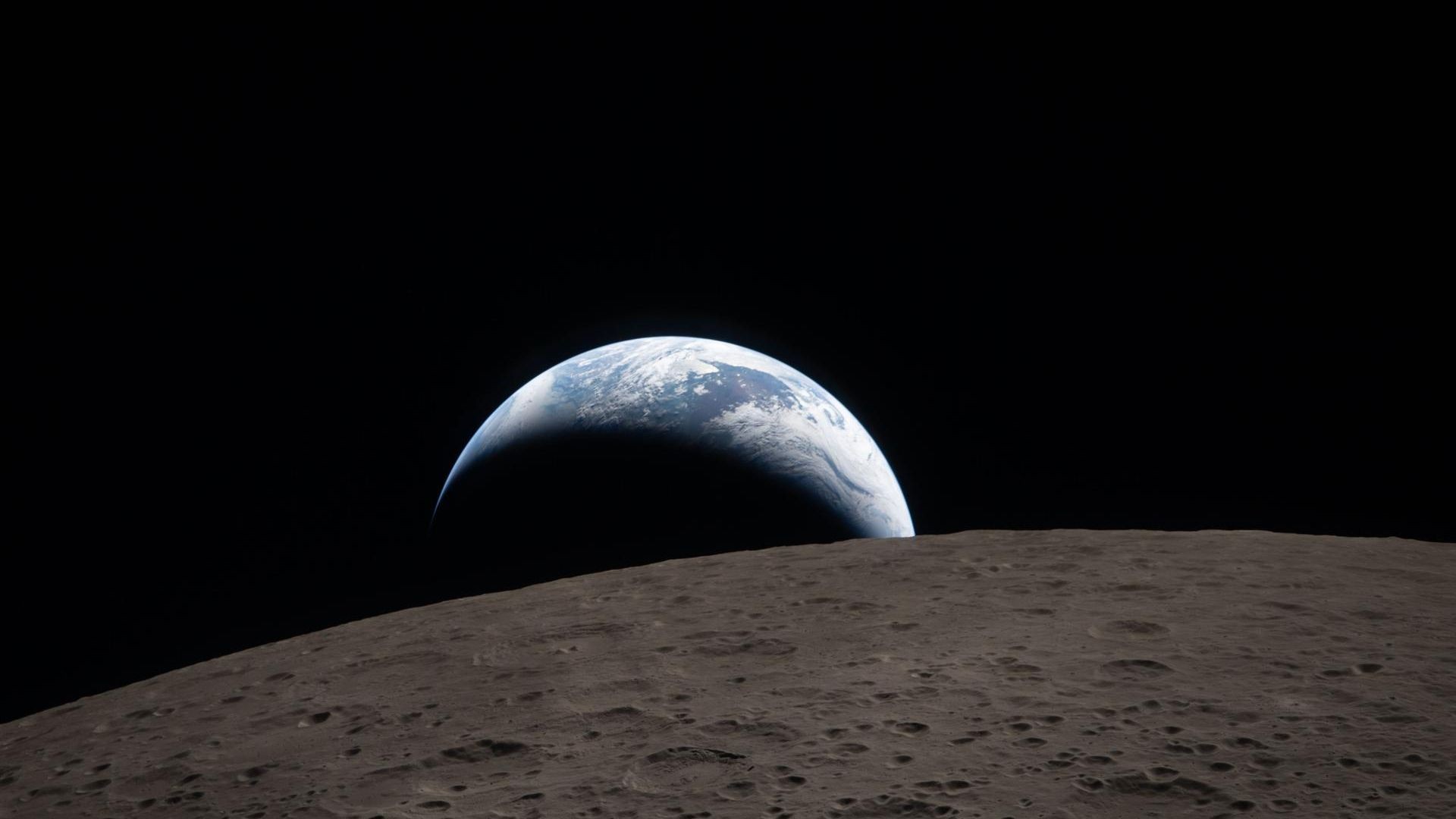
As we celebrate Earth Day, the perspective of our home planet has undergone a profound transformation. Through the lenses of various space missions—from the pioneering Apollo era to the cutting-edge Artemis program—we have moved from seeing Earth as a distant object to understanding it as a fragile, interconnected system.
The Evolution of a Cosmic Perspective
The history of space photography is not just a timeline of technological progress; it is a history of shifting human consciousness. Each iconic image has served as a psychological turning point for how we view our place in the universe.
The Apollo 8 “Earthrise”
Fifty-eight years ago, the Apollo 8 mission captured what would become one of the most influential photographs in history: “Earthrise.”
Before this moment, humanity viewed Earth primarily from the ground up. Seeing the planet suspended in the black void of space—protected only by a thin, delicate atmosphere—changed everything. This image did more than document a mission; it provided a visual foundation for the modern environmental movement by highlighting the inherent fragility of our world.
The Voyager “Pale Blue Dot”
As technology advanced, our reach extended further. In 1991, the Voyager 1 spacecraft, traveling a staggering 3.7 billion miles from the Sun, captured a tiny, scattered speck of light in a beam of sunlight.
Astronomer Carl Sagan famously dubbed this image the “pale blue dot.” It served as a humbling reminder of our scale: in the vastness of interstellar space, our entire world is contained within a single, microscopic pixel.
The Artemis Era: A New Vantage Point
With NASA’s Artemis 2 mission, we have entered a new chapter. For the first time in over 50 years, astronauts have returned to the lunar vicinity, providing us with high-definition views from a perspective very few humans have ever experienced.
Watching the Earth Set
During their journey around the far side of the Moon, the Artemis 2 crew experienced a phenomenon that is both rare and profoundly moving: watching the Earth disappear behind the lunar horizon.
“It’s like watching sunset at the beach from the most foreign seat in the cosmos,” remarked mission commander Reid Wiseman.
During the 40 minutes the crew spent behind the Moon, they lost all contact with Earth. Wiseman described the sight of the Earth’s atmosphere and the lunar terrain projected across the planet as “unbelievable” before the world vanished from view.
“Hello, World” and the Zodiacal Light
Before reaching the Moon, the crew captured the “Hello, World” image during their translunar injection burn. This shot offers a rare celestial alignment:
– Earth eclipsing the Sun, creating a sliver of light.
– Zodiacal light, a glow caused by sunlight reflecting off interplanetary dust.
– Dual Auroras, visible as shimmering lights at the top and bottom of the planet.
A Unified Vision: Earth as a “Crew”
Beyond the technical achievements, the Artemis missions have fostered a deep philosophical shift. Astronaut Christina Koch, reflecting on her time looking back at the planet from the Orion capsule, offered a unique metaphor for our global existence.
Instead of viewing Earth as a collection of separate nations or ecosystems, she described the planet as a “crew.”
“A crew is a group that is in it all the time, no matter what… that is inescapably, beautifully, dutifully linked.”
This perspective shifts the narrative from one of isolation to one of collective responsibility, suggesting that much like a spacecraft crew, the inhabitants of Earth must work with a shared purpose and mutual accountability to survive.
Conclusion
From the revolutionary “Earthrise” to the intimate observations of the Artemis astronauts, space photography continues to remind us that Earth is not just a place we inhabit, but a fragile, singular vessel that requires our collective care.