



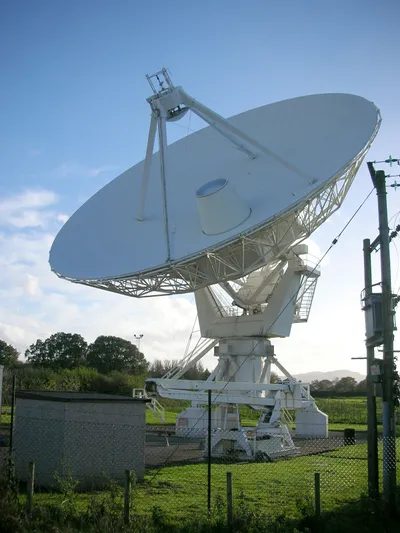
Looking at the night sky can seem like a passive activity. it is not. We are constantly exposed to invisible signals, radio waves emitted by stars, galaxies and phenomena that are too cold or far away to emit visible light. But they are hard to catch. A single satellite dish is like trying to see a sign a mile away with one eye closed. You get a blurry idea of what’s there, but I miss the details. To solve this problem, astronomers have developed a trick that turns a bunch of independent antennas into an Earth-sized superlens.
This is a radio interferometer.
Although it sounds like complicated design terminology, the concept is surprisingly simple. Use two or more separate antennas. Point them at the same target in space. Then connect them to the same receiver. By combining signals, resolutions that are not possible with a single antenna can be achieved. The antennas do not have to be next to each other. They can be scattered across fields, continents and even orbit. The Japanese VSOP satellite, combined with ground-based telescopes, create a baseline (the distance between the farthest points in the array) of up to 33,000 kilometers. It’s closer to the moon than most humans have ever been.
为什么尺寸在射电天文学中很重要
射电干涉仪的原理与可见光天文学中使用的光学干涉仪相同。 但有一个问题。 无线电波比光波长得多。 无线电波可以有公共汽车那么大。 光波比一粒沙子还要小。 由于波长要大得多,因此必须放大仪器才能匹配。
这就是物理学变得有趣的地方。 当来自遥远恒星的无线电波撞击地球时,它不会在完全相同的纳秒内撞击所有天线。 波首先击中最近的天线。 穿过地面到达下一个目标需要时间。 该时间差会产生相移。 如果您只是将原始信号加在一起,它们会相互抵消或产生噪音。
因此,工程师使用了可变延迟机制。 它本质上是一个高速定时器,可以阻止来自较近天线的信号,等待电波到达较远的天线。 一旦它们“同步”,系统就会让它们进行干扰。 这与将两块石头扔进池塘时看到的干涉图案相同。 波纹交叉,形成高水位区域(增强)和平坦表面(取消)。
在某些设置中,天线是固定的。 地球的自转改变了它们相对于信号源的距离,导致信号交替增强和抵消。 在其他情况下,您可以物理移动天线来改变间距。 干涉所需的距离取决于source的波长和直径。 如果您知道波长并测量干涉图样,则可以计算发射波的物体的物理尺寸。 这是一种衡量不可衡量事物的方法。
King of the Plains: VLA
If you want to know what the most powerful radio interferometers look like, go to New Mexico.
The Very Large Array (VLA) is located in the San Agustin Plains near Socorro. Widely recognized as the most powerful radio