



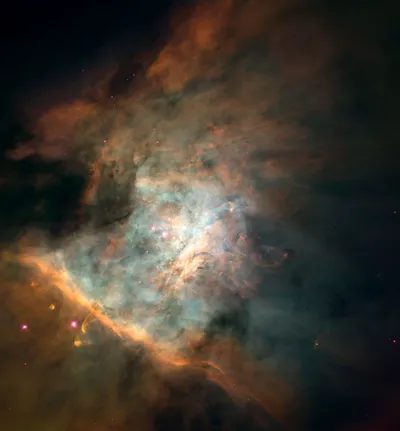
Most people are familiar with the Orion Nebula. It hangs from the hunter’s sword, and if the sky is dark enough, you can detect the faintest speck with your naked eye. Cataloged as NGC 1976 and M 42, this nebula is the brightest diffuse nebula in the night sky. But seeing it is just the beginning. The real story takes place 1,350 light years away, where the universe is busily building stars.
Nebulae glow because they are exposed to radiation. At its center is a Trapezium, a dense cluster of four massive stars. These are no ordinary suns. They are O-type stars, incredibly hot and young. Their intense output excites the surrounding gas and dust, forcing the entire cloud to emit light. This is a star nursery that attracts hundreds of young stars who are also in the spotlight.
We didn’t always know it was a nursery. For centuries it was just a point of light. Its ambiguous properties were first discovered by French scientist Nicolas-Claude Fabri de Peiresc in 1610 and Swiss astronomer Johann Cysat in 1618. Subsequent technology has revolutionized our understanding. In 1880, American Henry Draper took the first photograph of a nebula. This is a groundbreaking event. For the first time, we could to capture something that moves and changes over time.
The Orion Nebula is static. This is a vibrant factory where stars are born.
However, early photography was limited to what we could see. Visible light only tells part of the story. Dust blocks the view. To lift the veil, researchers had to look elsewhere. The change took place at the end of the 1980s. Advances in technology have allowed astronomers to take pictures of objects that emit infrared light. These are groups of stars and dust that cannot be resolved with an optical telescope. The nebula opened up.
Next is the Hubble Space Telescope. In 1991, Hubble provided the clearest data on known features ever seen. It is not just a about resolution. It’s a matter of context. Hubble reveals structures that explain how these stars actually form. Amidst the chaos, astronomers spotted jets. These are energy outflows, streams of gas released from young stars. They are exhaust of birth.
Why is this important? Because those jets are a sign of stars being born. They are physical evidence of a process we have been trying to understand for decades. The Orion Nebula is the closest example we know of. This allows us to study the mechanisms of star formation in real time. You can see the interaction between radiation, dust and outflows.
This is more than just a pretty photo. This is a laboratory. We are still learning how to interpret the results.