
It’s not about being invisible. It’s about being blurry.
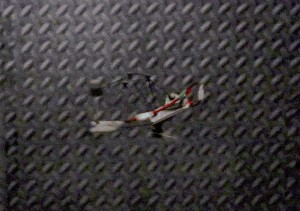
A team at Northwestern University just released a prototype drone called the Phantom Twist. It doesn’t use cloaking devices. It doesn’t have transparent wings. It tricks your brain. By spinning its parts fast enough, it turns itself into a translucent smudge. A hovering haze. Hard to focus on. Hard to track.
The researchers presented this study at the Robotics: Science and Systems conference in Sydney. They didn’t set out to make a stealth fighter for war. They wanted to stop scaring wildlife. But the implications stretch far beyond birdwatching.
The Problem With Traditional Stealth
Most drones you see try to hide by looking like rocks. Or trees. They use paint. They use transparent plastics. They try to bend light around their frame. It’s a visual game.
But cameras and eyes are good at spotting movement. A conventional quadcopter has a solid body. Four rotors spin. You see the frame. It stands out against a sky full of clouds or a forest of branches.
Michael Rubenstein, an associate professor at Northwestern and the study’s first author, put it bluntly.
“Most efforts to hide drones focus on making them look like their surroundings,” he said. “Instead, we asked whether we could design the drone around the way humans perceive motion.”
The result? A machine that behaves less like a helicopter and more like a ceiling fan.
How Phantom Twist Hides
Strip away the four rotors. Remove the stable frame.
You’re left with a single motor and a single propeller. That’s it.
But here’s the trick. The propeller spins one way. The body spins the opposite way. There are no stationary parts for your eye to latch onto. The whole thing spins 25 times per second.
Too fast for human vision to resolve clearly.
Emma Alexander, a computer vision expert on the team, explained the physiology behind the magic. The human eye accumulates signals over time. Like a camera with a slow shutter speed. When things spin fast enough, edges smear. You don’t see a shape. You see blur.
The Phantom Twist is roughly 10 times less visually perceptable than a standard quadcopter.
It doesn’t disappear. It just becomes background noise. A translucent smudge where a machine should be.
Designing the Invisible
You don’t build this by trial and error. You don’t even really design it by hand.
The team used algorithms. They generated 20,000 theoretical drone configurations. Each one shuffled a motor, battery, circuit board, and counterweight into random positions. Stability was the baseline requirement. If it fell out of the sky, it didn’t count.
Then AI took over.
The system iteratively rearranged components. It tested visibility from nearly every angle. It respected aerodynamic constraints. It ran simulations, compositing the spinning drone over 100 real-world backgrounds. Skies. Trees. Buildings.
A perception model scored each design. How well did it blend? Lower scores were better. The system picked the 500 least visible designs. Ran the loop again. Squeezed out more stealth.
When the math worked, they built it.
The final shape is strange. Deliberately spread out. Components sit at different heights. Angles vary. There is empty space between parts. Why? Because if parts overlap during the spin, they form a solid silhouette. A clear shape. Easy to spot.
By spacing them out, the blur remains diffuse. Unfocused.
Why Does This Matter?
Noise pollution is still an issue. The propeller whines. The thin support rods catch the light. It’s not a perfect ghost.
But it’s good enough to change how we survey the environment.
Imagine monitoring nesting birds without startling them. The drone doesn’t look like a predator. It looks like a glitch in the air.
Surveying wetlands becomes quieter. Less intrusive. Flocks of waterbirds don’t scatter when a black quadcopter hovers overhead.
Inspecting aging bridges or power lines doesn’t alter human behavior. People on the ground don’t stop to stare at a machine buzzing near their head. It fades into the periphery.
The team is already working on next-gen versions. Quieter propulsion. More transparent materials. Better aerodynamics.
For now, the Phantom Twist exists as proof of concept. It proves that hiding doesn’t mean being unseen. It means being perceived as part of the world around you.
Rubenstein and Alexander showed us a new frontier in low-vis flight. One where the best camouflage isn’t a color. It’s speed.
And maybe, just maybe, it’s the reason you’ll never notice a drone flying overhead again. Until you look down and see the ground undisturbed.