


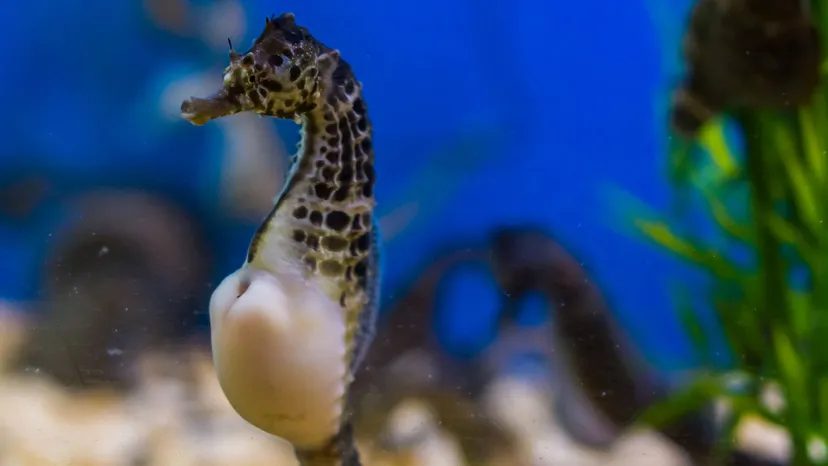
The rule of biology is simple. Females gestate. Males impregnate. It is a reliable rhythm across almost the animal kingdom. Seahorses break the rhythm. They are the exceptions that prove the rule wrong.
Male seahorses are the mamas.
This isn’t a metaphor. It is a literal biological fact. The Syngnathidae family — which includes seahorses, seadragons, and pipefishes — has flipped the script on reproduction. The female deposits eggs into a specialized brood pouch located in the male’s tail. There, the male fertilizes them. He incubates them. He gives birth.
But how does a fish deliver up to 2,000 live young? The answer lies in muscle type. And it is not what you expect.
Why Male Seahorses Give Birth
To understand the birth mechanism, you first have to accept the premise of the pregnancy. The male seahorse possesses a uterus-like pouch. It functions similarly to a mammalian placenta. During the 24-day gestation period, the father provides oxygen and nutrients to the developing embryos.
He produces sperm, not eggs. So he remains male in the traditional sense. But his role shifts entirely to that of a gestational carrier.
The evolutionary reason for this is likely survival. Seahorse babies are small. They are soft. They are eaten by predators. If females did the carrying, they would be tied down for weeks. By handing off the burden to males, females can immediately produce more eggs. They can be fertilized again. The labor is shared. The species survives.
How Male Seahorses Give Birth
Most mammals and birds rely on oxytocin to trigger labor. This hormone causes smooth muscles to contract involuntarily. You cannot consciously command your uterus to push. It just happens.
Male seahorses do not work this way.
A September 2022 study published in the journal Placenta by researchers from the University of Sydney and the University of Newcastle uncovered the specific mechanism. They found that the male seahorse’s brood pouch lacks the smooth muscle tissue necessary for an oxytocin-driven labor.
Instead, the birth is driven by skeletal muscles.
The study identified three small bones at the opening of the brood pouch, where the anal fin attaches. These bones are connected to skeletal muscles. Female seahorses have tiny, almost nonexistent anal fins. Males have prominent ones.
During courtship, the male does a situp-style dance. He crunches and expands his abdomen to let water into the pouch. It is a preparatory motion. The same muscles are used during labor.
The male presses and relaxes his abdomen. The skeletal muscles of the anal fin contract. This action opens the brood pouch. Thousands of babies spew forth.
It is a voluntary, or at least semi-voluntary, act. Unlike the involuntary smooth muscle contractions of other animals, this birth relies on the fin structure.
Where the Evidence Was Found
The research team looked at the tissue composition of the brood pouch. They tested the response to the fish version of oxytocin. The tissue did not respond. The pouch contained very little smooth muscle.
The key was the anal fin.
“It turns out the anal fin and skeletal muscles that power it is a key to the mystery of seahorse birth.”
The researchers noted that the muscles play a dual role. They are used for mating. They are used for labor. The same physical mechanism triggers both events.
How Much Can a Male Seahorse Give Birth To?
A single birth can involve up to 2,000 babies.
This number is staggering. It requires a lot of energy. It requires a lot of muscular effort. The skeletal muscles of the anal fin must contract repeatedly to expel the young.
After the birth, the male recovers quickly. He is ready to receive a new batch of eggs from a female. He can have multiple broods in a single breeding season. This rapid turnover is essential for maintaining population numbers in a dangerous ocean environment.
What Remains Unknown
The study confirms the muscle type. It confirms the anatomical structure. But it does not fully explain the control.
Do the fathers consciously make the contractions happen? Or do the skeletal muscles override normal rules and contract on their own?
The researchers suggest further study is needed to distinguish between conscious effort and involuntary override. The boundary between voluntary and involuntary movement in the seahorse might be blurrier than we think.
Frequently Asked Questions
How do male seahorses provide oxygen to their developing embryos?
Male seahorses develop complex placental structures in their brood pouches. These structures allow for efficient exchange of oxygen and carbon dioxide with the embryos during pregnancy.
How long does it take for male seahorses to recover after giving birth?
Recovery is rapid. Males are ready to receive a new batch of eggs soon after birth. This allows for multiple broods in one season.
The seahorse father is a biological anomaly. He is a male that functions as a mother. He uses skeletal muscles where other animals use smooth ones. He pushes out thousands of young using a fin.
It is a strange, efficient, and violent process. The ocean is full of predators. The babies are soft. The father’s muscles are strong. The species continues.
For now.